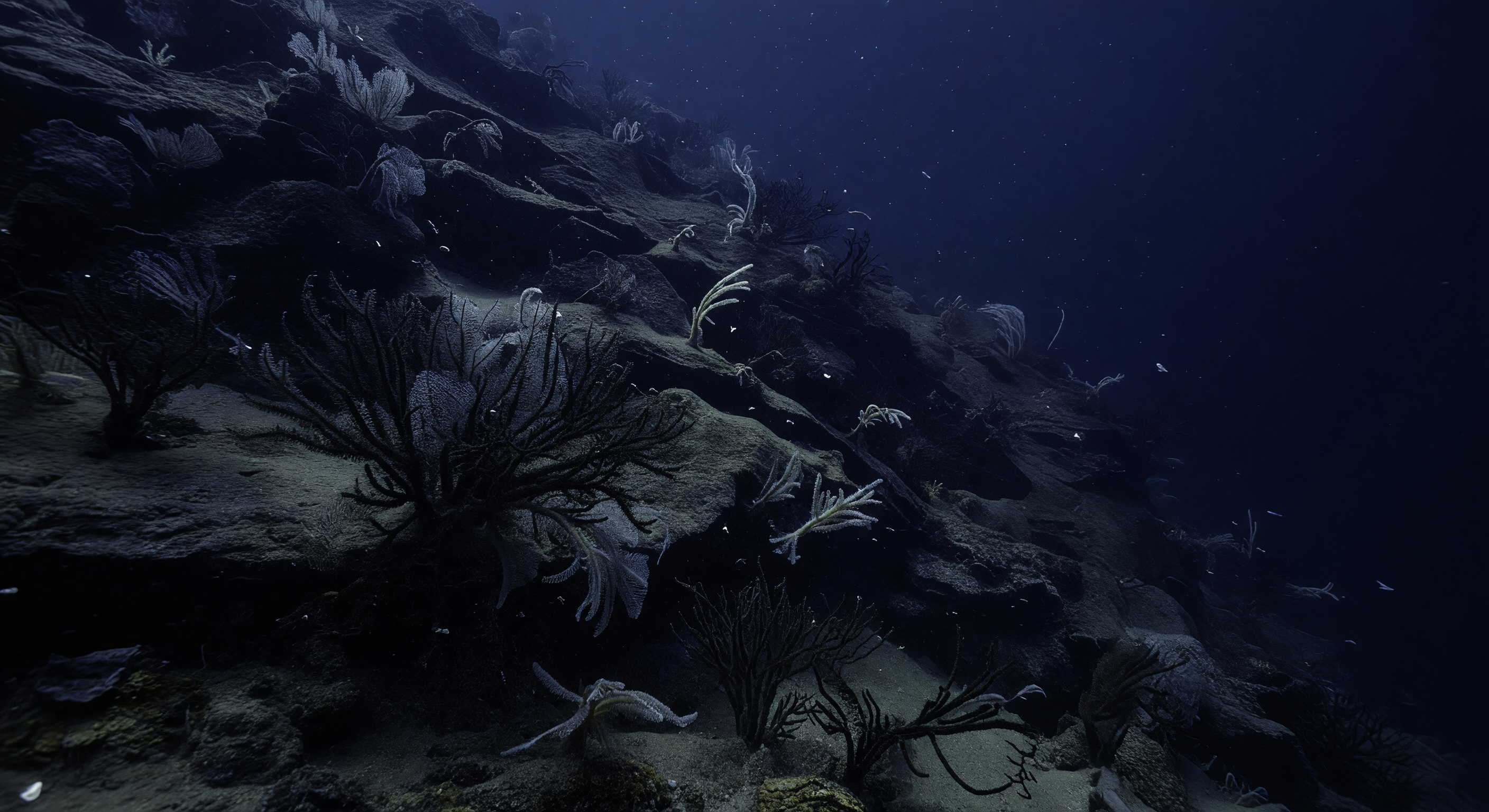
At 780 metres on the continental slope, where the shelf break is long past and the seafloor tilts steeply toward the abyss, a fractured rock escarpment rises through water pressing down at roughly 78 atmospheres — cold, near 4–6 °C, and carrying only the most attenuated ghost of sunlight that has filtered through nearly a kilometre of ocean above. That residual indigo twilight, too faint to be called illumination in any terrestrial sense, is just sufficient to render antipatharian black corals as intricate dark silhouettes against the cobalt water column; their polyp-covered branches have grown outward over decades or centuries into the sluggish along-slope current, filtering a rain of particulate organic matter drifting down from productive surface waters far above. Glassy hexactinellid sponges cling to the ledges and gullies of the escarpment, their siliceous frameworks faintly translucent where the ambient light catches them, while the spread arms of crinoids — stalked or free-living feather stars — intercept the same slow flow, their ambulacral grooves directing captured particles toward central disc mouths. Sediment drapes pocket the rock shelves, reworked by contour currents and episodic gravity flows channelled down from shallower canyon heads, and a thin nepheloid layer of resuspended fine particles drifts freely across the scene. Scattered blue-green bioluminescent pinpoints from dinoflagellates, copepods, and small crustaceans punctuate the midwater beside the wall — light produced entirely from within living tissue, chemistry answering chemistry in a place where the sun has never directly reached — while below the escarpment's base the slope simply vanishes into blue-black void, continuing its descent toward depths that exist in absolute and permanent darkness.
Continental slope