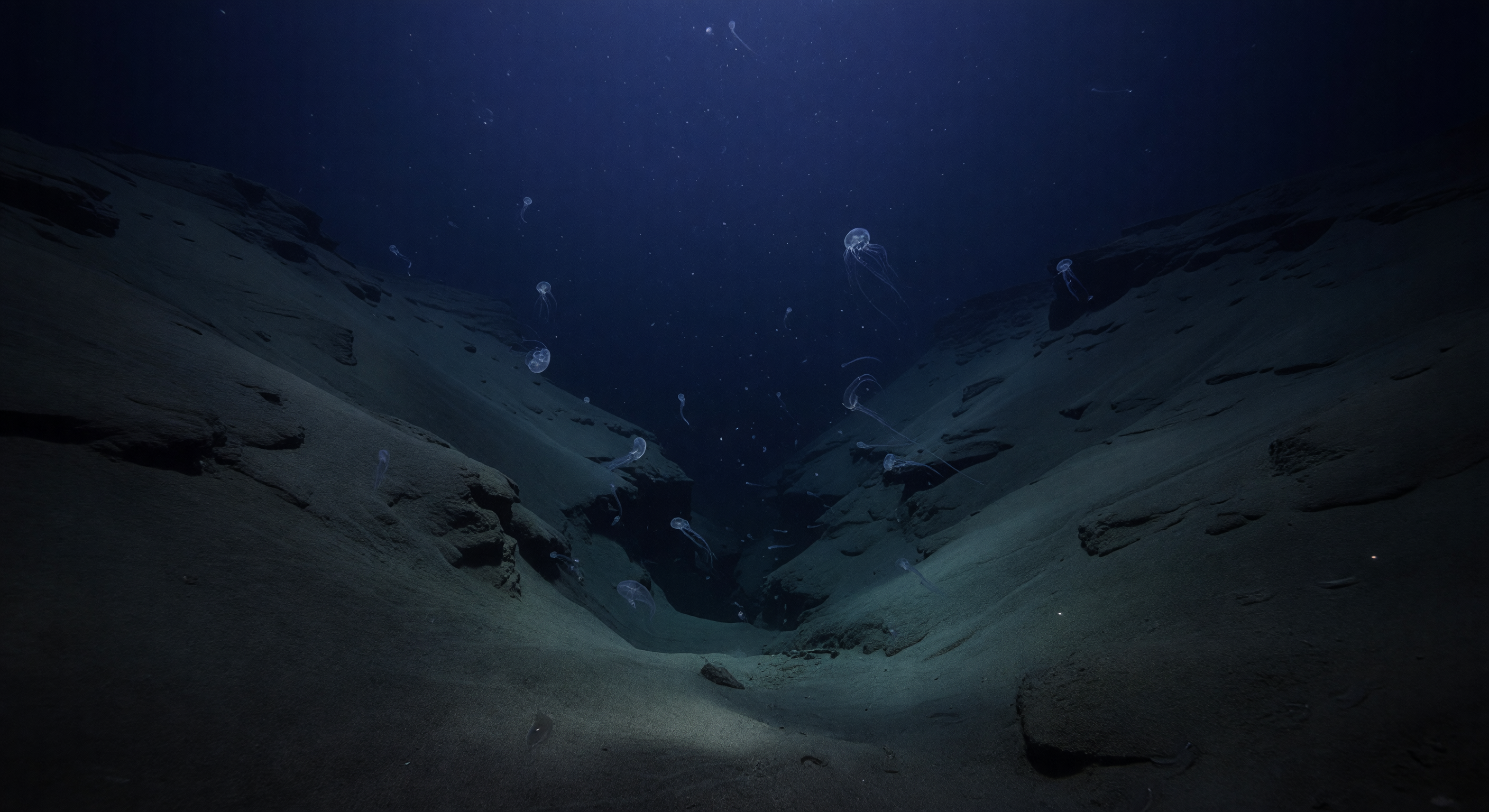
Along the canyon's steeply descending axis, the last residual photons of surface daylight filter down as a cold cobalt veil, dissolving into near-black long before they reach the sedimented floor some four hundred meters below the sunlit world. At this depth, pressure bears down at roughly forty atmospheres, cold enough to slow nearly every chemical process, yet the canyon corridor is quietly alive: ctenophores hang suspended in the open water like slivers of living glass, their refractive edges catching the faint ambient blue and throwing back pale, linear glints, while short siphonophore chains trail their specialized zooids in loose formation, each colony a superorganism whose division of labor — feeding, reproduction, defense — rivals any more familiar animal body plan. Fine marine snow, the constant rain of organic particles from the productive surface far above, drifts freely through the water column, accumulating into a subtle nepheloid layer close to the sediment-draped walls, its slow drift tracing the canyon's persistent downslope currents and the advection of distinct intermediate water masses along the continental margin. The canyon walls themselves record an older violence: slump scars, small ravines, and occasional exposed rock ledges speak to episodic gravity flows that have carved and recarved this passage over geological time, shaping a corridor through which organic matter, sediment, and pelagic life all move together into the deeper ocean. Here, in the permanent twilight between geology and open water, a world of extraordinary biological sophistication unfolds in total, undisturbed silence.
Other languages
- Français: Corridor de Cténophores
- Español: Corredor de Ctenóforos
- Português: Corredor de Ctenóforos
- Deutsch: Rippenquallen-Schlucht-Korridor
- العربية: ممر مشطيات الخليج
- हिन्दी: कैन्यन टेनोफोर गलियारा
- 日本語: 海底峡谷クシクラゲ回廊
- 한국어: 협곡 빗해파리 통로
- Italiano: Corridoio dei Ctenofori
- Nederlands: Canyon Ribkwallen Corridor