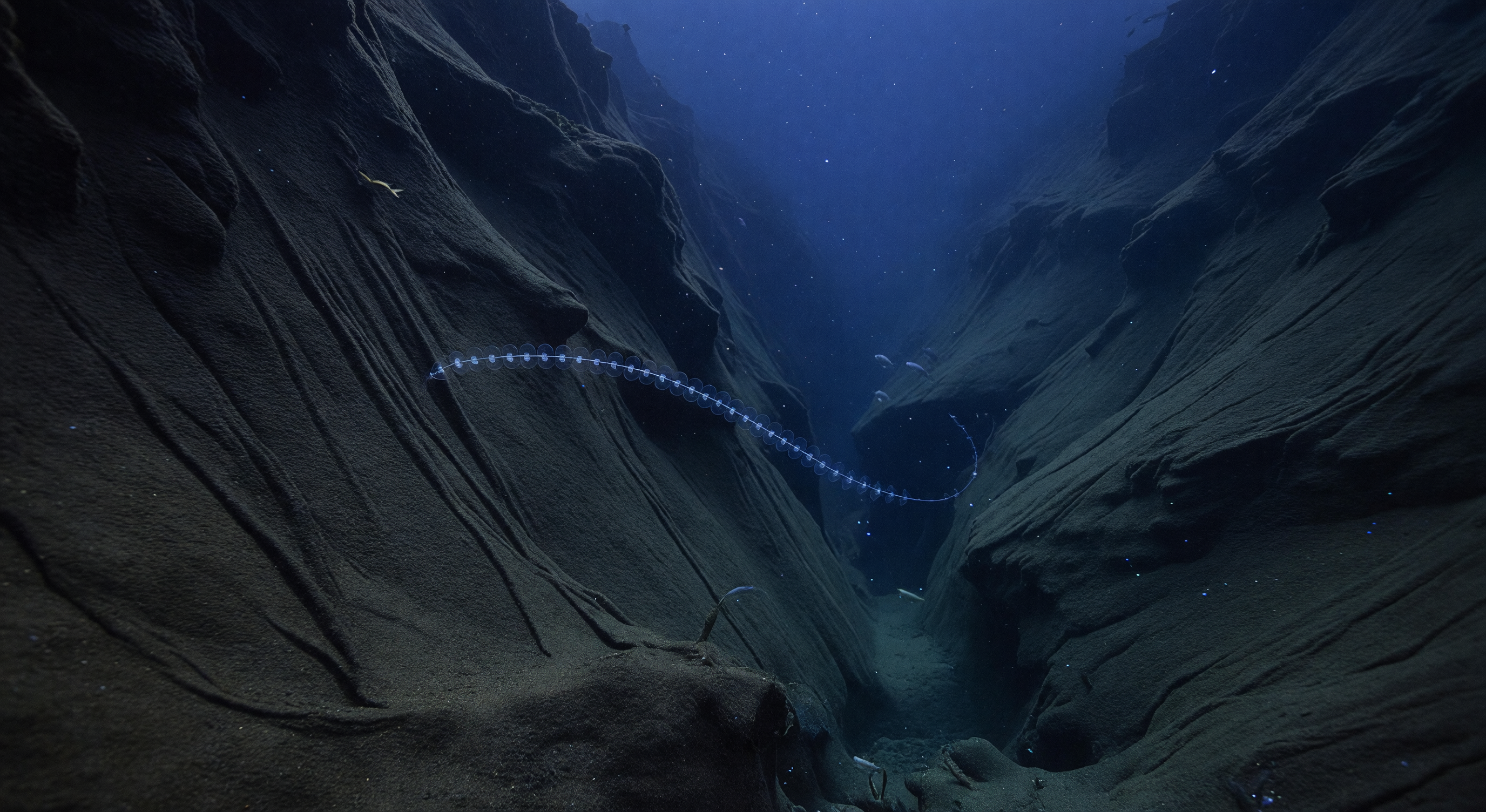
At roughly 340 meters depth, the continental slope fractures into a narrow ravine where dark mud rills streak down the near wall like arrested rivers of fine sediment, and ledges draped in pale silt overhang small slump scars — the quiet evidence of gravity's patient work on an unstable margin. Residual downwelling light, filtered to a cold monochromatic blue by hundreds of meters of water above, barely reaches this confined gash in the slope, fading to near-black against the opposite wall where the ravine swallows all illumination. Here, at roughly 35 atmospheres of pressure, the water is not empty but animated by a slow drift of marine snow — organic particles, diatom fragments, fecal pellets — descending through a column that supports an entire community of organisms evolved for perpetual twilight. Suspended in the middle distance, a meter-long siphonophore hangs almost imperceptible against the sedimented wall, its colonial body a chain of specialized zooids — nectophores, dactylozooids, gonozooids — each transparent enough that the ravine shows through it, betrayed only by faint refractive edges where gelatinous tissue bends the ambient blue. These colonial cnidarians drift as passive hunters through the mesopelagic, trailing tentacles across cubic meters of water in a silence that has never needed a witness.
Other languages
- Français: Dérive de Siphonophore en Ravin
- Español: Deriva de Sifonóforo en Barranco
- Português: Deriva de Sifonóforo no Ravine
- Deutsch: Schlucht Siphonophoren Drift
- العربية: انجراف سيفونوفور الوادي
- हिन्दी: घाटी साइफोनोफोर प्रवाह
- 日本語: 渓谷クダクラゲの漂流
- 한국어: 협곡 관해파리 표류
- Italiano: Deriva di Sifonoforo nel Burrone
- Nederlands: Ravijn Sifonofoor Drift