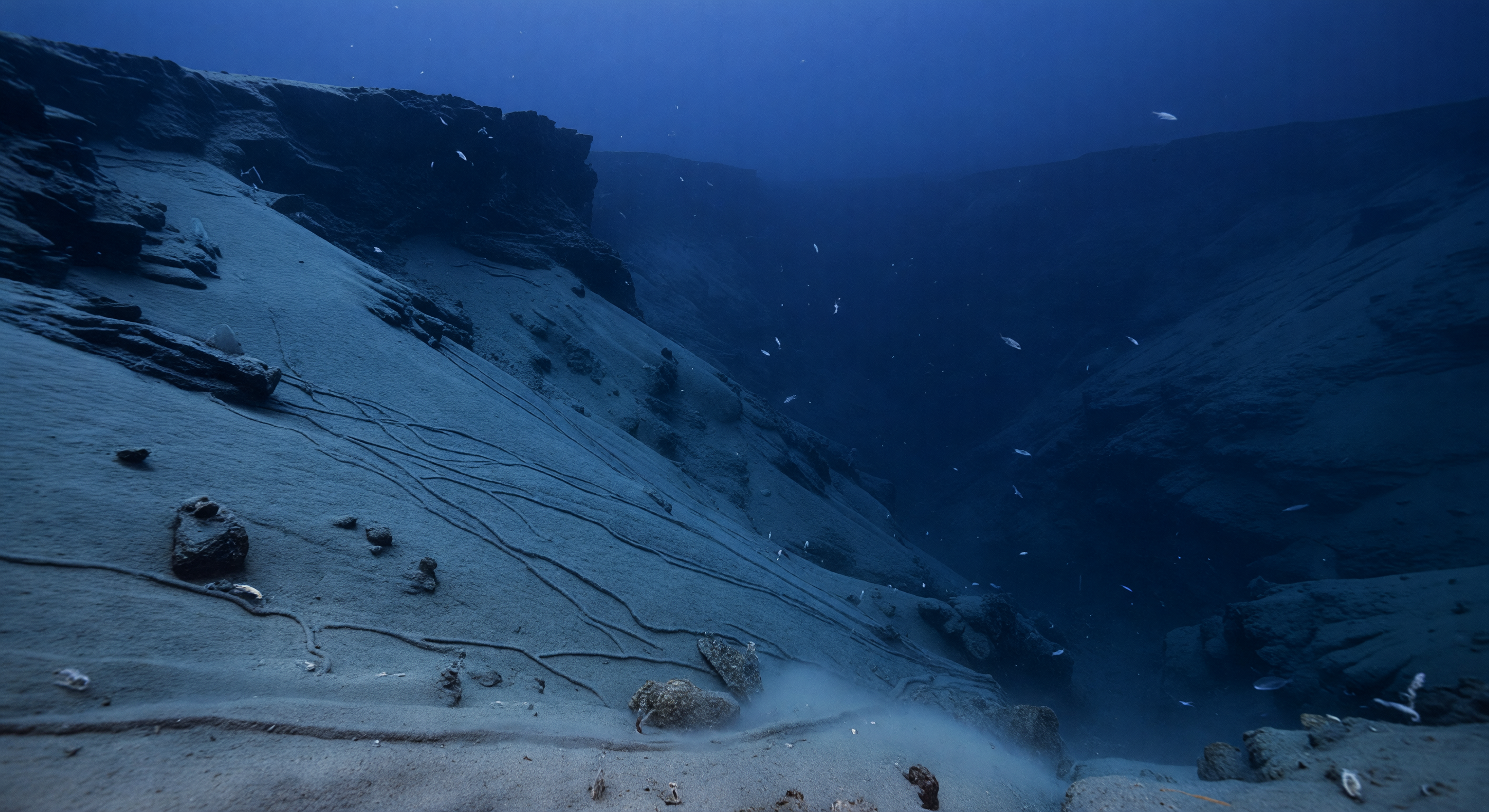
At roughly 220 metres, the continental shelf break marks one of the ocean's great topographic thresholds — the point where the gently inclined shelf abruptly surrenders to the steepening slope, and sunlight begins its final, losing struggle against depth. Here, in the upper mesopelagic, pressure already exceeds 22 atmospheres, and the residual solar radiation filtering down from the surface arrives as a dim, diffuse cobalt wash, attenuated to perhaps one percent of its surface intensity, stripping away warmer wavelengths and leaving only blue. The canyon wall descends in a steep diagonal of pale bluish-grey silt, its surface sculpted by narrow gullies, faint slump scars, and occasional dark rock outcrops — evidence of episodic gravity flows and the slow creep of sediment downslope under the influence of contour currents and the slope's own incline. A thin nepheloid layer clings close to the sediment surface, a suspension of resuspended particles stirred by near-bottom currents, while above it sparse marine snow drifts in slow, undeflected descent — the ceaseless rain of organic aggregates, fecal pellets, and diatom fragments that links the sunlit surface to the deep. Transparent medusae and small silvery mesopelagic fish hang as delicate silhouettes in the water column, adapted to this perpetual monochromatic dusk, while deeper in the canyon's shadow a handful of cold blue-white bioluminescent points pulse without witness — chemical light produced by organisms that have never needed the sun, in a world that has always existed in perfect indifference to our own.
Other languages
- Français: Descente du Rebord Continental
- Español: Descenso al Borde Continental
- Português: Mergulho na Quebra da Plataforma
- Deutsch: Abstieg am Schelfrand
- العربية: هبوط حافة الجرف
- हिन्दी: शेल्फ किनारे का अवतरण
- 日本語: 大陸棚縁の降下
- 한국어: 대륙붕 경사 하강
- Italiano: Discesa al Bordo della Piattaforma
- Nederlands: Afdaling langs de Schelfrand