Along the continental slope at 430 meters, a loose procession of myctophids — lanternfish of the family Myctophidae — threads upward along the contour, their slender silver bodies suspended in water where downwelling daylight has diminished to a faint cobalt residue, insufficient to cast shadows yet just sufficient to strike mirror flanks as brief, cold blue-gray flickers. At this depth, pressure exceeds 43 atmospheres, temperatures hover between 6 and 10 degrees Celsius depending on the intermediate water mass pressing against the slope, and the mesopelagic twilight zone is defined precisely by this threshold where photosynthetically active radiation collapses but biological light begins to take its place — the ventral photophores of each fish igniting as tiny cyan-white points that serve for counter-illumination, concealing their silhouettes from predators looking upward against the last remnant of sky. The slope wall itself is fractured and sedimented, carved by contour currents and episodic gravity flows into gullies and narrow ravines draped with fine hemipelagic silt, a tectonically shaped substrate hosting the transition between shelf benthos and true deep-sea communities — sparse encrusting forms barely distinguishable against the cold blue-gray rock. This population of myctophids is almost certainly engaged in diel vertical migration, ascending each dusk toward productive surface waters and retreating each dawn into the oxygen-minimum-zone margins, a behavioral cycle that makes lanternfish among the most important vectors of biological carbon export on Earth, their collective metabolism linking the sunlit ocean to the abyss below. Marine snow drifts freely through the water column between them — microscopic fecal pellets, mucus aggregates, and the transparent bodies of gelatinous zooplankton — each particle part of the slow gravitational rain that feeds the slope community beneath, in a world that has operated this way, without witness, for millions of years.
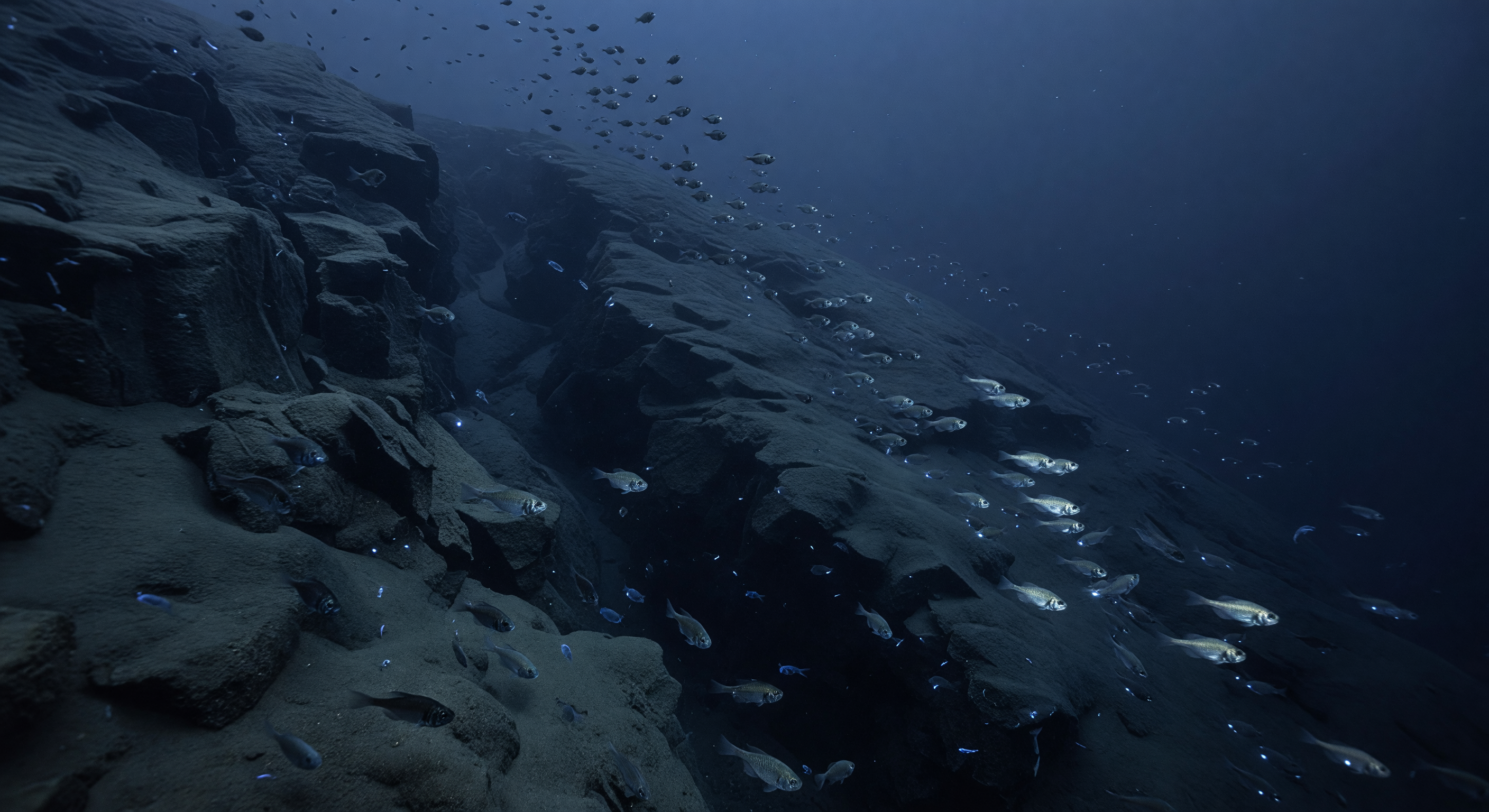
Continental slope