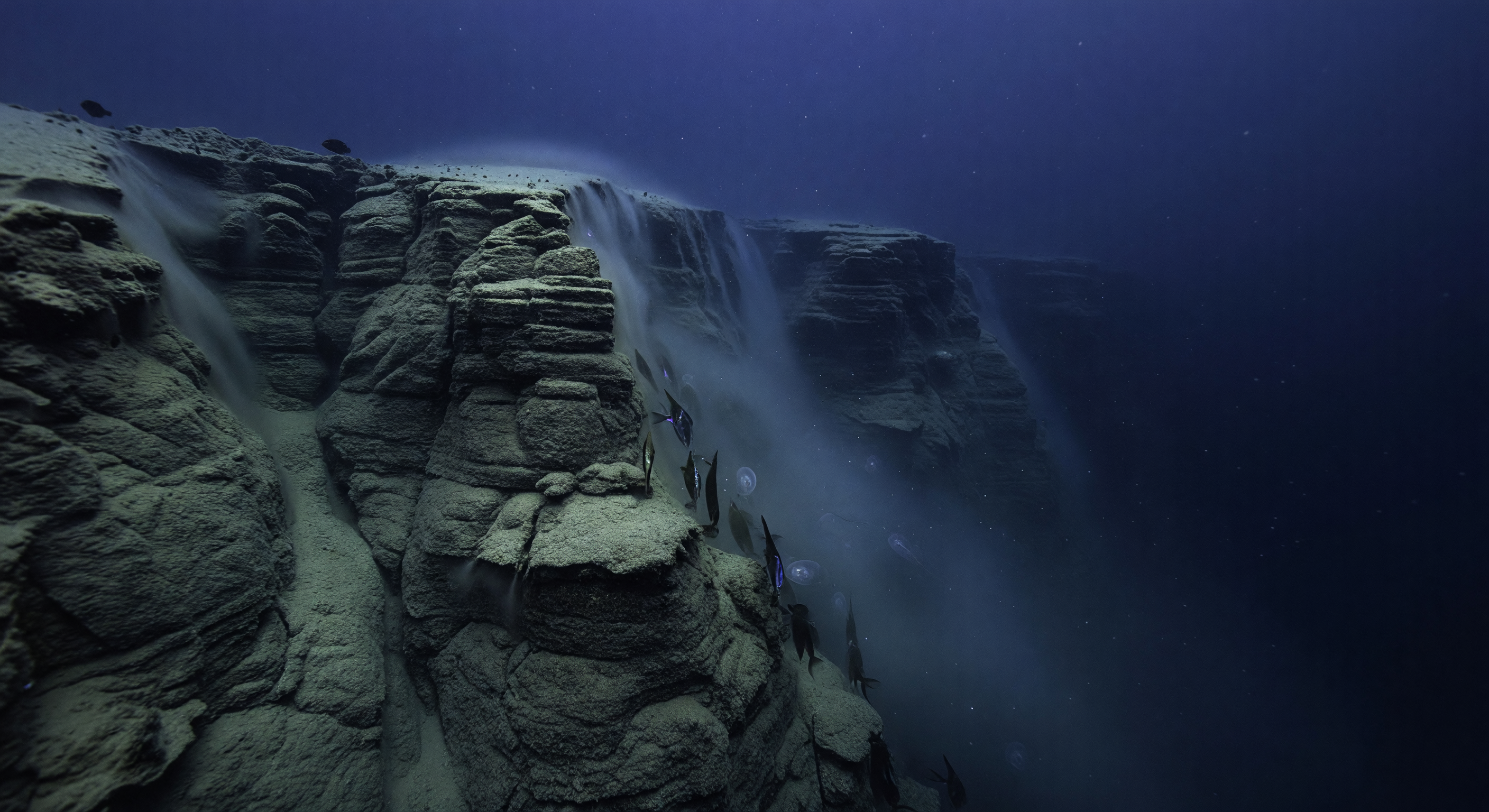
At around 500 metres depth along the continental slope, the water enters a realm where dissolved oxygen plummets to near-lethal minima, creating an oxygen minimum zone that acts as an invisible biological filter — a curtain of physiological pressure that compresses life into narrow, specialized bands along canyon walls and rocky ledges. The last traces of sunlight penetrate here only as a cold, monochromatic blue suffusion, attenuated to perhaps one ten-thousandth of surface irradiance, just barely enough to cast the faintest silhouette of a hatchetfish's laterally flattened, mirror-scaled body as it hovers at the boundary layer, its ventral photophores providing counter-illumination against the residual downwelling light in a predator-evasion strategy refined across tens of millions of years. The submarine canyon wall beside them bears the layered geological record of the continental margin itself — sedimentary sequences slumped and re-draped, narrow ravines carved by turbidity currents, ledges mantled in fine hemipelagic sediment carried grain by grain through the water column as marine snow, which now drifts visibly through the frame as pale motes suspended in a nepheloid haze pressed close to the rock face. Ctenophores — gelatinous, nearly optically transparent, their eight comb rows of fused cilia occasionally catching ambient blue light in a fleeting iridescent shimmer — drift without muscular effort through water pressing down at roughly 51 atmospheres, their bodies so nearly equivalent in density to seawater that pressure itself is barely a constraint. This is a world of chemical boundaries and geological architecture, existing in cold silence utterly independent of any observer, shaped entirely by physics, chemistry, and the slow negotiation of life with scarcity.
Other languages
- Français: Rideau de Frontière Anoxique
- Español: Cortina de Límite Oxígeno
- Português: Cortina da Fronteira Anóxica
- Deutsch: Sauerstoffgrenz Vorhang
- العربية: ستارة حدود الأكسجين
- हिन्दी: ऑक्सीजन सीमा पर्दा
- 日本語: 酸素境界の帳
- 한국어: 산소 경계 장막
- Italiano: Sipario del Limite Ossigeno
- Nederlands: Zuurstofgrens Gordijn