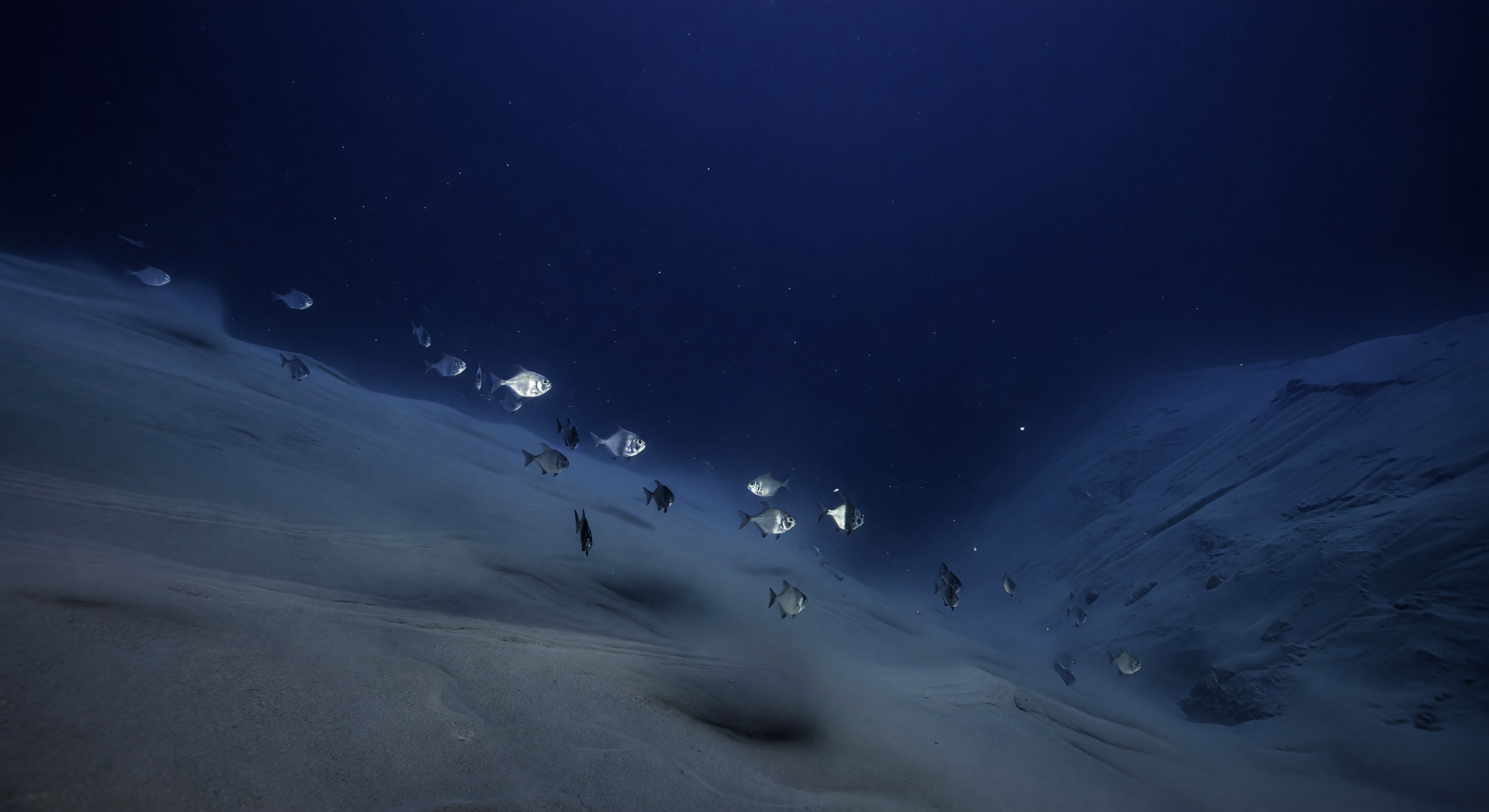
Along this open continental slope at 260 meters, the last viable wavelengths of sunlight — compressed into a cold, monochromatic indigo — penetrate just enough to cast soft gradients across a pale sediment drape that has settled silently over the incline over millennia, its surface faintly scoured by contour currents that move parallel to the slope in persistent, invisible rivers of denser water. At this depth, pressure exceeds 26 atmospheres, and the water temperature has fallen through the thermocline into the mid-single digits, creating conditions that demand extraordinary physiological adaptation from every organism present. Sternoptyx and related hatchetfish hover in the midwater flow, their ultra-thin, laterally compressed bodies and mirror-finish flanks — composed of stacked guanine crystal platelets — functioning as near-perfect camouflage in this dim column, reflecting ambient blue light so precisely that they become indistinguishable from the water itself when viewed edge-on by predators below. Alongside them, juvenile bristlemouths of the genus Cyclothone, among the most numerically abundant vertebrates on the planet, drift in the same cross-current, their translucent tissues and bioluminescent photophores calibrated for this exact niche of attenuating twilight. Further into the cobalt haze, where the ravine wall dissolves into depth, faint pinpricks of biological light pulse autonomously — a grammar of bioluminescence written entirely for an audience of other creatures, in an ecosystem that has been complete and coherent long before any surface-dwelling mind conceived of its existence.
Other languages
- Français: Poissons-miroirs en courant côtier
- Español: Peces espejo en corriente costera
- Português: Peixes-espelho em fluxo contorno
- Deutsch: Spiegelfische im Hangstrom
- العربية: سمك المرايا في تيار المنحدر
- हिन्दी: दर्पण मछलियाँ प्रवाह में
- 日本語: 鏡魚と等深流
- 한국어: 등심류의 거울물고기
- Italiano: Pesci specchio nella corrente costiera
- Nederlands: Spiegelvis in contourstroom