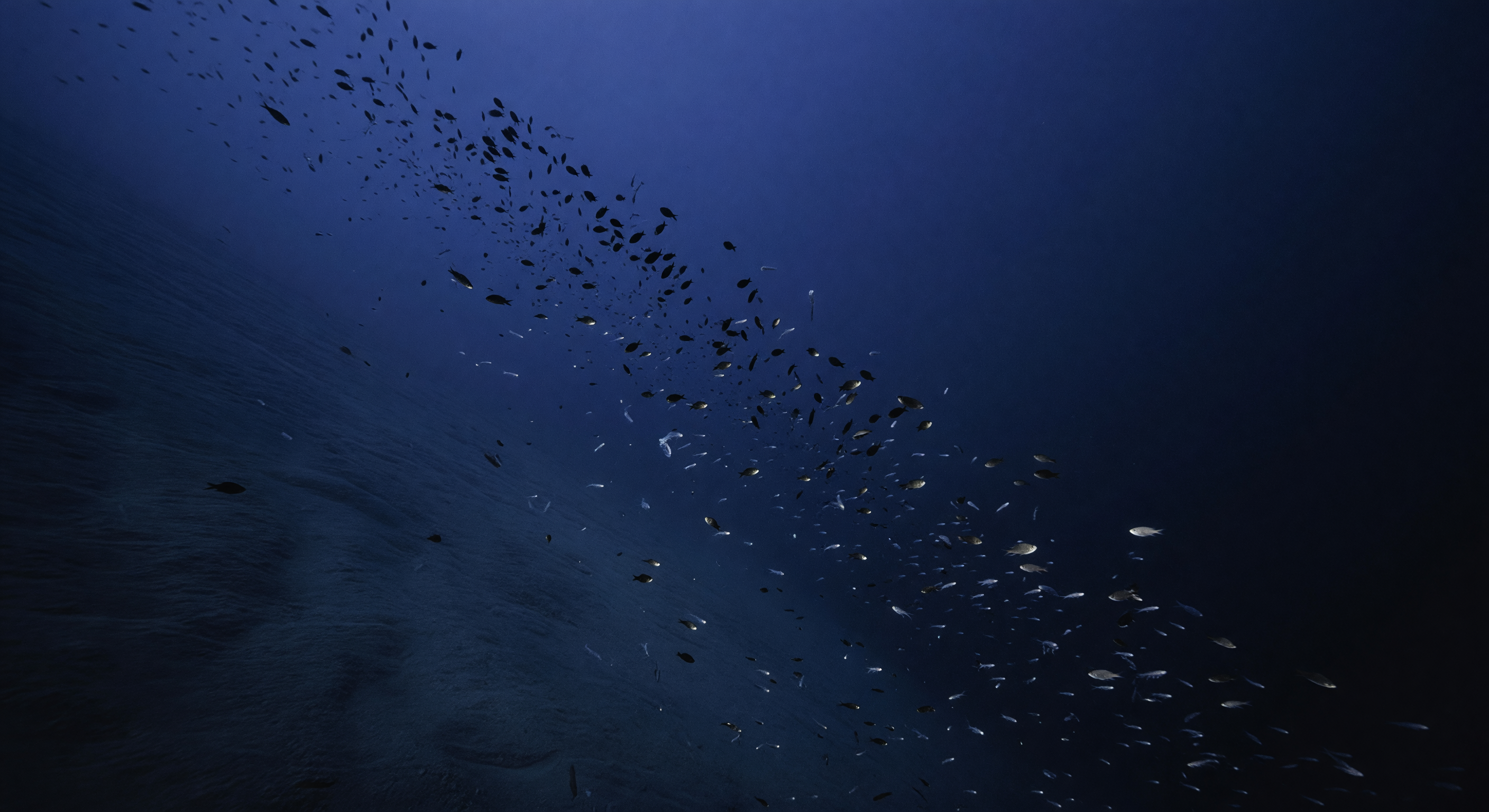
The lander sits motionless against the base of the continental slope, its faint observation light barely reaching a meter into water that presses down at roughly forty atmospheres, cold and almost perfectly still. To the left, the slope wall rises as a vast matte plane of dark cobalt that dissolves upward into monochromatic haze long before any edge becomes visible, its surface texture only hinting at the enormous geological structure it represents — an ancient sediment-draped margin where the deep ocean basin meets the shallower shelf. Against this wall, something extraordinary is happening: the deep scattering layer, normally a diffuse acoustic horizon spread across hundreds of meters of open water column, has been forced into a compressed ribbon by the slope's topography, concentrating lanternfishes into low-contrast silver silhouettes, transparent sergestid shrimps and euphausiid krill into glassy drifting clusters, and scattered ctenophores into fragile spinning geometries, all streaming slowly upslope in a living current thickest near the wall and fraying into the blue-black open water to the right. Marine snow catches the lander's light for an instant and vanishes, a few fish flanks flash silver where residual downwelling blue still reaches from far above, and deep within the band tiny bioluminescent points flicker and go dark — the metabolic sparks of organisms adapted to carry their own light because none arrives from the surface. This is one of the most biomass-dense environments on Earth, an acoustically opaque horizon that once fooled wartime sonar operators into believing they had found the seafloor, now revealed as a compressed wall of living tissue migrating along geology that has been building for millions of years.
Other languages
- Français: Compression contre la pente
- Español: Compresión en la pared submarina
- Português: Compressão na encosta abissal
- Deutsch: Hangwand-Verdichtung
- العربية: ضغط جدار المنحدر
- हिन्दी: ढाल दीवार संपीड़न
- 日本語: 斜面壁の圧縮流
- 한국어: 경사면 벽 압축
- Italiano: Compressione sulla parete sommersa
- Nederlands: Hellингwand compressie