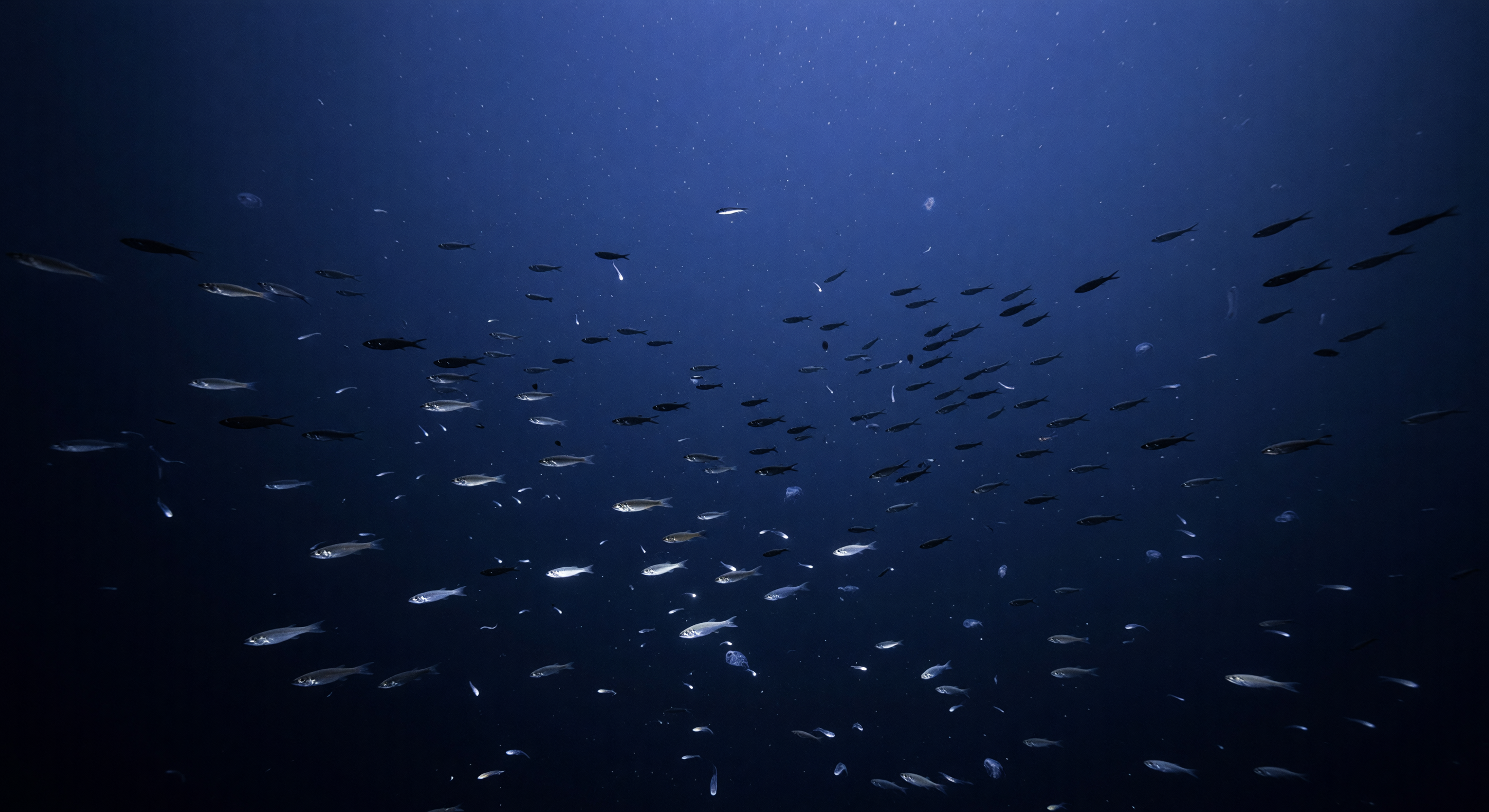
The AUV's nose camera tilts upward into a vast, living architecture: thousands of lanternfish—myctophids no longer than a finger—angle through the water column in staggered, dissolving bands, their flanks occasionally catching the last ghost of downwelling cobalt light in knife-thin silver flashes before fading back into silhouette. At 280 meters, the pressure bears down at roughly 28 atmospheres, and what little solar energy remains has been stripped to a faint, diffuse ceiling of blue-indigo that brightens only at the center of the frame before bleeding away to near-black at the edges—there is no sun here, only its memory. This is the dusk ascent of the deep scattering layer, one of the largest synchronised animal migrations on Earth, as billions of mesopelagic organisms ride the retreating light gradient upward each evening to feed in richer, shallower waters before descending again at dawn. Drifting among the lanternfish are glassy ctenophores trailing refractive comb rows, scattered krill, and translucent shrimps, all suspended in a gentle snowfall of marine particulates—organic detritus sinking from the productive surface far above—that catches the AUV's barely perceptible spill of cool light within arm's reach before vanishing into the dark below. The scene is cold, silent, and profoundly volumetric: a biological horizon that once fooled wartime sonar operators into believing they had found the seafloor, now revealed as a living, breathing, migrating frontier of the ocean's twilight interior.
Other languages
- Français: Colonne de Poissons-Lanternes
- Español: Columna de Peces Linterna
- Português: Coluna de Peixes-Lanterna
- Deutsch: Laternenfisch Aufstiegsäule
- العربية: عمود صعود سمك الفانوس
- हिन्दी: लालटेन मछली आरोहण स्तंभ
- 日本語: ハダカイワシ上昇の柱
- 한국어: 등불고기 상승 기둥
- Italiano: Colonna di Pesci Lanterna
- Nederlands: Lantaarnvis Opstijgende Kolom