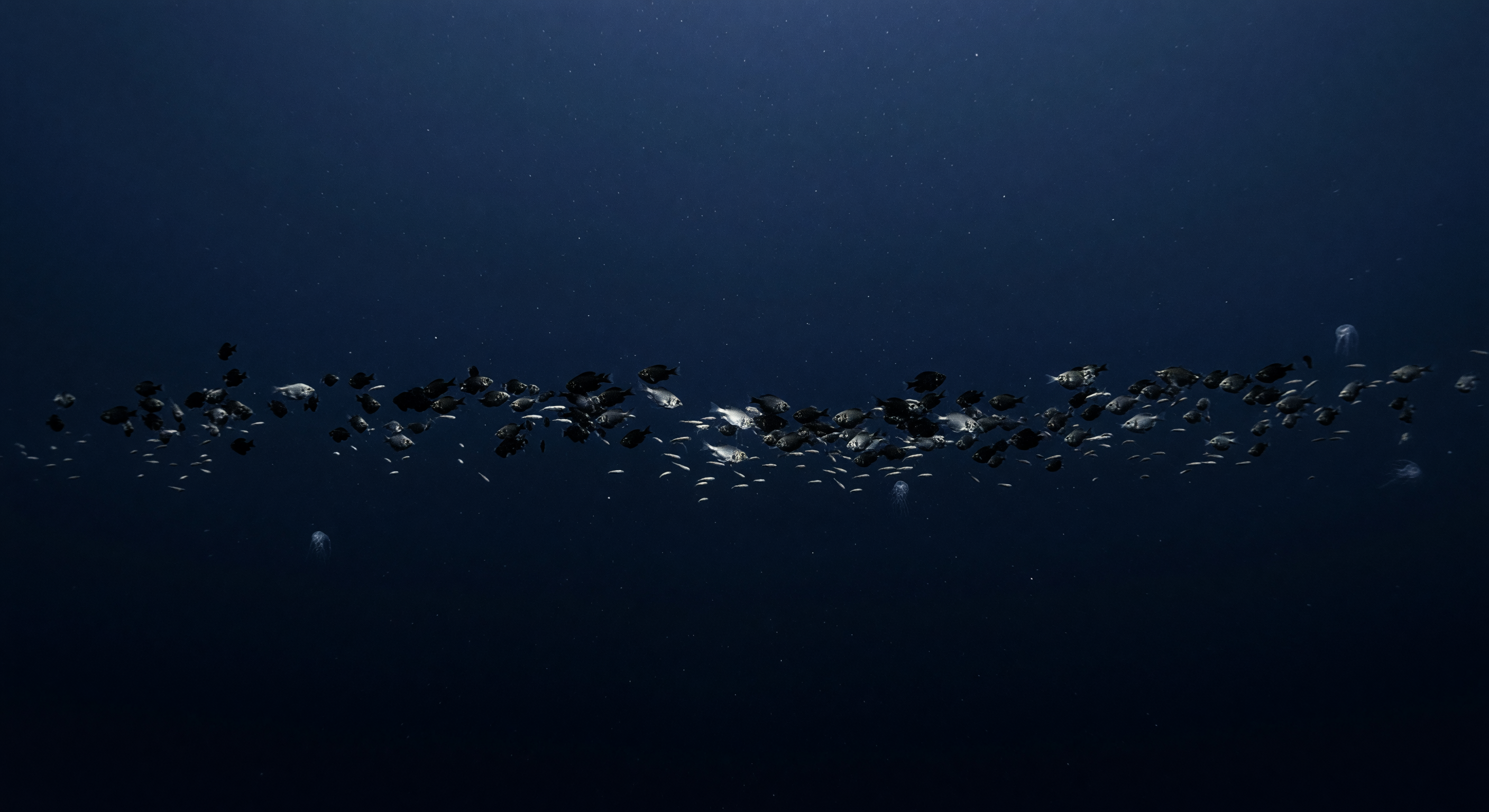
The submersible drifts in an almost perfectly still water column, and as the forward lamps sweep ahead, they reveal something extraordinary: a living horizon suspended in open ocean, a compressed ribbon of lanternfishes, krill, and small shrimps hovering at the precise boundary where dissolved oxygen drops sharply enough to create a biological bottleneck, concentrating thousands of animals into a band no more than a few meters thick yet stretching invisibly in every direction beyond the light cones. At sixty atmospheres of pressure, the water feels viscous and absolute, and the air inside the sphere seems to carry the weight of the sea itself; up here in the mesopelagic twilight zone, the last ghost of blue daylight fades into a dim gradient near the top of the viewport while everything below tumbles quickly into cobalt and then near-black, leaving the submersible's two cool-white lamps as the only meaningful illumination. The animals in the ribbon barely move — myctophid flanks flashing cold metallic silver as photophores glint in erratic pinpoints, transparent shrimp bodies rendered almost invisible until a carapace catches the beam at exactly the right angle, a pair of ctenophores pulsing with faint iridescence at the edge of visibility — because this oxygen-minimum interface acts as an ecological trap, rich enough in migrating biomass from above to feed predators, yet chemically hostile enough to thin the fauna above and below, producing the stark emptiness that makes the band so visually arresting. Fine marine snow drifts continuously through both light cones, each particle a slow confession of the surface world hundreds of meters overhead, and in the darkness beyond the beams, tiny bioluminescent sparks flicker and vanish, the deep scattering layer announcing itself with the same acoustic authority that once convinced wartime sonar operators they had found the seafloor.
Other languages
- Français: Lisière Sans Oxygène
- Español: Borde de Oxígeno Comprimido
- Português: Margem de Oxigênio Comprimido
- Deutsch: Komprimierte Sauerstoffgrenze
- العربية: حافة الأكسجين المضغوط
- हिन्दी: संकुचित ऑक्सीजन किनारा
- 日本語: 圧縮された酸素の縁
- 한국어: 압축된 산소 경계
- Italiano: Bordo di Ossigeno Compresso
- Nederlands: Gecomprimeerde Zuurstofgrens