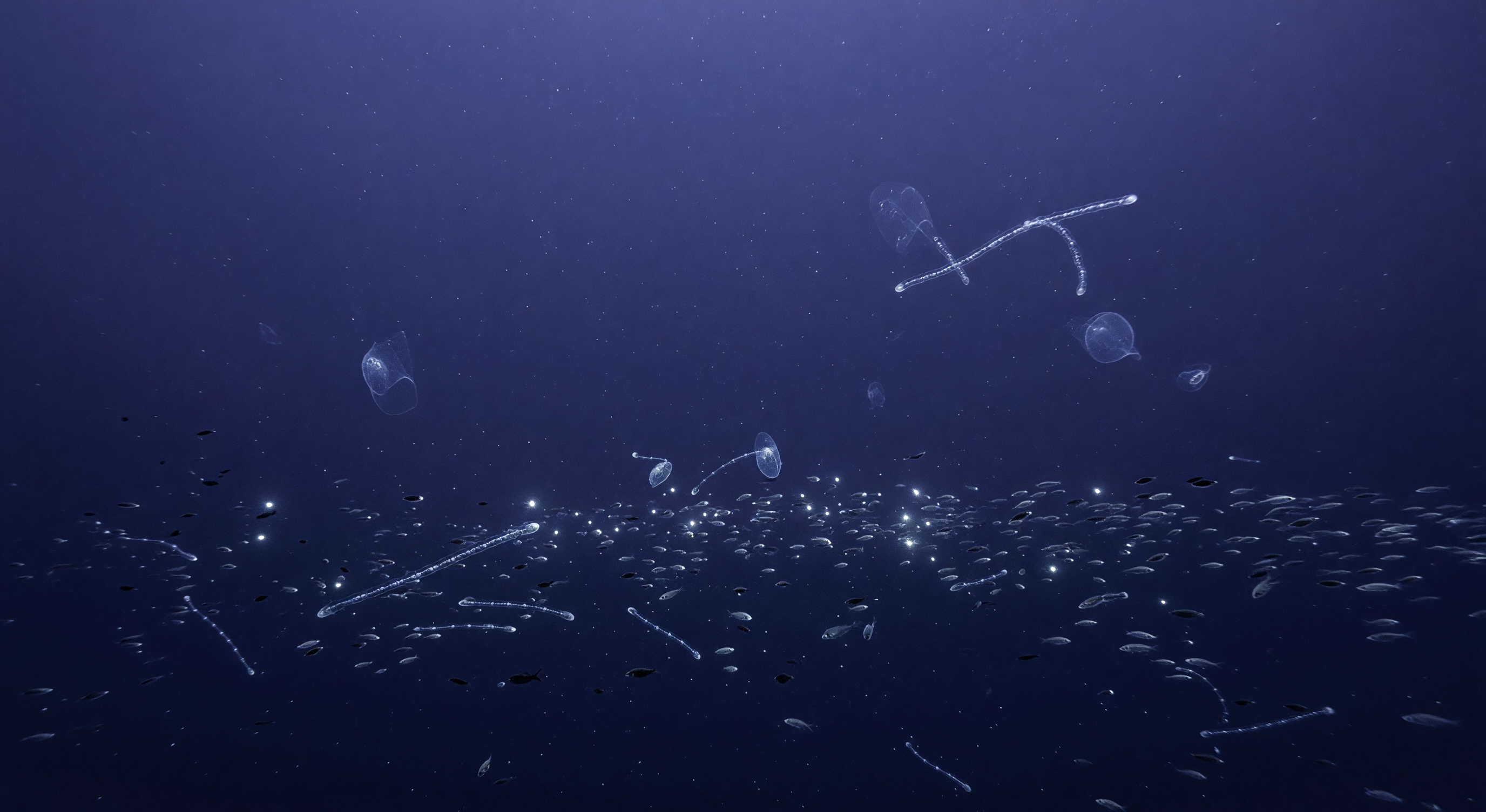
Pressed against the acrylic dome at 240 meters, the submersible's occupant watches long chains of salps drift past in slow procession, each gelatinous capsule catching the last feeble downwelling light as a faint indigo outline before dissolving back into the blue-black water column — at this depth, roughly 25 atmospheres of pressure compress the world into silence, and the warm wavelengths of sunlight have been stripped away hundreds of meters above, leaving only this cool monochrome twilight at the very edge of human visibility. Collapsed larvacean houses hang in the midwater like shed ghosts, their mucus-mesh architecture now shapeless and translucent, releasing captured marine snow back into slow descent — these abandoned filtration structures are among the ocean's most efficient carbon-export vehicles, ferrying surface productivity toward the seafloor in a biological pump that shapes the planet's carbon cycle. Below the submersible, the water thickens into something alive and volumetric: the deep scattering layer is rising with the fading sun, and what sonar operators once mistook for a false seafloor reveals itself here as a swarm of krill and lanternfish so dense it forms its own trembling horizon, individual animals flickering as silver glints and dark silhouettes amid scattered sparks of bioluminescence. This nightly upward migration — hundreds of meters traveled in a matter of hours — represents one of the largest coordinated movements of animal biomass on Earth, a biological tide that redistributes energy between the productive surface and the twilight depths in rhythms older than any human science.
Other languages
- Français: Chaînes de Salpes au Crépuscule
- Español: Cadenas de Salpas al Crepúsculo
- Português: Cadeias de Salpas no Crepúsculo
- Deutsch: Salpenketten in der Dämmerung
- العربية: سلاسل السالب في الشفق
- हिन्दी: संध्या में सैल्प श्रृंखलाएं
- 日本語: 薄暮のサルパの連鎖
- 한국어: 황혼 속 살파 사슬
- Italiano: Catene di Salpe al Crepuscolo
- Nederlands: Salp Ketens in de Schemering