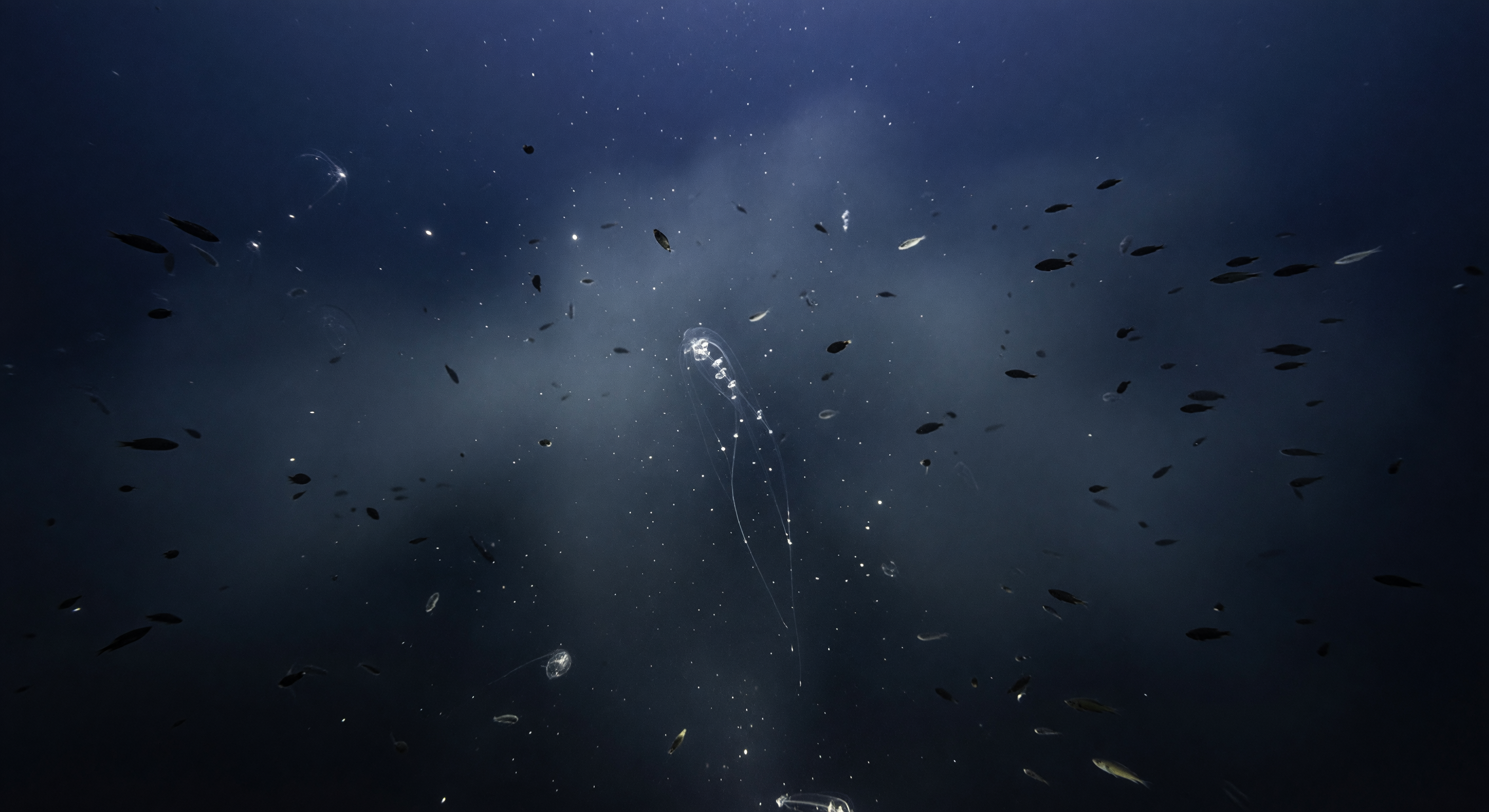
The ROV holds position at 430 meters, its thrusters barely whispering, as a siphonophore of extraordinary length drifts to within centimeters of the camera housing — a colonial organism so architecturally intricate it seems less like an animal and more like a sentence written in glass, each pneumatophore and nectophore barely catching the observation light before dissolving back into blue. At this depth, roughly 44 atmospheres press against every surface, sunlight has been reduced to a colorless whisper of downwelling photons that the human eye would register as near-total darkness, and yet the water column ahead is alive in a way that defies the silence: a volumetric haze of lanternfish, euphausiid krill, and gelatinous micronekton drifts slowly through the frame, their aggregate biomass so acoustically dense that early naval sonars mistook this living curtain for the seafloor itself. Individual myctophids flash silver for a fraction of a second where their mirror-like scales intersect the ROV's restrained cool-white beam, then vanish back into silhouette, while the siphonophore's trailing tentilla — each armed with nematocysts capable of paralyzing small prey — remain nearly invisible except as a trembling suggestion of filament against the fading blue. Marine snow particles, the continuous rain of organic detritus from the productive surface far above, drift through the near-field light like slow static, each fleck a reminder that this entire biological architecture is sustained by the thin thread of carbon falling from a sunlit world the animals here may visit only under cover of darkness.
Other languages
- Français: Siphonophore devant le banc
- Español: Sifonóforo ante el banco
- Português: Sifonóforo diante do cardume
- Deutsch: Siphonophore vor dem Schwarm
- العربية: سيفونوفور أمام السرب
- हिन्दी: झुंड के आगे साइफनोफोर
- 日本語: 群れの前のクダクラゲ
- 한국어: 군집 앞의 관해파리
- Italiano: Sifonoforo davanti al banco
- Nederlands: Sifонofoor voor de school