The submersible hangs motionless in the water column at 350 meters, and through the thick acrylic viewport an extraordinary vision fills the frame: a broad, uneven horizon of living matter stretches from edge to edge, charcoal-blue and dense as a storm front, composed of countless myctophid lanternfishes whose silvery flanks catch the submersible's barely-lit lamps in momentary mirror-flashes, interspersed with krill and small shrimps suspended like frozen sparks in the dim column. At this depth, pressure exceeds 35 atmospheres, and the last vestiges of downwelling blue light from the sunlit surface filter down just enough to silhouette the upper contour of the layer against a faintly luminous ceiling of water, while the layer's lower edge dissolves without boundary into open blackwater below. This is the deep scattering layer — a daily-migrating pelagic assemblage that once confounded wartime sonar operators into believing they had found a false seafloor, a biological phenomenon rather than any geological feature, dense enough to return strong acoustic echoes across its vertical extent of tens to hundreds of meters. Transparent ctenophores drift at the margins, their delicate bodies nearly invisible until a stray photon catches them, and deep within the biological haze, faint bioluminescent pinpricks pulse and vanish — the photophores of lanternfishes communicating in a language older than any predator that hunts them. The water beyond the viewport is immaculately still, threaded with marine snow and suspended particles, carrying the absolute silence of open-ocean mid-water where no seafloor anchors the world below.
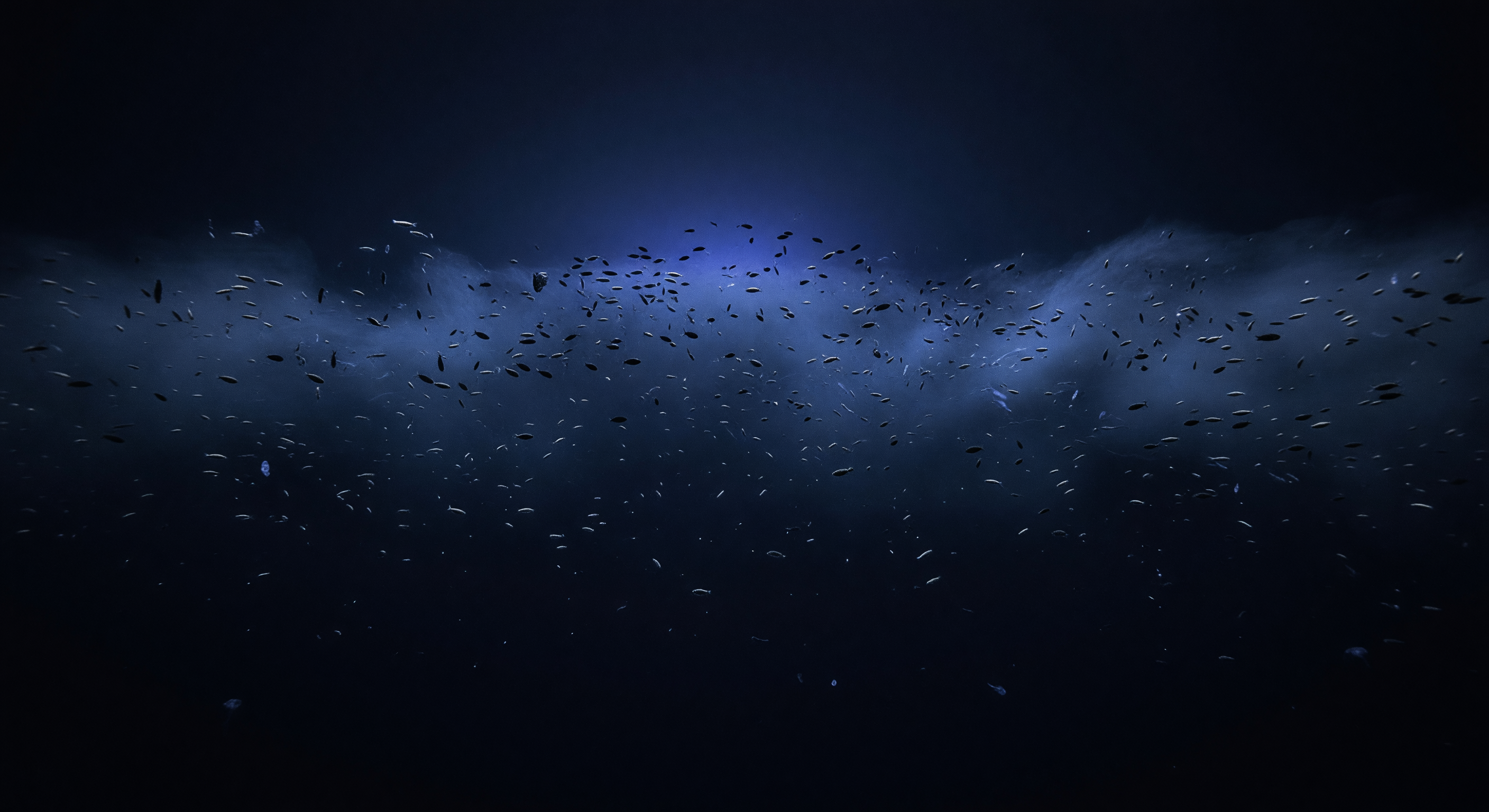
Deep scattering layer