The ROV drifts weightless in open water, its forward camera revealing a living haze suspended between the last whispers of surface light and absolute darkness — directly ahead, transparent shrimps and ctenophores hang motionless in the weak cobalt downwelling glow, their glassy tissues barely distinguishable from the surrounding seawater until a sharp electric-blue spark ignites against a shrimp's flank, then another, then a third among the ghostly lobes of a ctenophore, bioluminescent chemistry firing in cold sequence across the frame. At this depth, roughly 30 atmospheres of pressure compress the water column into near-silence, and the sun's spectrum has been stripped to a single residual wavelength of blue that fades to nothing within a few meters in any lateral direction, leaving only the ROV's dim observation spill to graze the nearest marine snow and reveal the faint silver mirror-flanks of distant myctophid silhouettes layered deeper in the dark. This is the deep scattering layer in its daytime refuge — a volumetric biological cloud famously mistaken by wartime sonar for a false seafloor, built not from rock but from millions of migrating organisms whose gas-filled swim bladders bounce acoustic pulses as decisively as sediment. Here krill, euphausiid shrimps, siphonophores, and lanternfishes share this suspended middle world, each species occupying its preferred pressure stratum, waiting for dusk to trigger one of the planet's largest daily animal migrations — a vertical ascent of hundreds of meters that will carry this entire living horizon toward the surface in darkness. For now, the only light belongs to the animals themselves, each blue pinprick a chemical signal in a world where vision has been almost entirely surrendered to chemistry and sound.
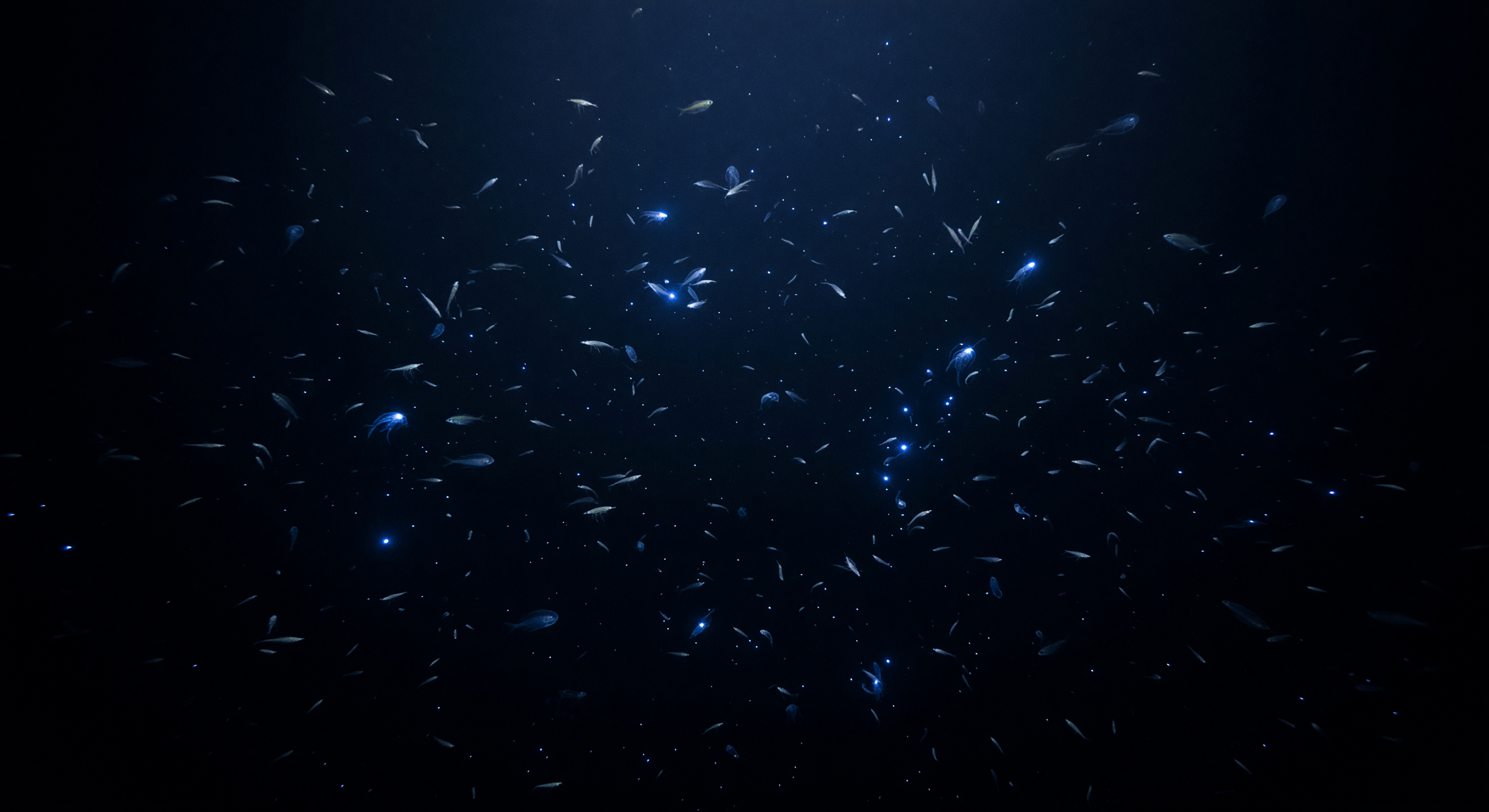
Deep scattering layer