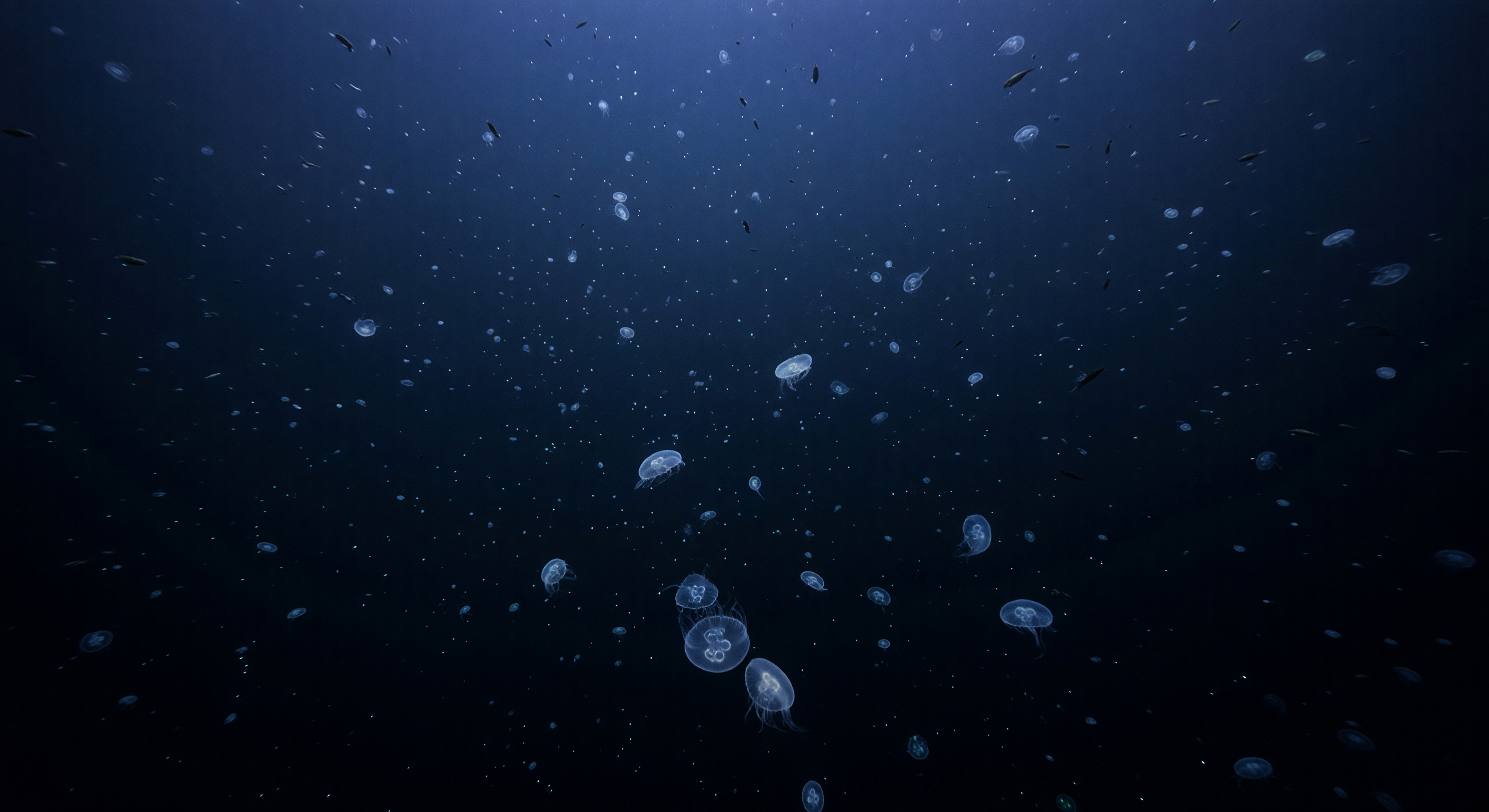
The ROV glides forward at 460 meters into what the camera renders as a silent snowfall in reverse—hundreds of ctenophores suspended in the cobalt-black water column, their glass-clear bodies catching the vehicle's cool-white lamps in brief, translucent flashes before the light fails and they recede into pale ovals and scattered blue-green bioluminescent pinpoints. At this depth, pressure exceeds 47 atmospheres and the last trace of downwelling sunlight has collapsed to a faint monochromatic blue gradient above, leaving the surrounding water to thicken into indigo darkness just meters beyond the ROV's reach. This is the daytime heart of the deep scattering layer—the biological "false bottom" that once deceived wartime sonar operators into misreading their own charts—a mobile, vertically migrating aggregation of gelatinous fauna, micronekton, and lanternfishes that constitutes one of the largest daily animal migrations on Earth. Threading through the ctenophore field, slender myctophid silhouettes cross the dim blue field with minimal photophore display, conserving their bioluminescent signatures in the presence of the ROV's artificial light, their gas-filled swim bladders compressed by pressure into acoustically dense targets that collectively form the layer's strong sonar return. Fine marine snow drifts continuously through the frame—particulate organic matter descending from the productive surface far above—giving the water column a volumetric, living texture that reminds the observer that this silent, pressurized darkness is not empty but is among the most biologically significant habitats in the ocean.
Deep scattering layer