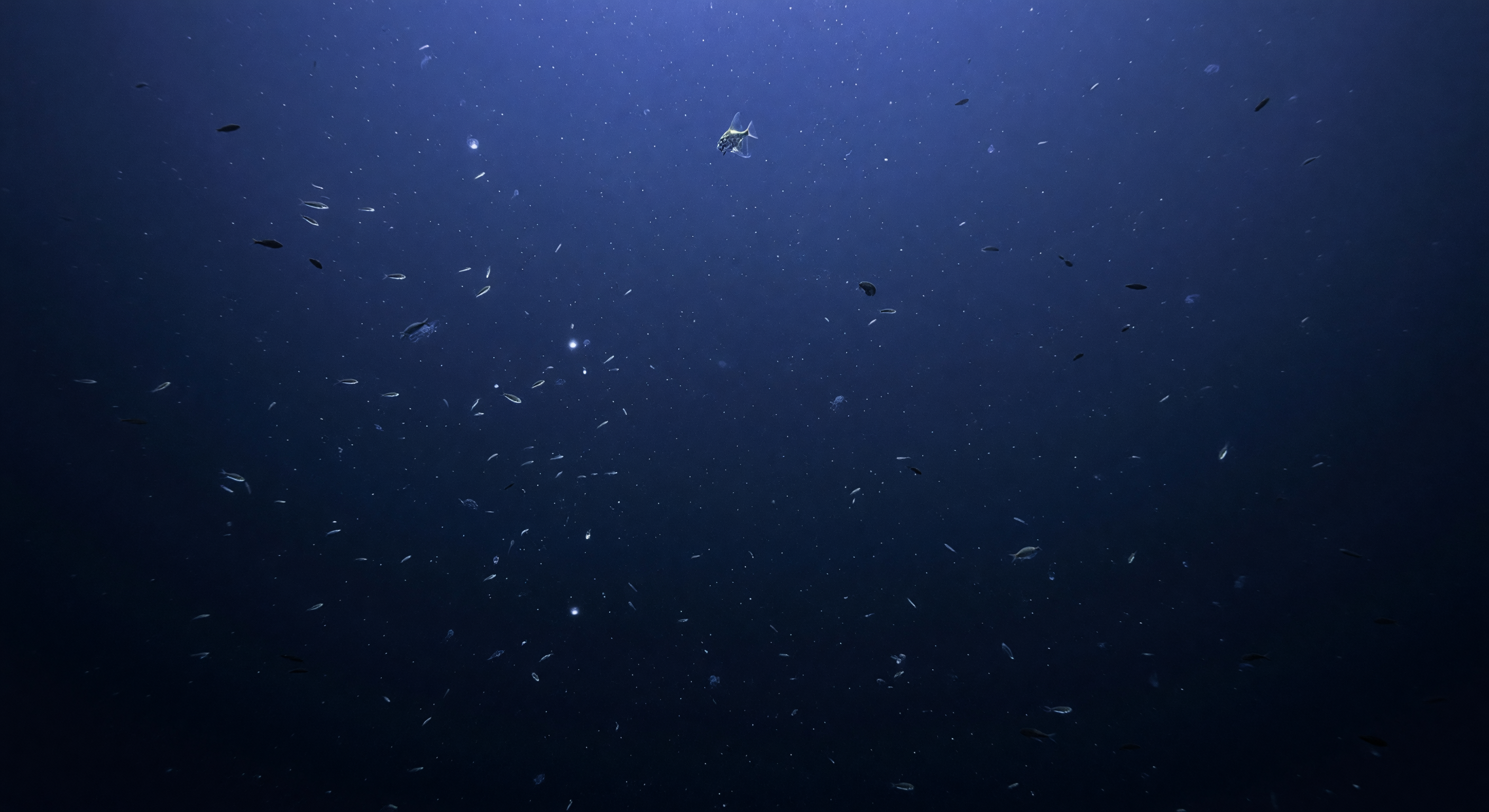
The lander's upward-facing camera peers into a vast column of open water at roughly 370 meters, where the last ghost of blue-violet downwelling light—attenuated to near-nothing by a third of a kilometer of ocean above—filters through a living haze of krill, decapod shrimps, and lanternfishes that constitute the daytime deep scattering layer, the same biological aggregation that fooled Second World War sonar operators into charting a phantom seafloor. At this depth, pressure bears down at approximately 38 atmospheres, compressing swim bladders and altering the acoustic backscatter signature that first made this layer famous, while the surrounding water settles into the cold, stable chemistry of the mesopelagic thermocline below. The assemblage drifts past in volumetric suspension—dark comma-shaped myctophids at mid-distance, translucent siphonophore chains barely resolving against the indigo gradient, pinprick sparks of bioluminescence igniting and extinguishing in the further dark—a self-lit ecosystem conducting the metabolic business of the twilight zone in what might as well be outer space. Then, for a single frozen instant, a hatchetfish materializes overhead: wafer-thin, its mirror-bright flanks evolved to counter-illuminate against downwelling light through photophores along its belly, a biological stealth technology refined over millions of years of predator pressure in exactly this half-lit niche. It catches the faintest cold gleam from the lander's instrument glow, flashes once like a struck coin, and is swallowed back into the haze, leaving only the immensity of the water column pressing silently in every direction.
Other languages
- Français: Hachette sur le Brouillard
- Español: Hacha sobre la Bruma
- Português: Peixe-Machado sobre a Névoa
- Deutsch: Beilbauchfisch über dem Dunst
- العربية: سمكة الفأس فوق الضباب
- हिन्दी: धुंध के ऊपर हैचेटफिश
- 日本語: 霞の上のオノメウオ
- 한국어: 안개 위의 도끼고기
- Italiano: Pesce Ascia sulla Foschia
- Nederlands: Bijlvis boven de Nevel