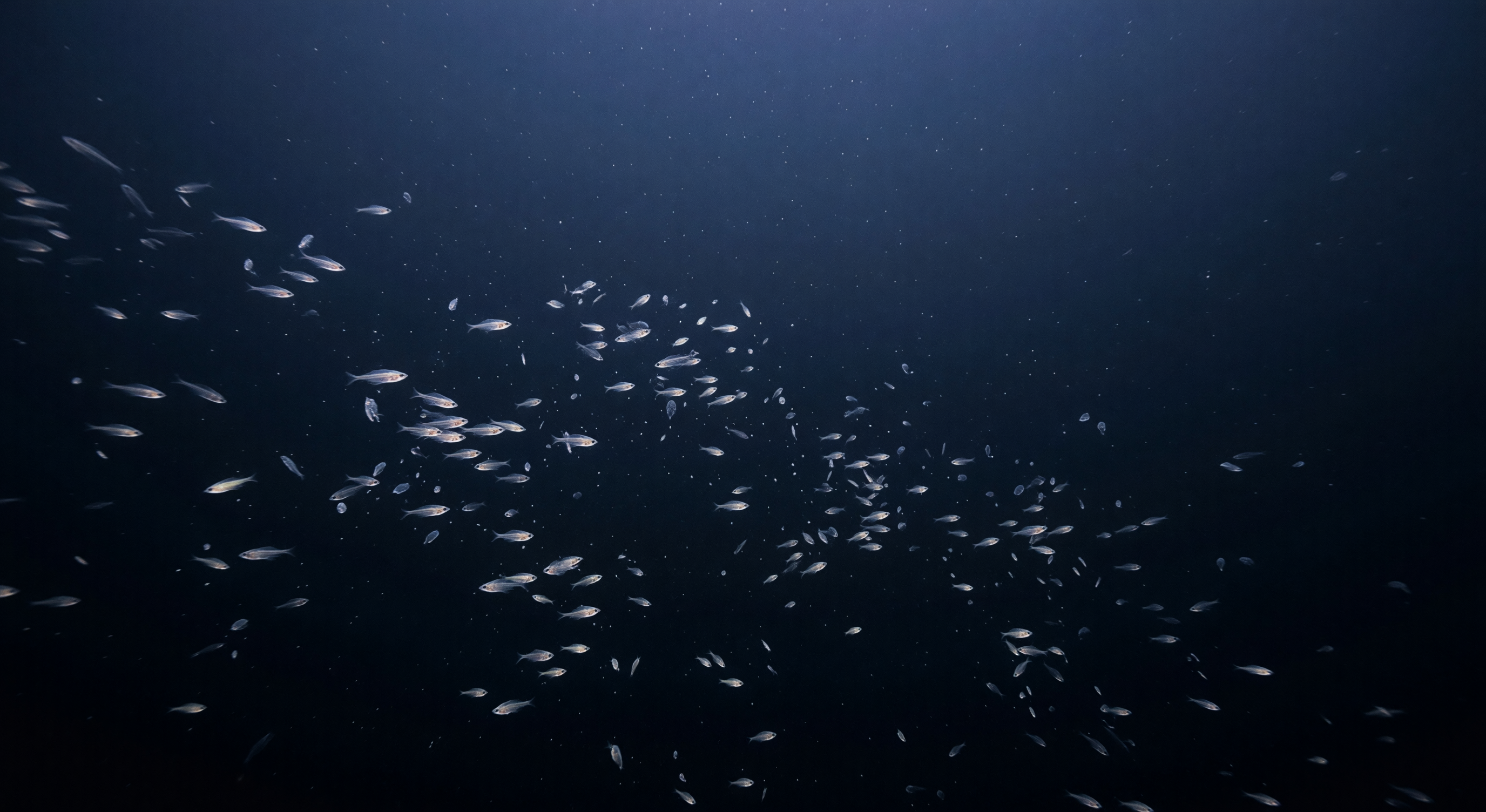
The submersible hangs motionless in a column of near-absolute darkness, its twin lamps carving a narrow white-blue cone into water pressing down at roughly 52 atmospheres — a pressure that would collapse an unprotected human body in seconds. Through the forward viewport, dense streams of krill surge sideways across the beam like a living blizzard, each animal semi-transparent and silvery, their tiny black eyes catching the light for a fraction of a second before they dissolve back into the surrounding void; this is the deep scattering layer in daylight position, the biological aggregation that once fooled wartime sonar operators into believing they had found a false seafloor. Between the krill, isolated ctenophores drift like glass commas, nearly invisible until the lamps ignite their transparent lobes and the faint ribbons of their internal structure, while farther out in the gloom, pinpricks of cold blue-green bioluminescence flicker and vanish — organisms communicating, startled, or simply completing biochemical processes evolved over hundreds of millions of years of darkness. Fine marine snow sparkles close to the lights and disappears within meters, underscoring how brutally short the light budget is here, where no downwelling sunlight of any biological consequence remains and the only photons that matter are the ones an animal generates itself. Beyond the reach of the submersible's lamps, the water column extends in every direction as a featureless biological haze, neither seafloor nor surface within sight, just an immense living suspension preparing, as it does every dusk, to migrate hundreds of meters upward in one of the largest animal movements on Earth.
Deep scattering layer