Scientific confidence: High
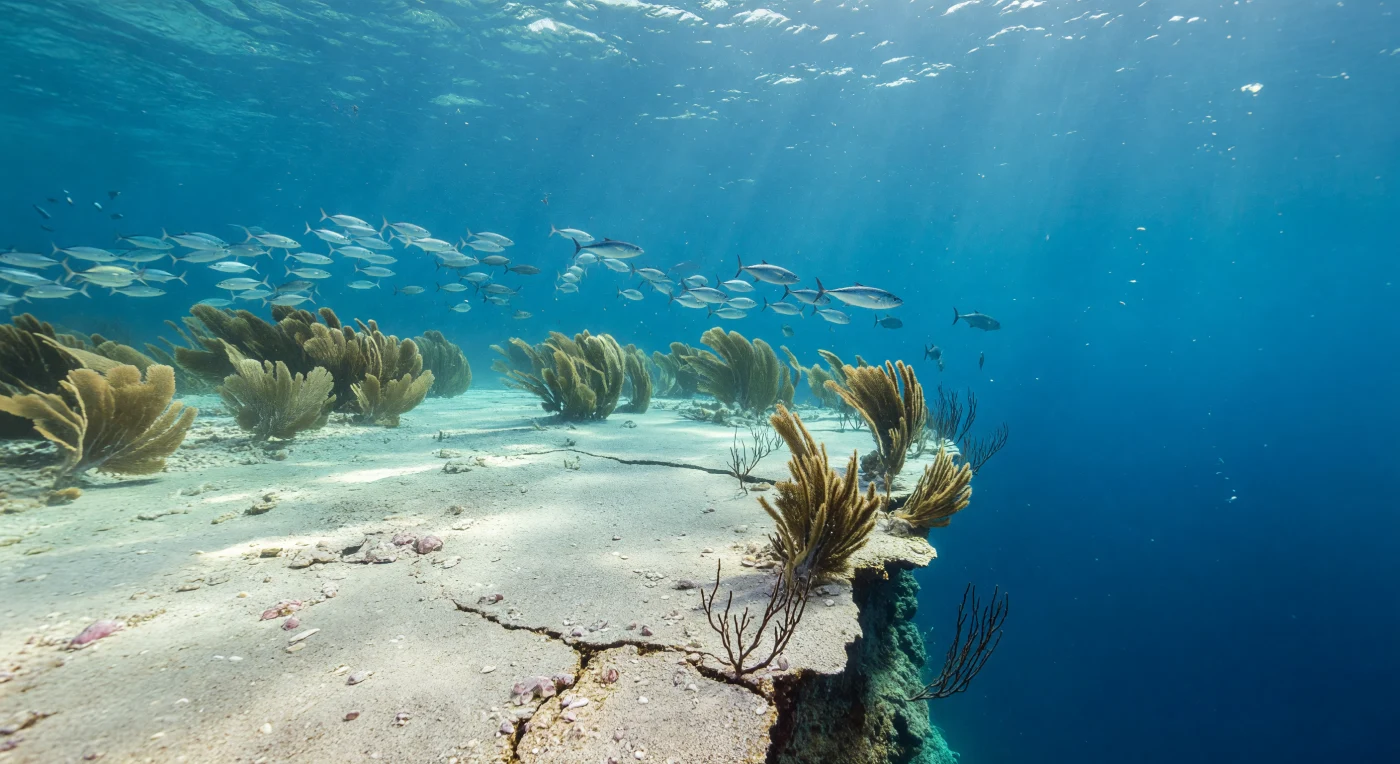
At the edge of an ancient drowned volcano, the carbonate pavement of a guyot stretches flat and pale — cream and ash-gray limestone planed smooth by wave action millions of years ago when this summit still broke the surface, now resting perhaps fifty to eighty meters below in the full flood of tropical sunlight. Caustic light ripples across the hard substrate in shifting golden nets, animating patches of encrusting coralline algae and fractured ledge, while god rays lance down through extraordinarily clear oceanic water carrying fine marine snow in slow suspension. At the rim, where the plateau ends with geological abruptness, tawny gorgonian fans lean uniformly into the persistent current — each one a passive filter feeding on the plankton-laden flow that seamount topography concentrates and accelerates — and sparse black coral branches rise from cracks along the very lip, their wiry forms silhouetted against a sheer drop of open cobalt where the volcanic flank falls away into featureless blue. Above this threshold, dense banks of carangues wheel and flash in silver-white arcs, their schooling behavior tightening instinctively as large yellowfin tunas drive through in sharp predatory passes, exploiting the seamount's role as an open-ocean oasis where hard substrate, upwelled nutrients, and aggregated prey converge in a self-sustaining cycle that has operated, unwitnessed and complete, across geological time.
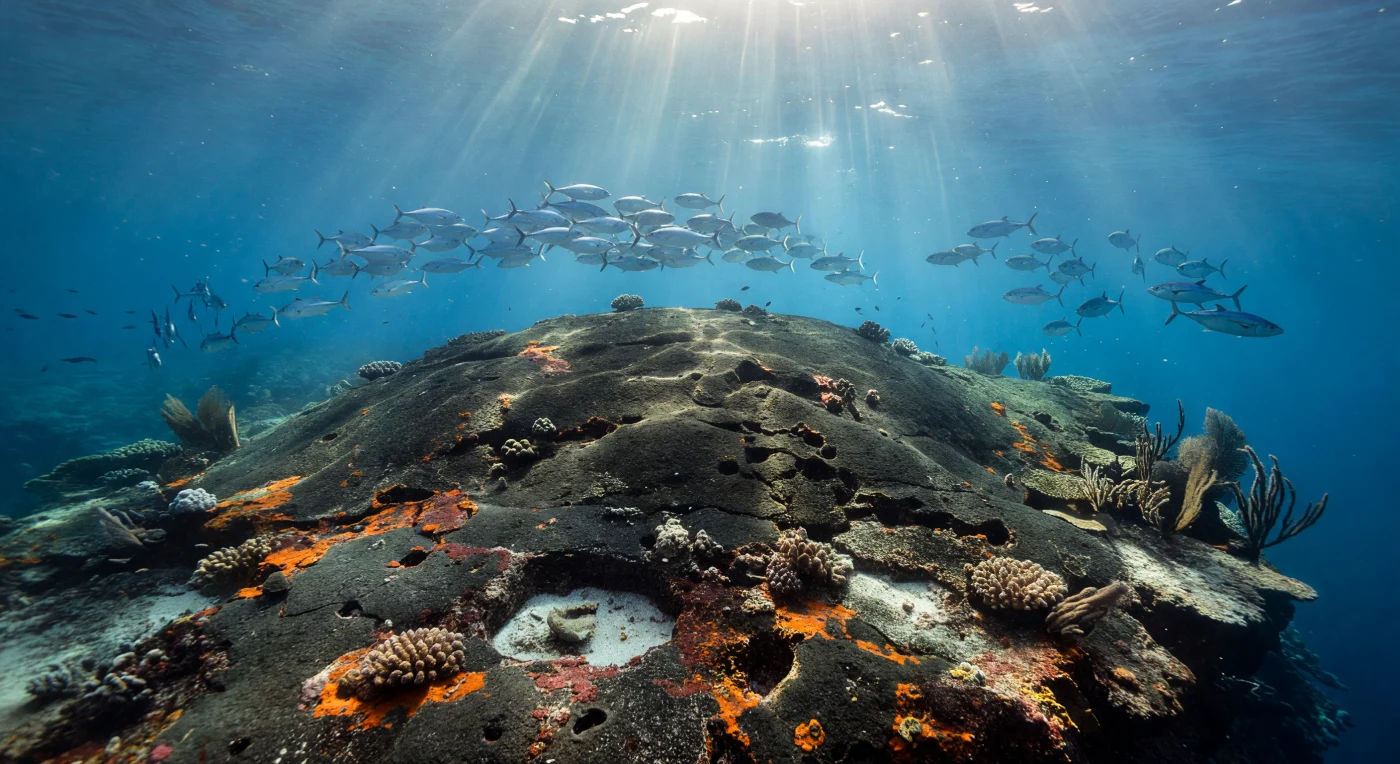
At the crest of a submerged volcanic mountain, white noon sunlight descends in laddering god rays through water of exceptional clarity, casting shifting caustic patterns across a rounded cap of dark, pitted basalt — ancient seafloor that once built itself upward from the abyssal plain over millions of years of eruption and cooling. The hard substrate, swept perpetually clean by open-ocean currents, is colonized by orange encrusting organisms and pale coral knobs that have anchored themselves wherever the volcanic rock offers purchase, exploiting the nutrient pulses that topographic upwelling drives up from below. A dense school of silver trevallies wheels overhead in tight, flashing arcs, each body a mirror catching the full-spectrum noon light, while beyond the abrupt summit rim — where the basalt crown drops sharply away into open cobalt blue — tunas power through the water column on a hunting pass, compressing a baitfish mass into a tightening sphere. On the deeper rim, gorgonians and black coral branches lean into the current, marking the boundary between sunlit abundance and the darkening gradient below, their presence a reminder that even this shallow volcanic peak is itself a form of topographic relief that reshapes the entire water column above it. This is an oceanic oasis defined entirely by geology and current, a place that organizes life around itself in its own ancient, silent logic.
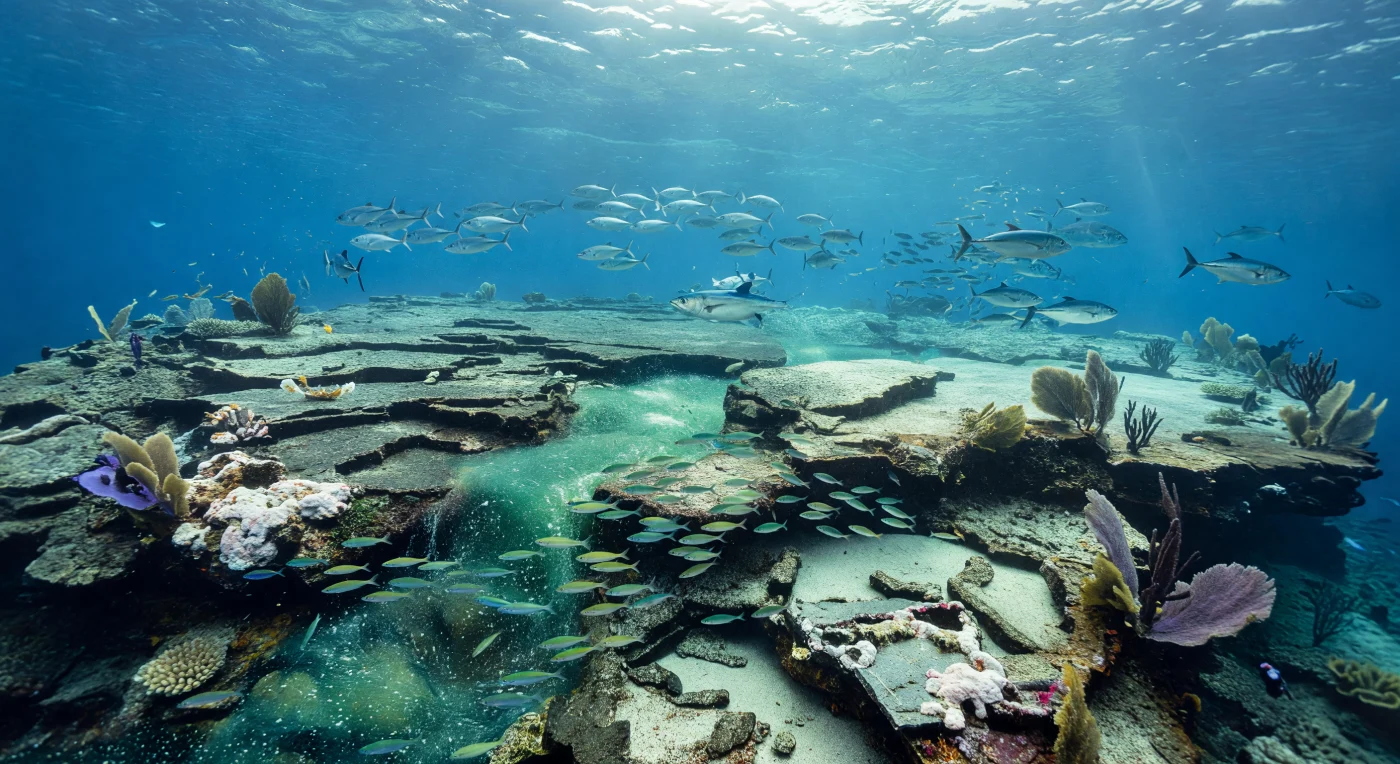
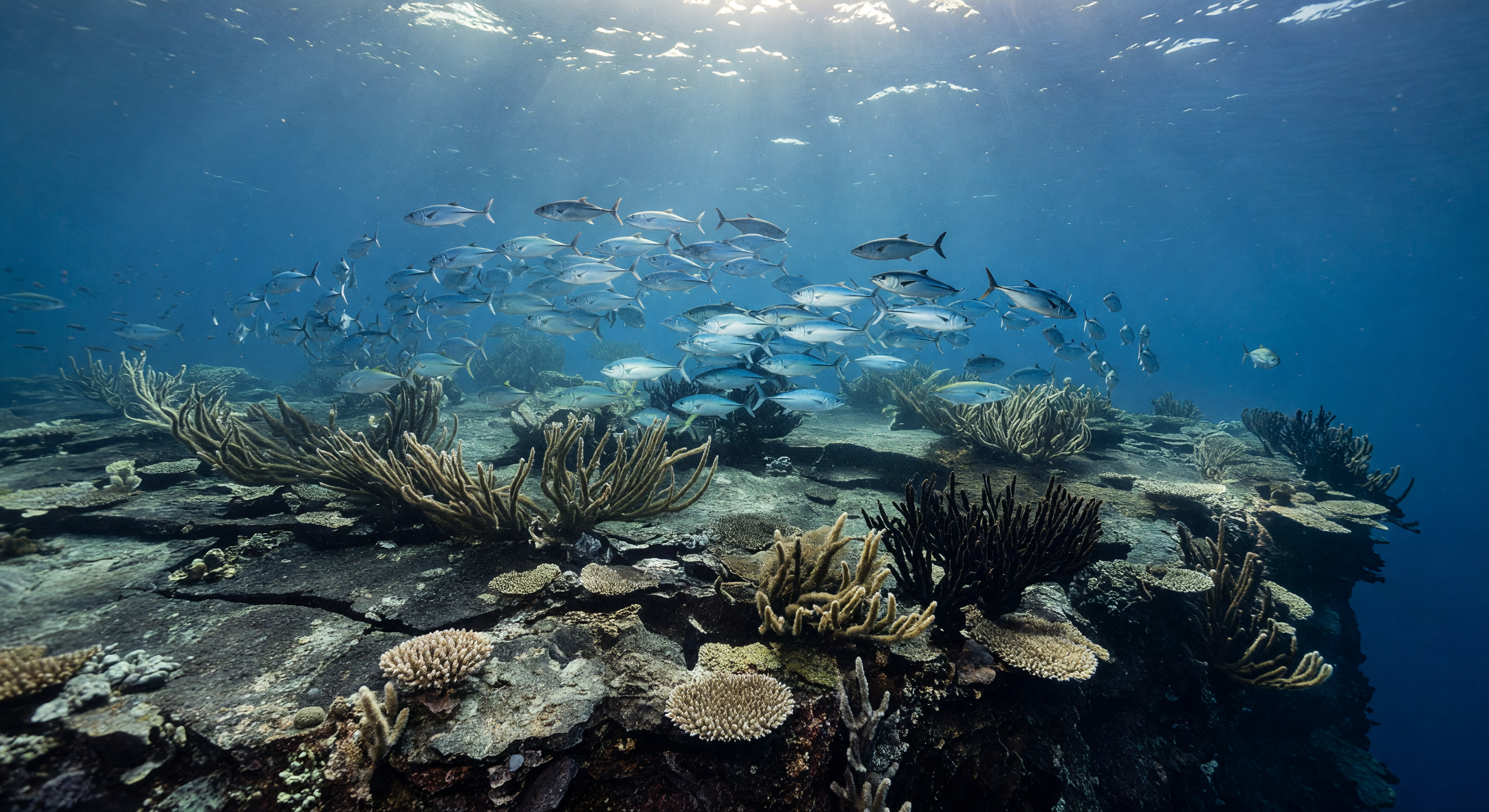
Sunlight pours down from above in shifting god rays, fracturing across the fractured basalt terraces of the seamount's summit plateau and throwing rippling caustics over cobalt and turquoise water dense with suspended plankton — a productive bloom that softens the column into pale green-blue and draws the entire food web upward into the shallows. At these depths, pressure barely exceeds a handful of atmospheres, yet the topography does extraordinary work: the seamount forces deep, nutrient-laden water upward through tidal pumping and internal-wave breaking, concentrating life at its crown with an intensity that rivals any coastal reef. Ribbons of small planktivores stream low over the encrusted lava ledges, flashing silver in the surge, while wheeling jacks and slashing tunas exploit the chaos above the drop-off where the summit rim falls in a sheer wall into the open blue. On the slightly deeper current-facing edges, gorgonian fans spread perpendicular to the flow and black coral colonies rise as dark branching silhouettes, their polyps extended to harvest the plankton tide sweeping past. This isolated volcanic pinnacle exists as a silent oasis in the open ocean — hard substrate, accelerated current, and concentrated sunlight conspiring to produce a density of life entirely out of proportion to anything the surrounding blue desert would suggest.
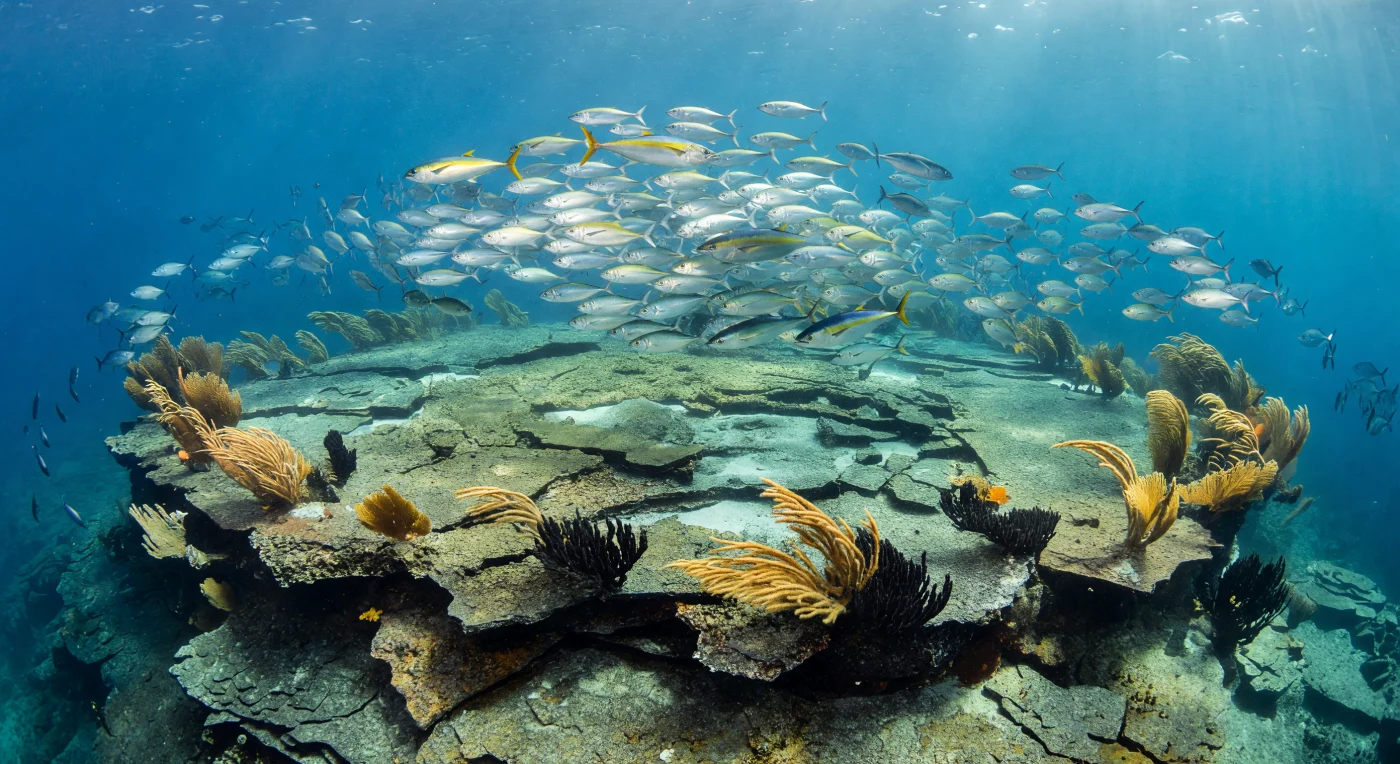
At the summit of a submerged volcanic mountain, morning sunlight penetrates the clear oceanic water in long, shifting god rays that sweep across fractured basalt and carbonate pavement, casting rippling caustic patterns over the hard substrate below. Above this current-swept plateau, a dense baitball of small silver fish — likely anchovies or sardine-like clupeids — twists and contracts into a living sphere, a collective survival response to the pressure of predation from every angle, while powerful yellowfin tuna (*Thunnus albacares*) — animals capable of sustaining burst speeds exceeding 70 kilometers per hour — carve bright, arcing passes through the school, their iridescent flanks flashing gold and steel in the unfiltered sunlight. Seamounts function as offshore oases in otherwise nutrient-sparse open water: hard substrate anchors filter feeders, the topography forces currents upward through a process known as topographic upwelling, concentrating zooplankton and the small fish that feed on them, which in turn draws successive tiers of predators including jacks wheeling in tight formation along the outer water column. Along the summit rim, gorgonian sea fans stream horizontally in the persistent flow, their polyps extended to intercept passing particles, while black corals colonize the slightly deeper ledges where the plateau breaks away into open ocean and light begins its long fade into cobalt. This is a world governed entirely by current, sunlight, and biology — a sunlit pinnacle poised over immense depth, pulsing with life that has no awareness of anything beyond the endless blue.
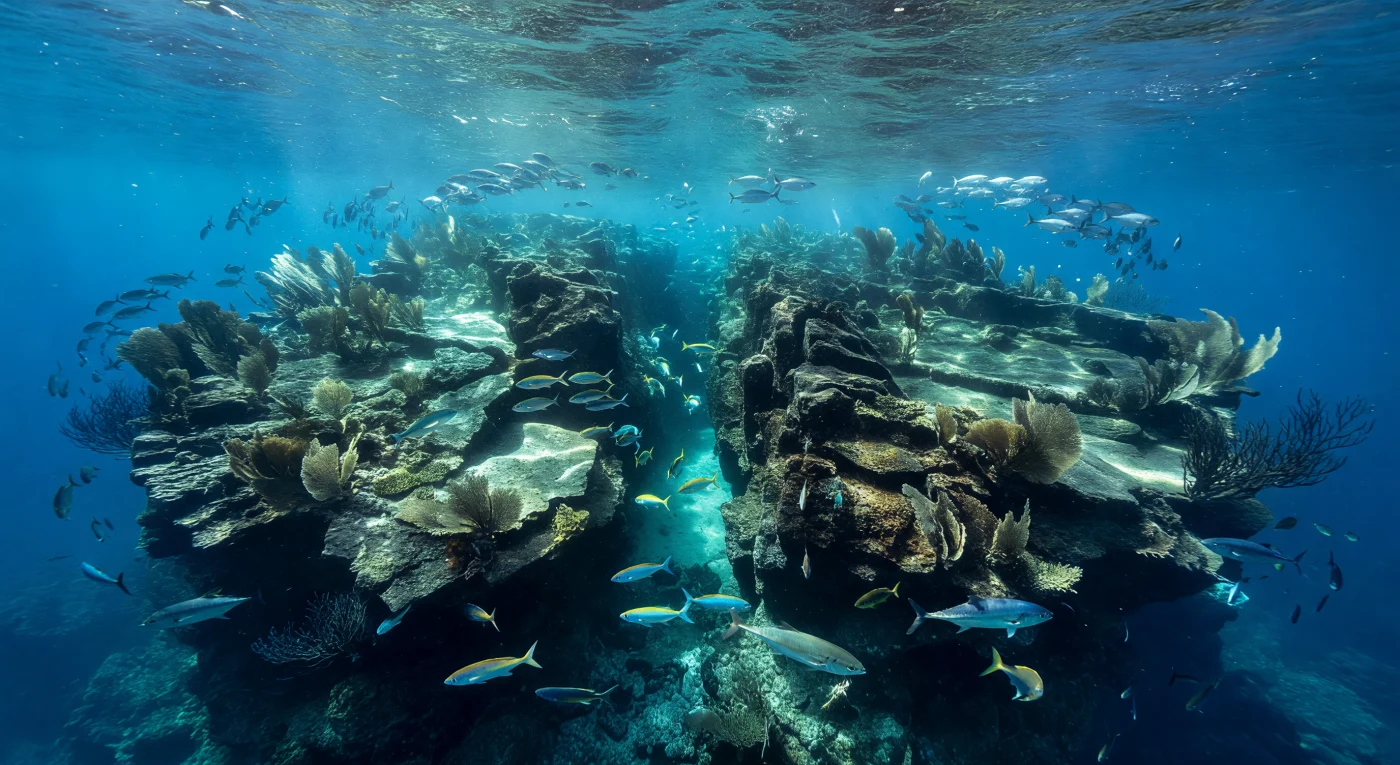
At the summit of a mid-ocean seamount, raw sunlight pours through the wave-broken surface and scatters into racing networks of caustic light that sweep continuously across the black basalt faces — volcanic rock fractured and weathered over millions of years into pinnacles, ledges, and narrow corridors where pale biogenic sand has quietly accumulated in pockets sheltered from the current. The seamount acts as a physical obstacle forcing nutrient-rich water upward through tidal pumping and internal-wave interaction, concentrating plankton in the illuminated column and drawing in cascading trophic layers: dense schools of jacks wheel and compress above the summit cap, rainbow runners cut in tight formation through the turquoise corridors between pinnacles, and larger tunas accelerate through baitfish near the abrupt drop-off where the cap falls steeply into open cobalt water and gorgonian fans — bent horizontal by persistent flow — give way to darker wire-form black coral colonies anchored on the cooler, dimmer rim. At this depth, pressure remains modest but the chemistry, the current, and the structural complexity of hard volcanic substrate conspire to make seamount summits among the most biologically concentrated environments in the open ocean, oases entirely of their own making, operating on their own timescales in water that was never meant to be witnessed.
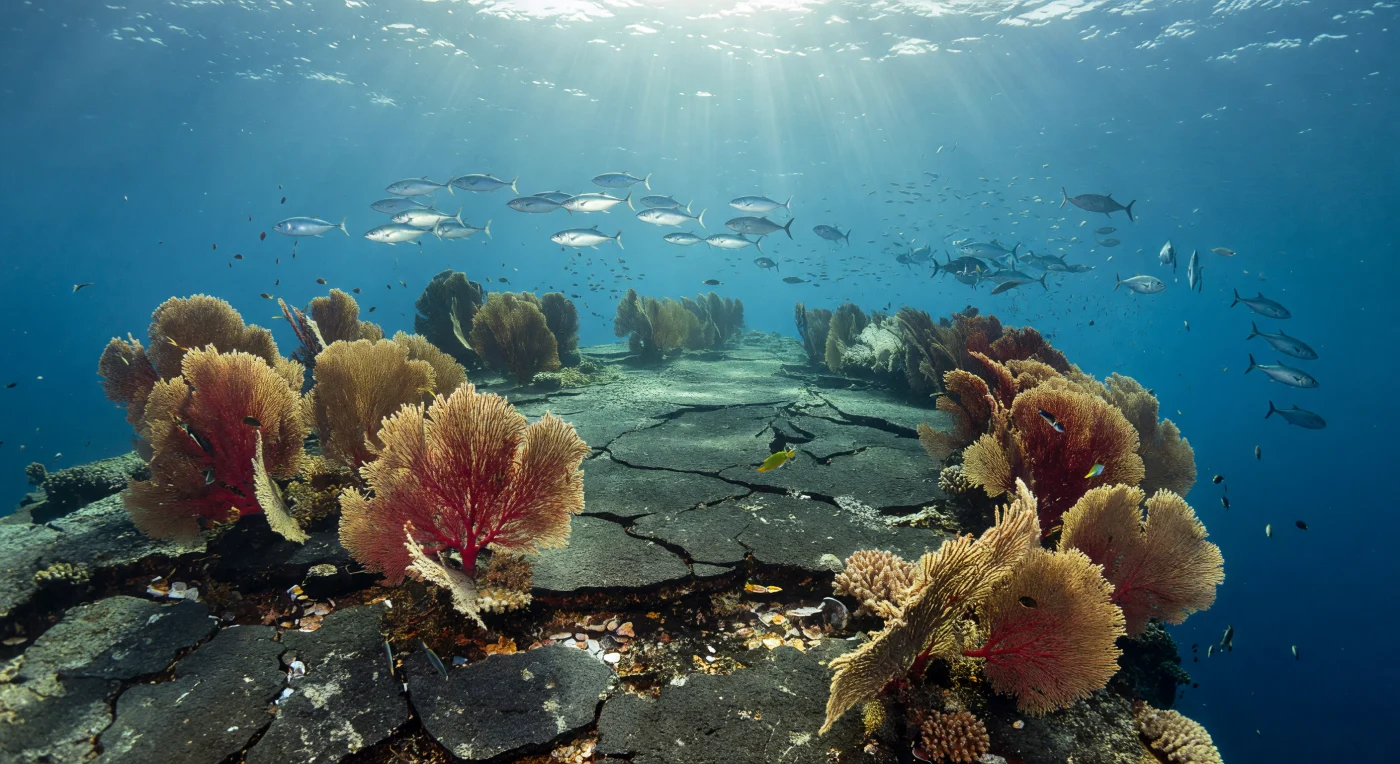
Along a wind-scoured basalt ledge at the crown of a submerged volcanic mountain, persistent oceanic current has stripped the rock bare, leaving fractured stone and pale coralline crust exposed to one of the ocean's most productive collisions — hard substrate meeting open-water flow in full sunlight. At roughly 35 to 50 metres, pressure runs between four and six atmospheres, yet the water remains brilliantly oxygenated and clear, sunlight entering from above at a steep slant that sculpts the scene in god rays and shifting caustic patterns, all warm colours still vivid at close range before fading naturally into deep cobalt over the abrupt drop-off at the ledge's outer rim. Dense ranks of red and gold gorgonians, each fan a colony of thousands of polyps extended to harvest plankton from the current, bend uniformly downflow in a living record of the seamount's dominant hydrodynamics — their orientations as reliable as a compass needle, shaped over decades of unrelenting flow. Above the plateau, a wheeling bank of carangues turns in synchrony, their mirrored flanks catching sunlight in stroboscopic flashes, while beyond the edge, sleek tunas accelerate through concentrated baitfish in brief, explosive strikes — the seamount functioning exactly as seamounts do worldwide, as an offshore oasis where topographic upwelling and tidal pumping concentrate life into one of the ocean's most densely animated, entirely self-sufficient theatres.
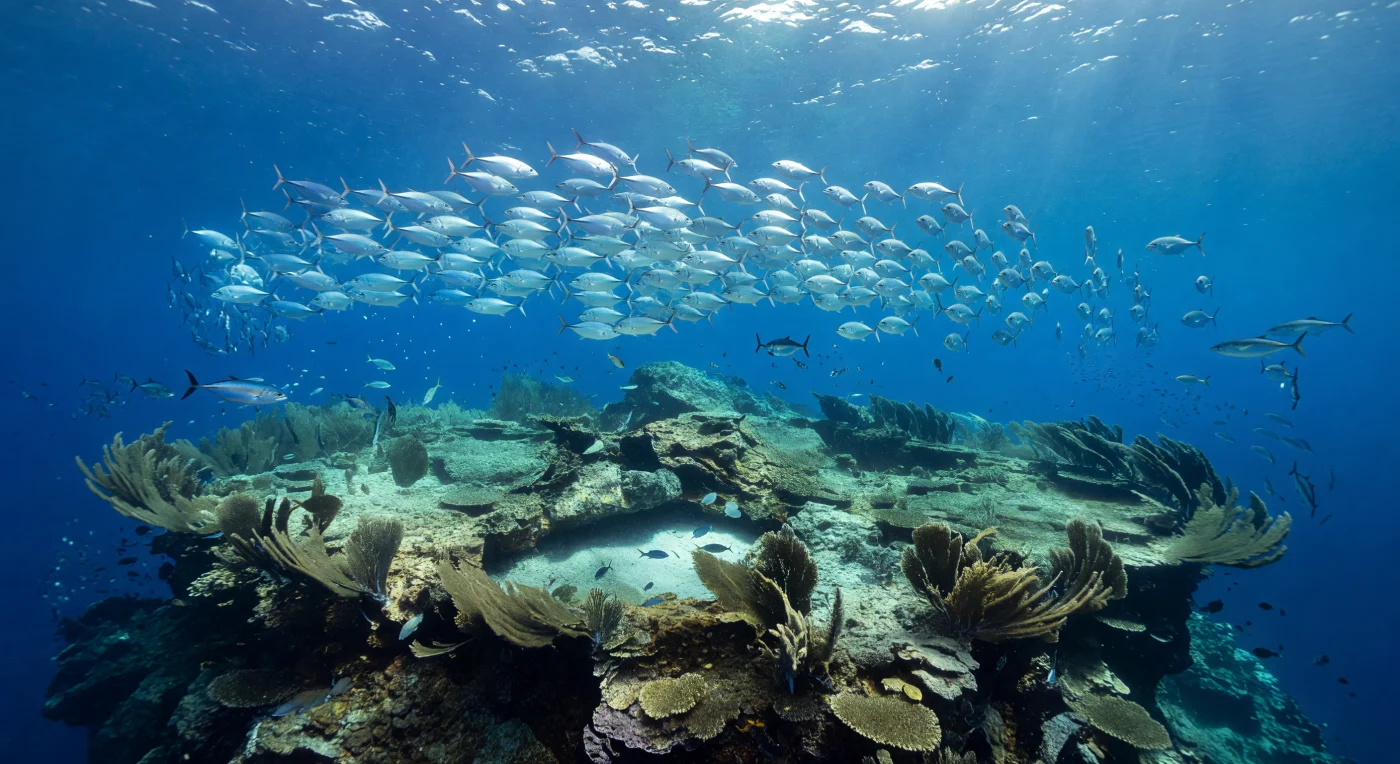
Sunlight pours from above in long, diverging rays through water of extraordinary oceanic clarity, scattering faintly off suspended plankton and painting the seamount summit in shifting blues and silver. The volcanic cap itself is a current-swept basalt and carbonate plateau, its fractured ledges crusted with coralline growth, gorgonians streaming outward from the upcurrent rim, and black corals anchoring to the steepening drop-off where the plateau falls abruptly into open ultramarine. Several meters above this hard substrate, a vaulted mass of carangids rotates in perfect collective unison — whole living panels of the school catching the sunlight in a simultaneous mirror-flash of silver before folding back into blue-green translucence, a behaviour driven by predator pressure as powerful tunas slice through the outer margin of the shoal in coordinated hunting passes. At this depth, pressure remains well below ten atmospheres, yet the seamount functions as an isolated offshore oasis: the abrupt topography forces nutrient-rich water upward through tidal pumping and internal-wave interaction, concentrating plankton, attracting baitfish, and drawing apex predators to a summit that rises from the surrounding ocean floor like a lone mountain from a dark plain. Here, thousands of kilometres from any coast, life clusters around hard substrate and accelerated flow in a luminous, tensely balanced moment that owes nothing to any outside witness.
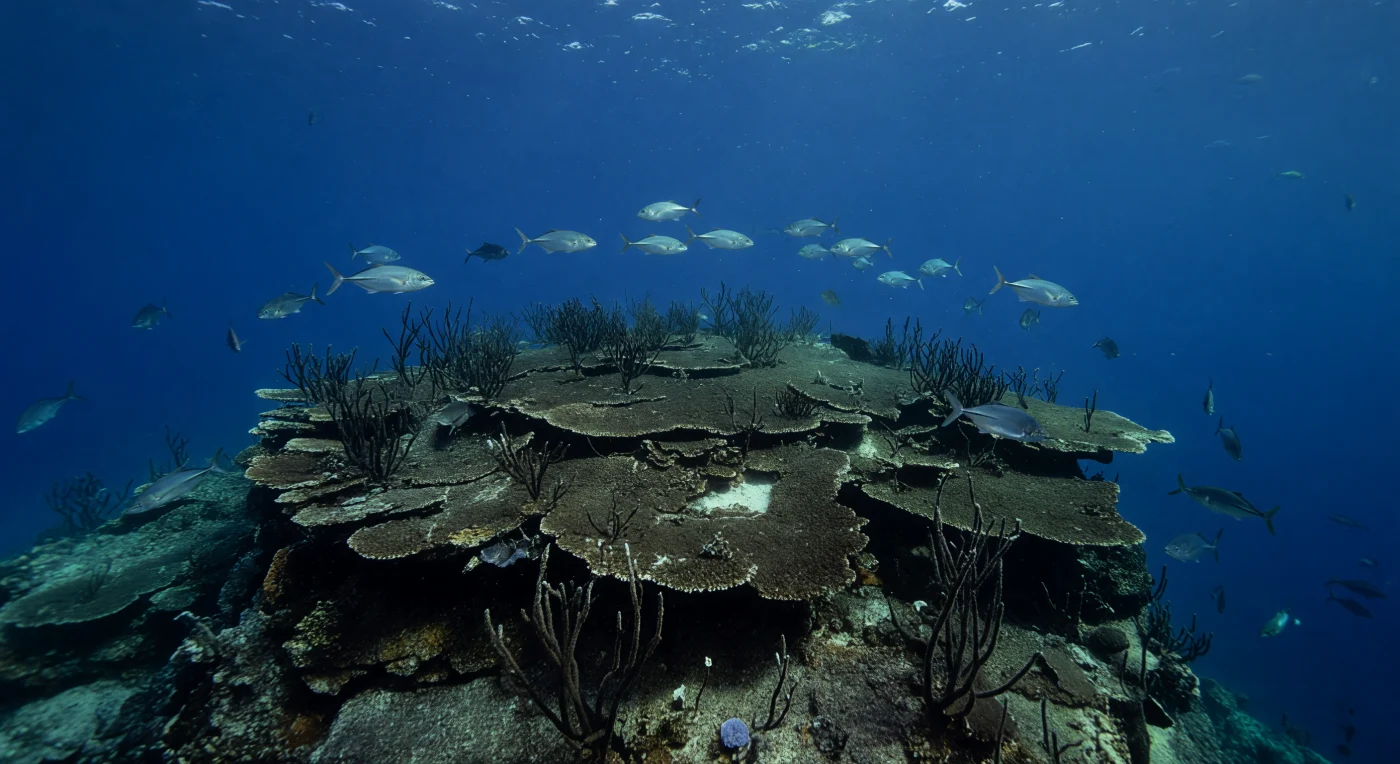
At the summit rim of a submerged volcanic mountain, residual sunlight descends through hundreds of meters of open ocean water and arrives here as a diffuse cobalt wash, its warmer wavelengths long since absorbed, leaving only cool blue to paint every surface. The basalt shelves beneath are fractured relics of ancient eruption, their hard substrate colonized by antipatharian black corals — wiry, patient suspension feeders that exploit the persistent current sweeping over the rim, each branching colony a living archive of slow oceanic time. Pressure here, perhaps ten to fifteen atmospheres, compresses the water column into crystalline clarity, so that fine particulate matter drifts visibly in the ambient light, tracing the current's direction like slow breath. Above the coral thickets, a loose aggregation of carangid jacks holds station against the flow, their laterally compressed bodies flashing cold silver as they intercept any concentration of smaller organisms the seamount's topographic upwelling pushes toward the surface. This is a classical seamount oasis — hard volcanic relief acting as an offshore island of productivity in otherwise oligotrophic open ocean, organizing life in its currents without any awareness that it does so, existing in the same patient way it has for millions of years.
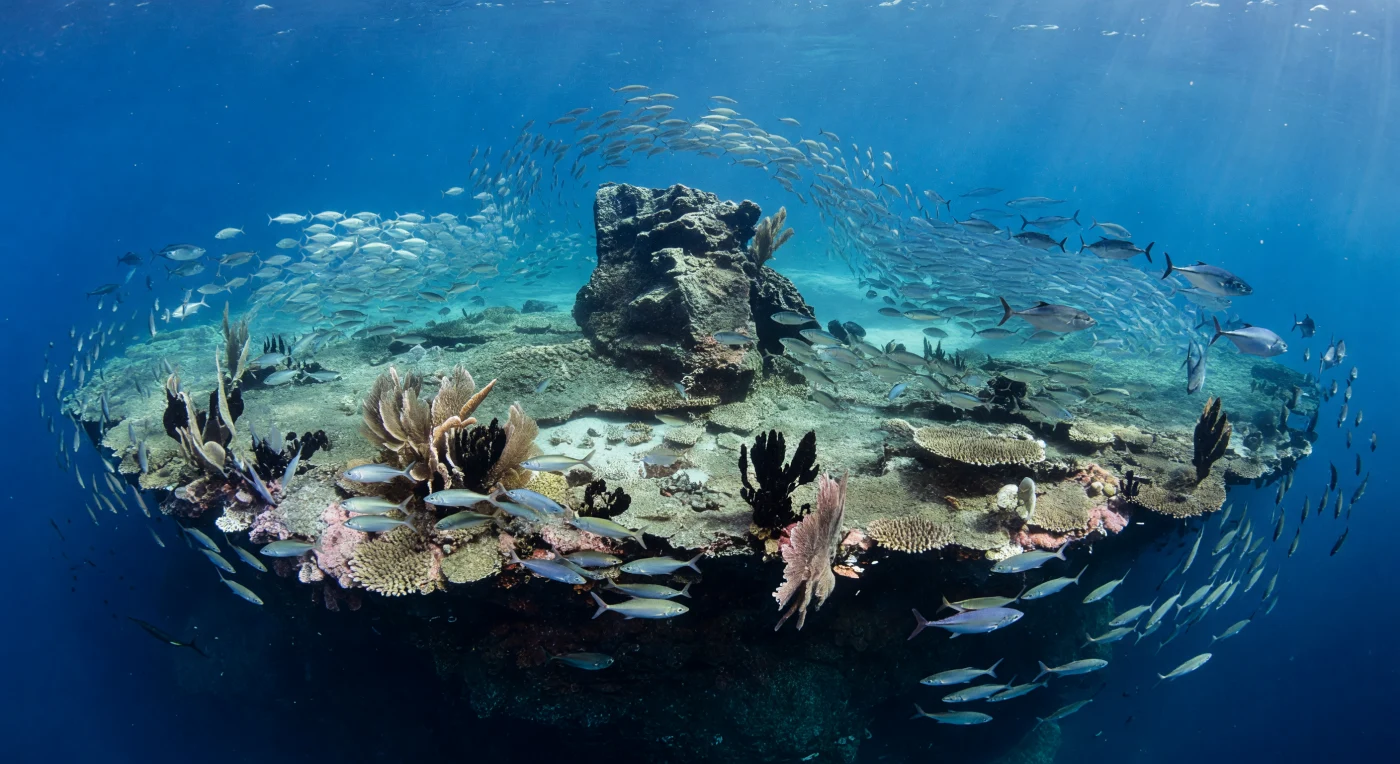
At the crest of a mid-ocean seamount, a blunt spire of fractured basalt cleaves the prevailing current, and in its lee a turquoise eddy spins slowly inward, cradling thousands of small silver fish in a trembling, self-organizing veil. Each individual hangs at the precise tension between shelter and flow, their scales catching the oblique shafts of sunlight that lance down from the bright surface above, refracting into shifting caustic patterns across the volcanic rock below. Where the eddy dissolves at the summit edge, the outer ranks of the school are peeled away by the faster water and swept back over the rim, where the plateau drops without warning into colder, darker cobalt — a sudden vertical wilderness that begins just meters from the sunlit cap. Above, jacks wheel in loose, purposeful arcs, their flanks strobing white when they bank into the light, while larger tunas drive through the bait cloud in tight, explosive passes, each strike sending a pulse of turbulence rippling outward through the column. The seamount summit functions as an open-ocean oasis: hard basaltic substrate, gorgonians streaming from current-facing ledges, pink coralline crusts cementing every horizontal surface, and the perpetual upward flux of nutrient-rich water stirred by tidal pumping and internal waves breaking against the topography — a place where the geometry of the seafloor reaches up to intercept the sunlit world, concentrating life in the otherwise empty blue.
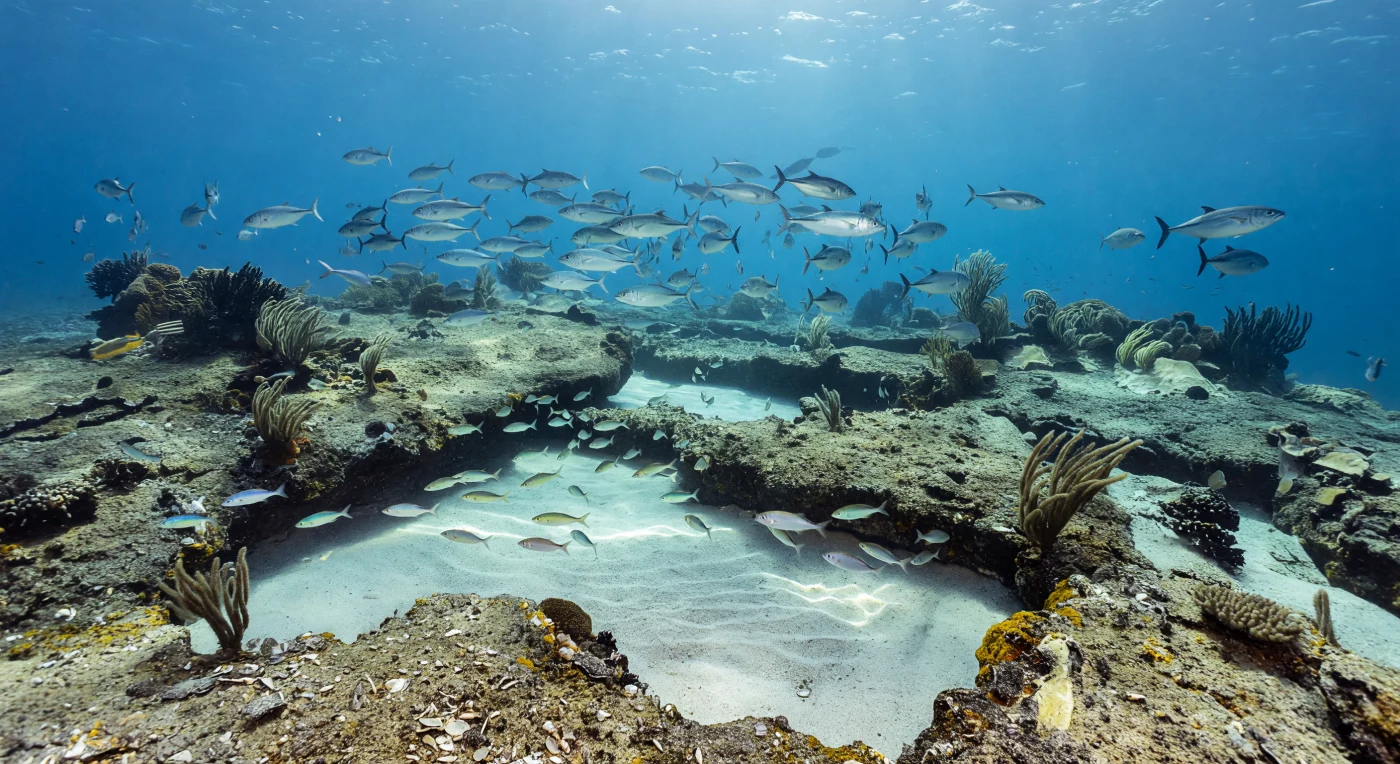
At the crest of a submerged volcanic mountain, sunlight pours through tens of meters of clear open-ocean water, fracturing into shifting caustic nets that slide across pale shell sand gathered in rippled hollows between hard, current-polished ridges of basalt and carbonate-encrusted rock. The summit rises close enough to the surface that the water column above carries a vivid blue-green clarity, fine plankton and shell fragments suspended in it like slow-drifting snow, while each tidal pulse sculpts the sand into new crescent ripples without ever quite settling them. Schools of small silver fish skim the boundary between sand and stone, flashing in broken coins of reflected light, and above them a wheeling aggregation of jacks banks and tilts across the plateau, their flanks catching the sun in staggered bursts as tunas drive through the outer margin of the school with the taut economy of open-water predators. On the current-facing ridges, gorgonian fans stream outward into the flow, and where the hard substrate begins its steep drop into deeper cobalt water, black coral colonies cling to the shaded rim — the seamount functioning, as it always has, as an offshore oasis where topography concentrates current, current concentrates plankton, and plankton draws every tier of the food web upward into the light.
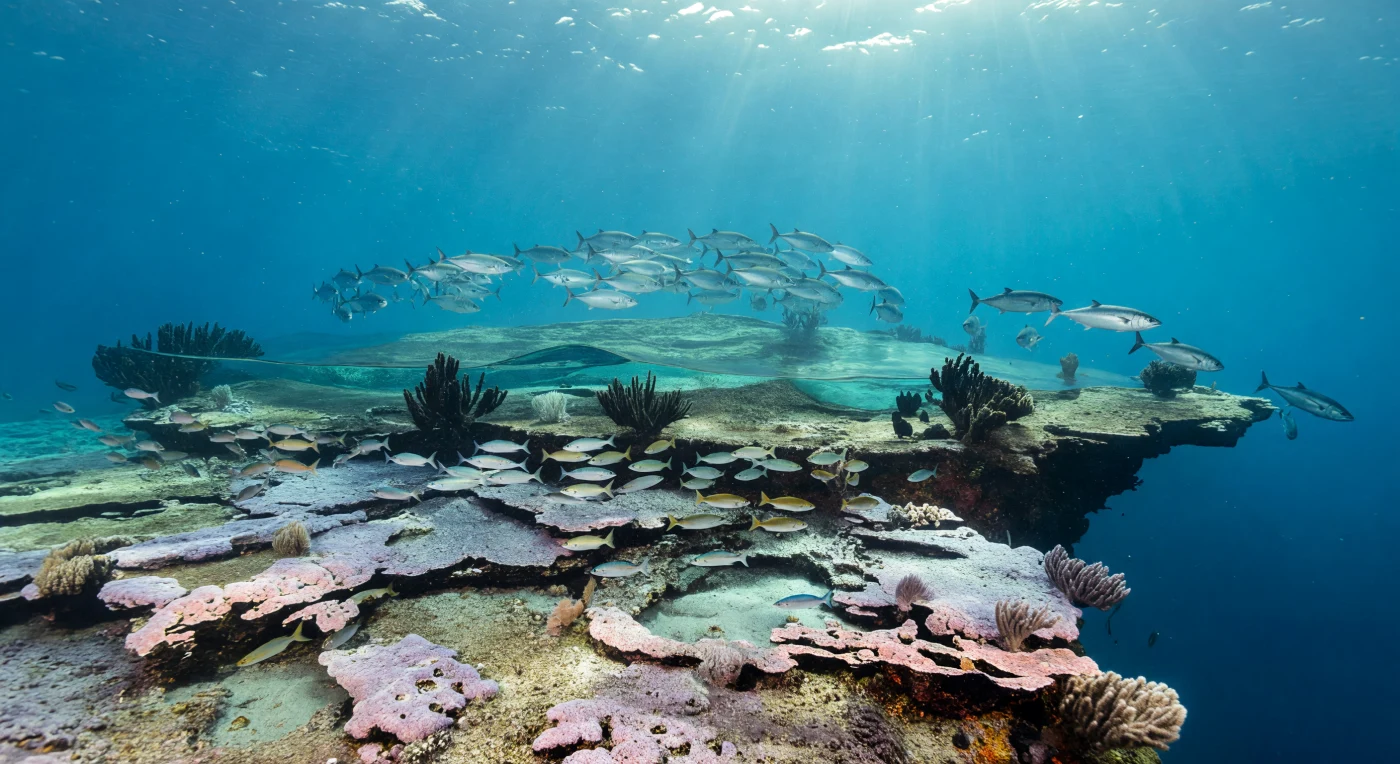
At 40 to 60 metres above the flanks of a submerged volcanic mountain, the seamount's fractured basalt plateau rises into one of the ocean's most productive collisions — between sunlit, nutrient-poor surface water and the cold, dense upwelling that the seamount's own bulk forces upward from below. Here, pink and lavender coralline algae paint the carbonate pavement in muted pastels, while gorgonian fans stream in unison from the summit rim, every polyp extended into the accelerating current to harvest the plankton it carries. A translucent cobalt lens of upwelled water — denser and perhaps three to five degrees cooler than the sunlit layer above — slides across the crest like a slow exhalation, sharpening a vivid colour boundary in the water column as warmer turquoise yields to saturated blue-green and then deep ultramarine where the plateau drops abruptly into open ocean. In that accelerated flow, compact schools of small baitfish hold centimetres above the rock with precise upstream angles, their silver flanks catching the caustic shimmer of sunshafts descending through exceptionally clear oceanic water, while a wheeling bank of jacks and the swift, muscular passes of hunting tuna above them reveal why seamount summits function as offshore oases — hard substrate, concentrated plankton, and channelled current conspiring to pull the entire food web upward into the light.
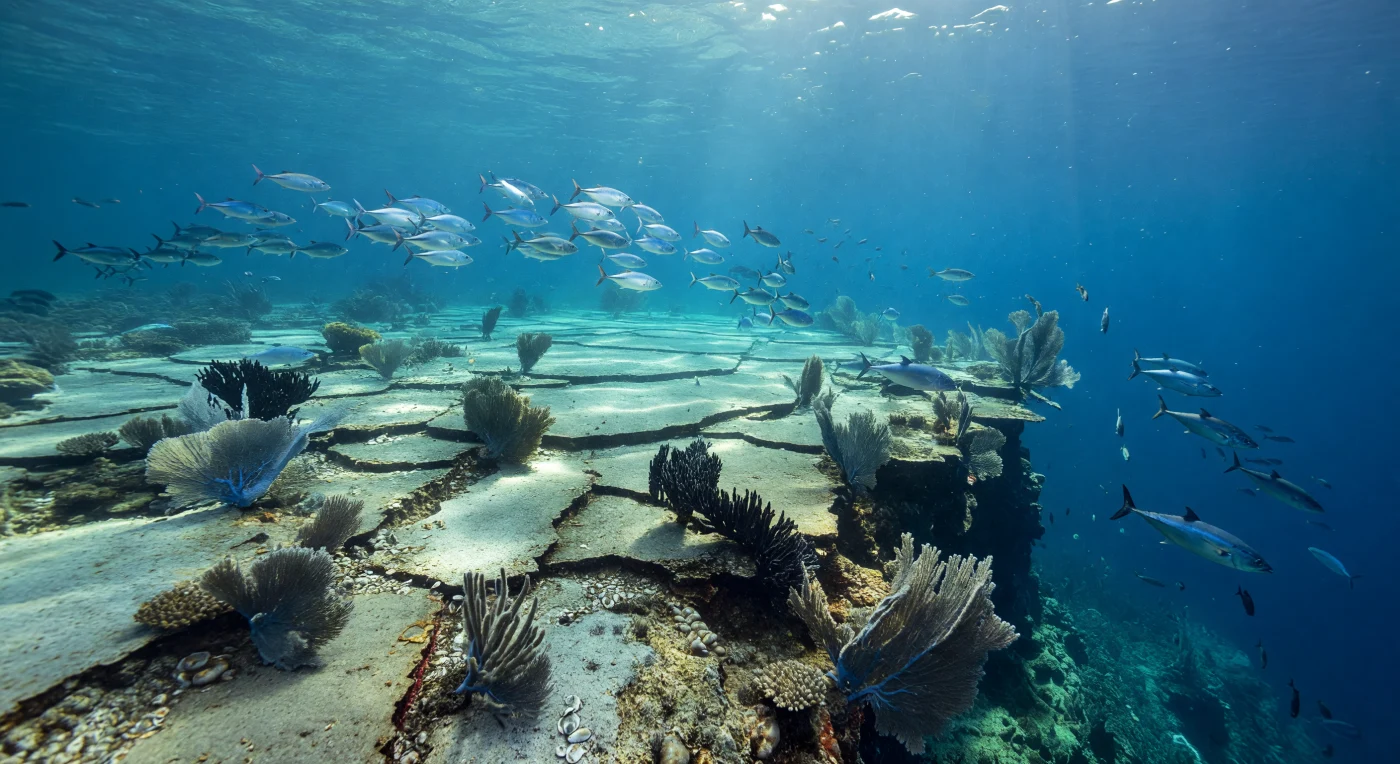
Late afternoon sunlight descends through the open ocean in long, angled shafts, striking a stepped terrace of pale carbonate pavement at the summit of a submerged volcanic mountain somewhere far from any coast — a place of pure oceanic geometry, where ancient lava has been planed, fractured, and colonized over geological time into layered ledges and fissured slabs. At this shallow depth, pressure remains modest and the full spectrum of daylight still penetrates, casting soft caustic patterns across coralline crusts and shell-grit pockets while branching gorgonian sea fans along the terrace rim throw cool blue shadows over the encrusted stone, their polyps extended into the passing current to intercept the fine rain of plankton drifting seaward from the sunlit surface above. Dense schools of jacks wheel in tight silver formations over the hard substrate, their flanks flashing white and blue as they bank and turn in unison, a behavior shaped by the seamount's gift of concentrated food and the constant presence of fast-moving predators — sleek tunas that slash through scattered baitfish near the drop-off with the unhurried precision of animals at the top of a self-sustaining food web. At the terrace edge, the carbonate pavement simply ends, and the first sprays of black coral mark the transition to open ultramarine, the summit cliff descending into a depth of blue that belongs entirely to the sea — a world that has persisted, hunted, grown, and died in its own rhythms long before and entirely apart from any witness.