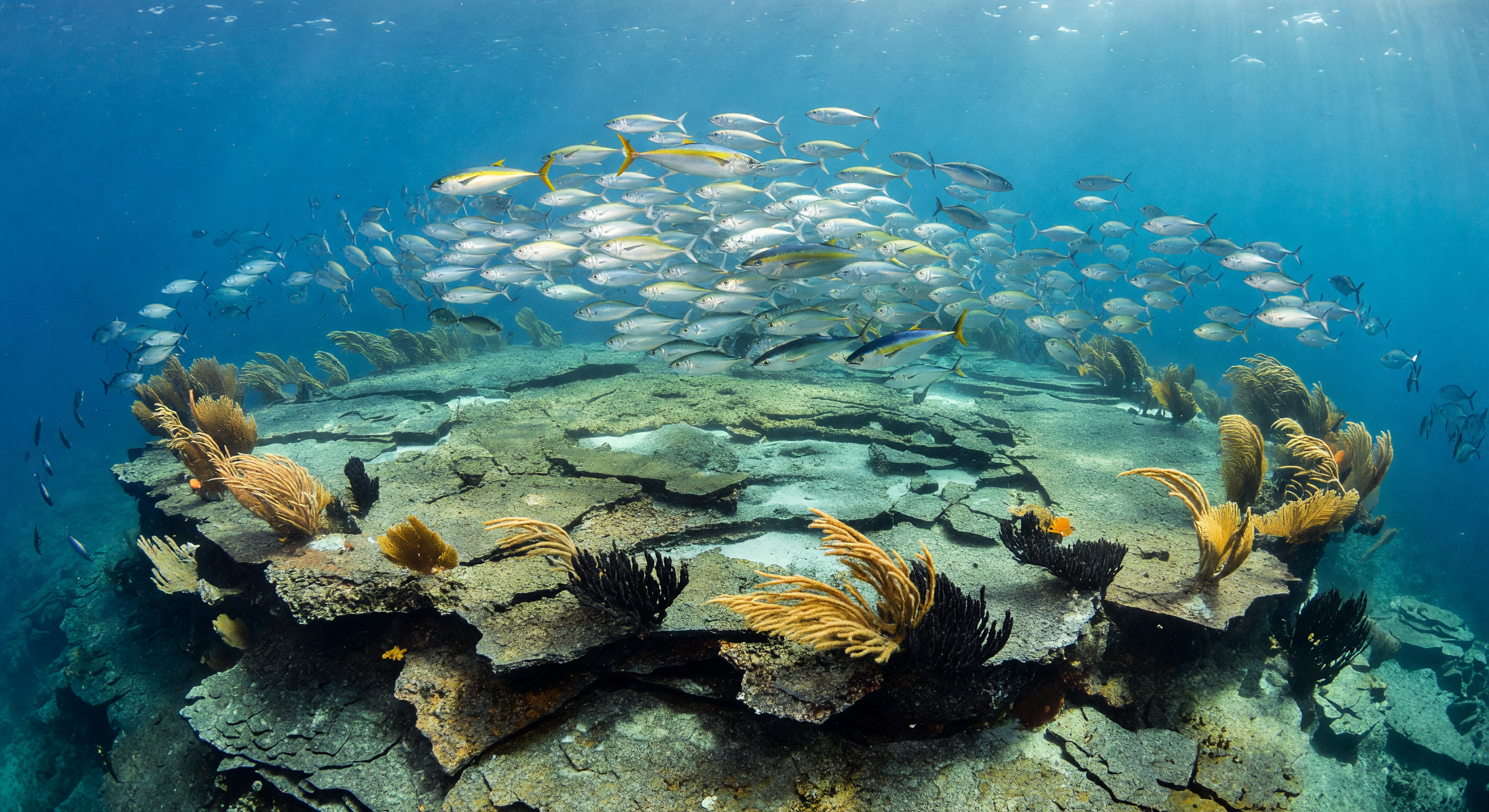
At the summit of a submerged volcanic mountain, morning sunlight penetrates the clear oceanic water in long, shifting god rays that sweep across fractured basalt and carbonate pavement, casting rippling caustic patterns over the hard substrate below. Above this current-swept plateau, a dense baitball of small silver fish — likely anchovies or sardine-like clupeids — twists and contracts into a living sphere, a collective survival response to the pressure of predation from every angle, while powerful yellowfin tuna (*Thunnus albacares*) — animals capable of sustaining burst speeds exceeding 70 kilometers per hour — carve bright, arcing passes through the school, their iridescent flanks flashing gold and steel in the unfiltered sunlight. Seamounts function as offshore oases in otherwise nutrient-sparse open water: hard substrate anchors filter feeders, the topography forces currents upward through a process known as topographic upwelling, concentrating zooplankton and the small fish that feed on them, which in turn draws successive tiers of predators including jacks wheeling in tight formation along the outer water column. Along the summit rim, gorgonian sea fans stream horizontally in the persistent flow, their polyps extended to intercept passing particles, while black corals colonize the slightly deeper ledges where the plateau breaks away into open ocean and light begins its long fade into cobalt. This is a world governed entirely by current, sunlight, and biology — a sunlit pinnacle poised over immense depth, pulsing with life that has no awareness of anything beyond the endless blue.
Seamount summit