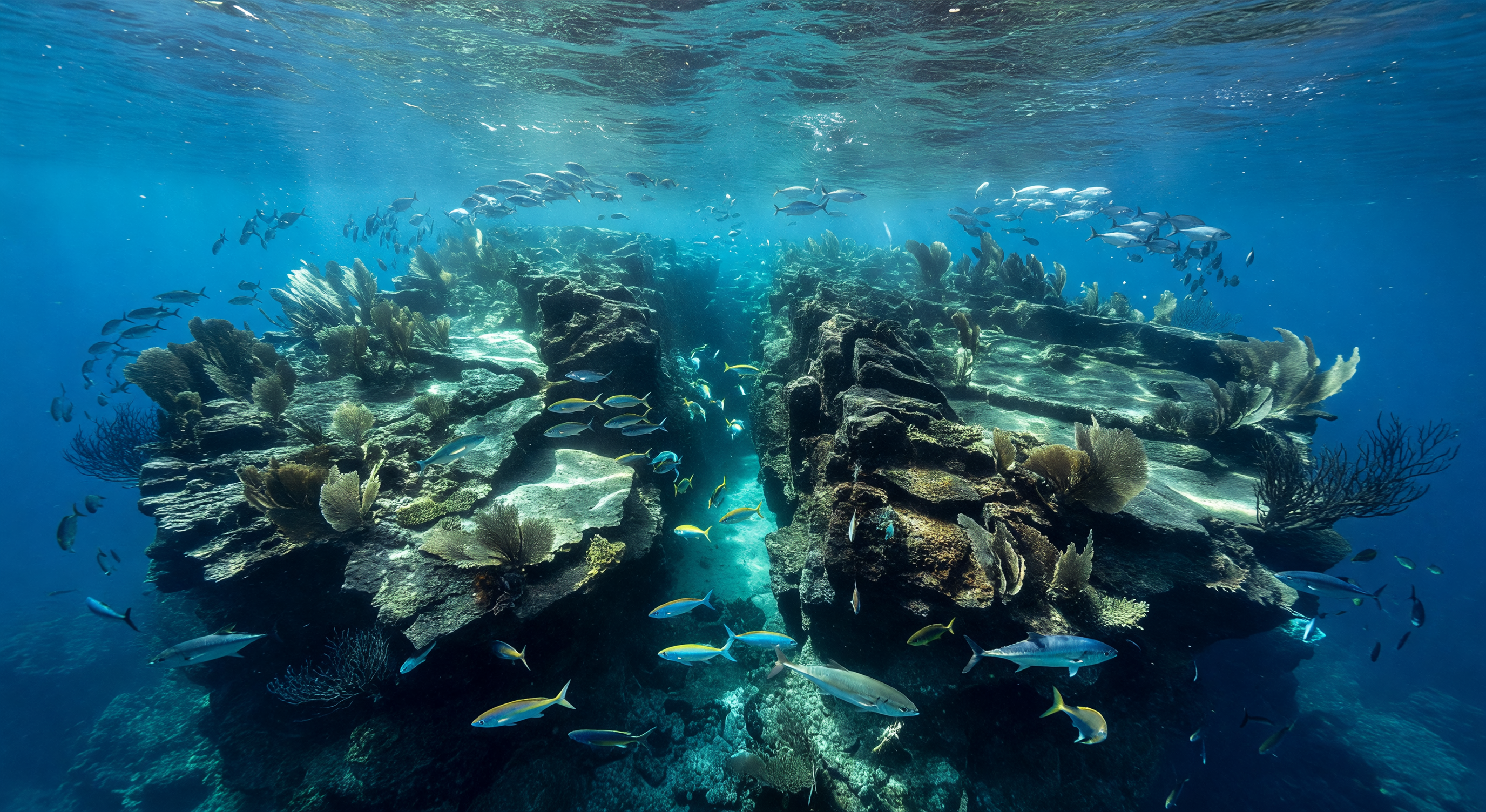
At the summit of a mid-ocean seamount, raw sunlight pours through the wave-broken surface and scatters into racing networks of caustic light that sweep continuously across the black basalt faces — volcanic rock fractured and weathered over millions of years into pinnacles, ledges, and narrow corridors where pale biogenic sand has quietly accumulated in pockets sheltered from the current. The seamount acts as a physical obstacle forcing nutrient-rich water upward through tidal pumping and internal-wave interaction, concentrating plankton in the illuminated column and drawing in cascading trophic layers: dense schools of jacks wheel and compress above the summit cap, rainbow runners cut in tight formation through the turquoise corridors between pinnacles, and larger tunas accelerate through baitfish near the abrupt drop-off where the cap falls steeply into open cobalt water and gorgonian fans — bent horizontal by persistent flow — give way to darker wire-form black coral colonies anchored on the cooler, dimmer rim. At this depth, pressure remains modest but the chemistry, the current, and the structural complexity of hard volcanic substrate conspire to make seamount summits among the most biologically concentrated environments in the open ocean, oases entirely of their own making, operating on their own timescales in water that was never meant to be witnessed.
Other languages
- Français: Labyrinthe de Pics Caustiques
- Español: Laberinto de Pináculos Cáusticos
- Português: Labirinto de Pináculo Cáustico
- Deutsch: Kaustisches Gipfel Labyrinth
- العربية: متاهة القمم اللاسعة
- हिन्दी: कास्टिक शिखर भूलभुलैया
- 日本語: 光の波紋と岩峰迷路
- 한국어: 가성 첨봉 미로
- Italiano: Labirinto di Pinnacoli Caustici
- Nederlands: Caustisch Pinnakel Doolhof