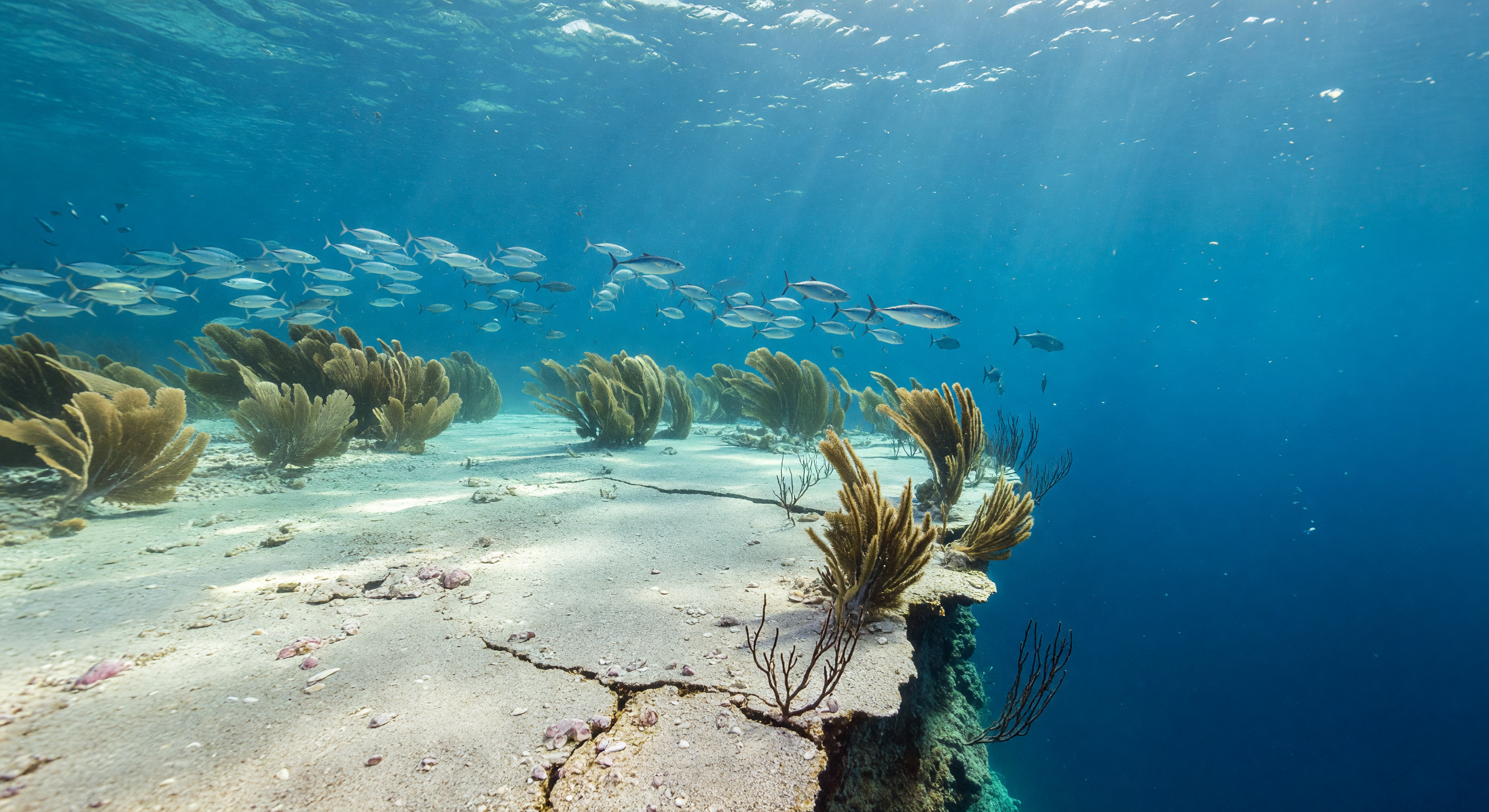
At the edge of an ancient drowned volcano, the carbonate pavement of a guyot stretches flat and pale — cream and ash-gray limestone planed smooth by wave action millions of years ago when this summit still broke the surface, now resting perhaps fifty to eighty meters below in the full flood of tropical sunlight. Caustic light ripples across the hard substrate in shifting golden nets, animating patches of encrusting coralline algae and fractured ledge, while god rays lance down through extraordinarily clear oceanic water carrying fine marine snow in slow suspension. At the rim, where the plateau ends with geological abruptness, tawny gorgonian fans lean uniformly into the persistent current — each one a passive filter feeding on the plankton-laden flow that seamount topography concentrates and accelerates — and sparse black coral branches rise from cracks along the very lip, their wiry forms silhouetted against a sheer drop of open cobalt where the volcanic flank falls away into featureless blue. Above this threshold, dense banks of carangues wheel and flash in silver-white arcs, their schooling behavior tightening instinctively as large yellowfin tunas drive through in sharp predatory passes, exploiting the seamount's role as an open-ocean oasis where hard substrate, upwelled nutrients, and aggregated prey converge in a self-sustaining cycle that has operated, unwitnessed and complete, across geological time.
Seamount summit