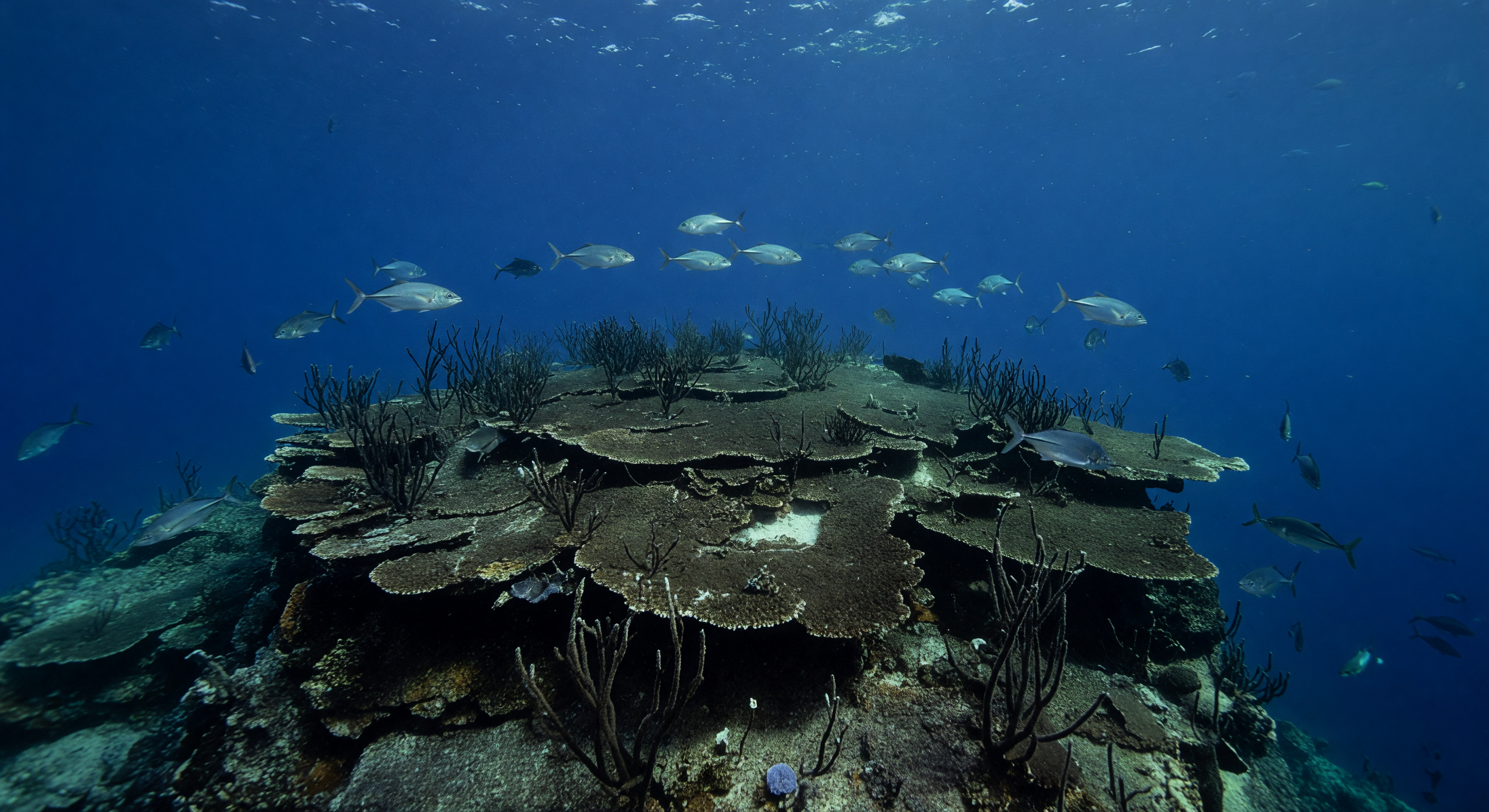
At the summit rim of a submerged volcanic mountain, residual sunlight descends through hundreds of meters of open ocean water and arrives here as a diffuse cobalt wash, its warmer wavelengths long since absorbed, leaving only cool blue to paint every surface. The basalt shelves beneath are fractured relics of ancient eruption, their hard substrate colonized by antipatharian black corals — wiry, patient suspension feeders that exploit the persistent current sweeping over the rim, each branching colony a living archive of slow oceanic time. Pressure here, perhaps ten to fifteen atmospheres, compresses the water column into crystalline clarity, so that fine particulate matter drifts visibly in the ambient light, tracing the current's direction like slow breath. Above the coral thickets, a loose aggregation of carangid jacks holds station against the flow, their laterally compressed bodies flashing cold silver as they intercept any concentration of smaller organisms the seamount's topographic upwelling pushes toward the surface. This is a classical seamount oasis — hard volcanic relief acting as an offshore island of productivity in otherwise oligotrophic open ocean, organizing life in its currents without any awareness that it does so, existing in the same patient way it has for millions of years.
Other languages
- Français: Jardin Corallien Bleu Résiduel
- Español: Jardín Coralino Azul Residual
- Português: Jardim de Coral Azul Residual
- Deutsch: Verbliebener Blauer Korallengarten
- العربية: حديقة المرجان الأزرق المتبقي
- हिन्दी: अवशिष्ट नीला प्रवाल उद्यान
- 日本語: 残存する青いサンゴの庭
- 한국어: 잔존하는 푸른 산호 정원
- Italiano: Giardino Corallino Blu Residuale
- Nederlands: Resterend Blauw Koraaltuinen