Sunlight pours from above in long, diverging rays through water of extraordinary oceanic clarity, scattering faintly off suspended plankton and painting the seamount summit in shifting blues and silver. The volcanic cap itself is a current-swept basalt and carbonate plateau, its fractured ledges crusted with coralline growth, gorgonians streaming outward from the upcurrent rim, and black corals anchoring to the steepening drop-off where the plateau falls abruptly into open ultramarine. Several meters above this hard substrate, a vaulted mass of carangids rotates in perfect collective unison — whole living panels of the school catching the sunlight in a simultaneous mirror-flash of silver before folding back into blue-green translucence, a behaviour driven by predator pressure as powerful tunas slice through the outer margin of the shoal in coordinated hunting passes. At this depth, pressure remains well below ten atmospheres, yet the seamount functions as an isolated offshore oasis: the abrupt topography forces nutrient-rich water upward through tidal pumping and internal-wave interaction, concentrating plankton, attracting baitfish, and drawing apex predators to a summit that rises from the surrounding ocean floor like a lone mountain from a dark plain. Here, thousands of kilometres from any coast, life clusters around hard substrate and accelerated flow in a luminous, tensely balanced moment that owes nothing to any outside witness.
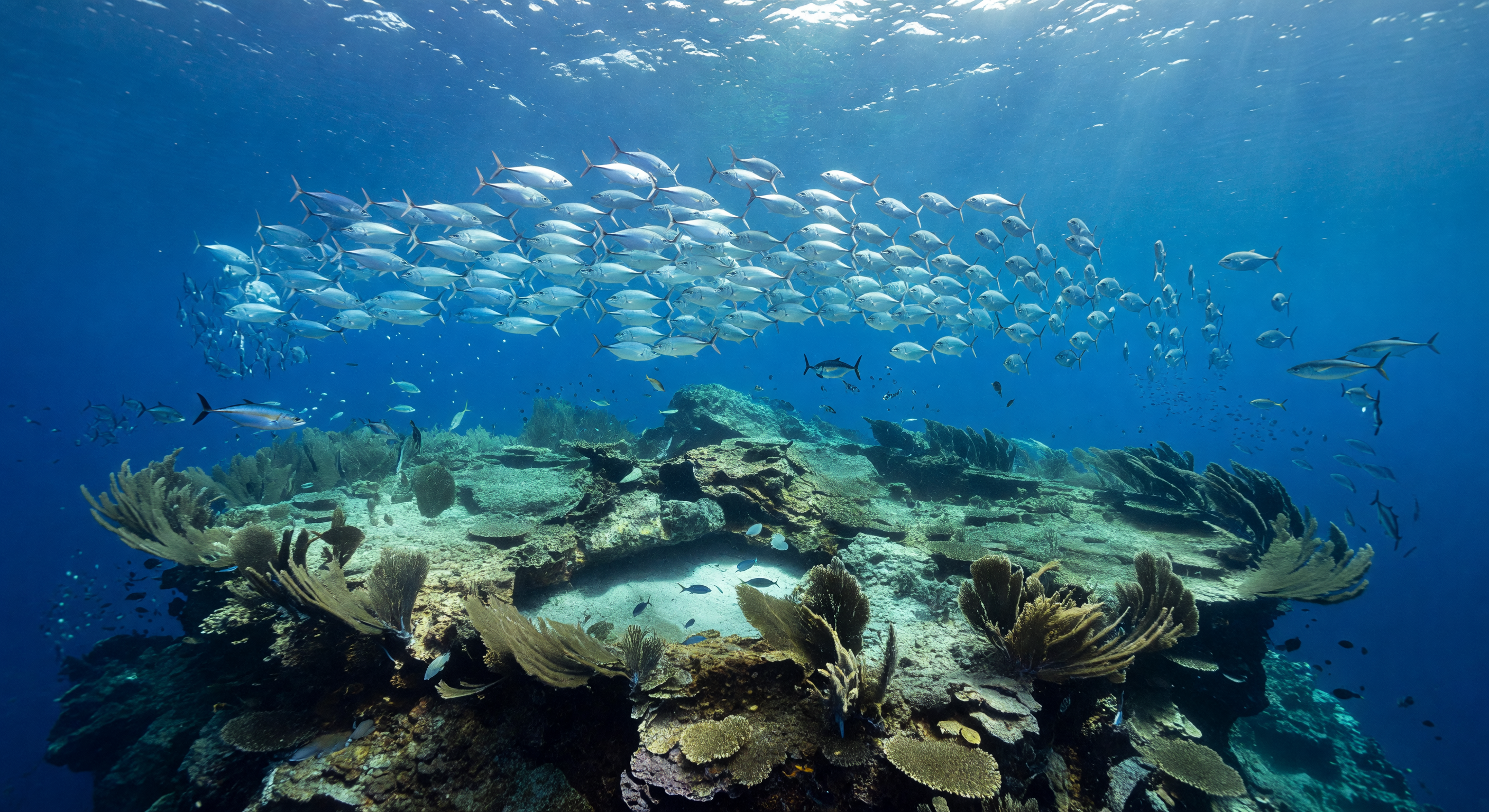
Seamount summit