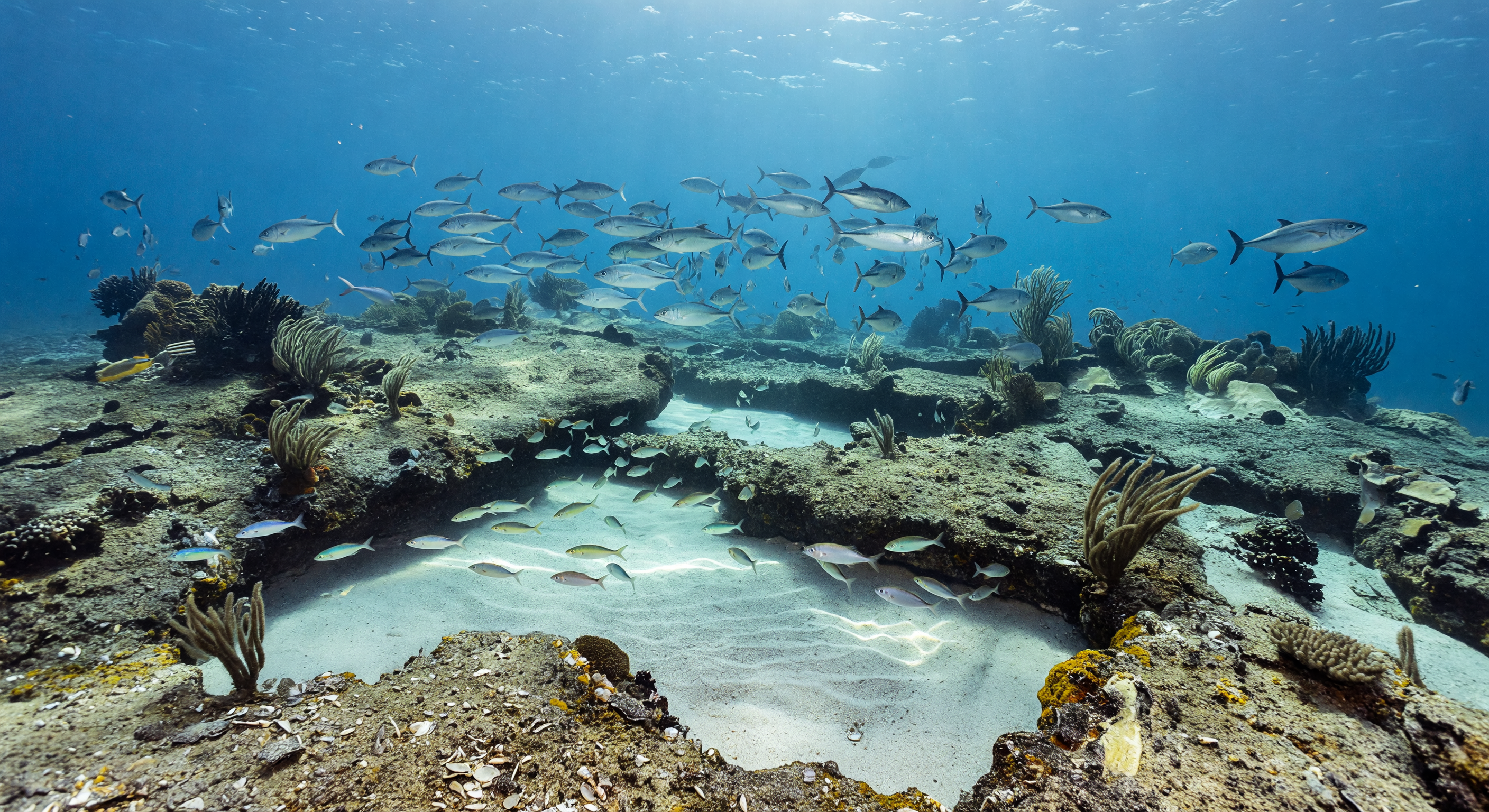
At the crest of a submerged volcanic mountain, sunlight pours through tens of meters of clear open-ocean water, fracturing into shifting caustic nets that slide across pale shell sand gathered in rippled hollows between hard, current-polished ridges of basalt and carbonate-encrusted rock. The summit rises close enough to the surface that the water column above carries a vivid blue-green clarity, fine plankton and shell fragments suspended in it like slow-drifting snow, while each tidal pulse sculpts the sand into new crescent ripples without ever quite settling them. Schools of small silver fish skim the boundary between sand and stone, flashing in broken coins of reflected light, and above them a wheeling aggregation of jacks banks and tilts across the plateau, their flanks catching the sun in staggered bursts as tunas drive through the outer margin of the school with the taut economy of open-water predators. On the current-facing ridges, gorgonian fans stream outward into the flow, and where the hard substrate begins its steep drop into deeper cobalt water, black coral colonies cling to the shaded rim — the seamount functioning, as it always has, as an offshore oasis where topography concentrates current, current concentrates plankton, and plankton draws every tier of the food web upward into the light.
Seamount summit