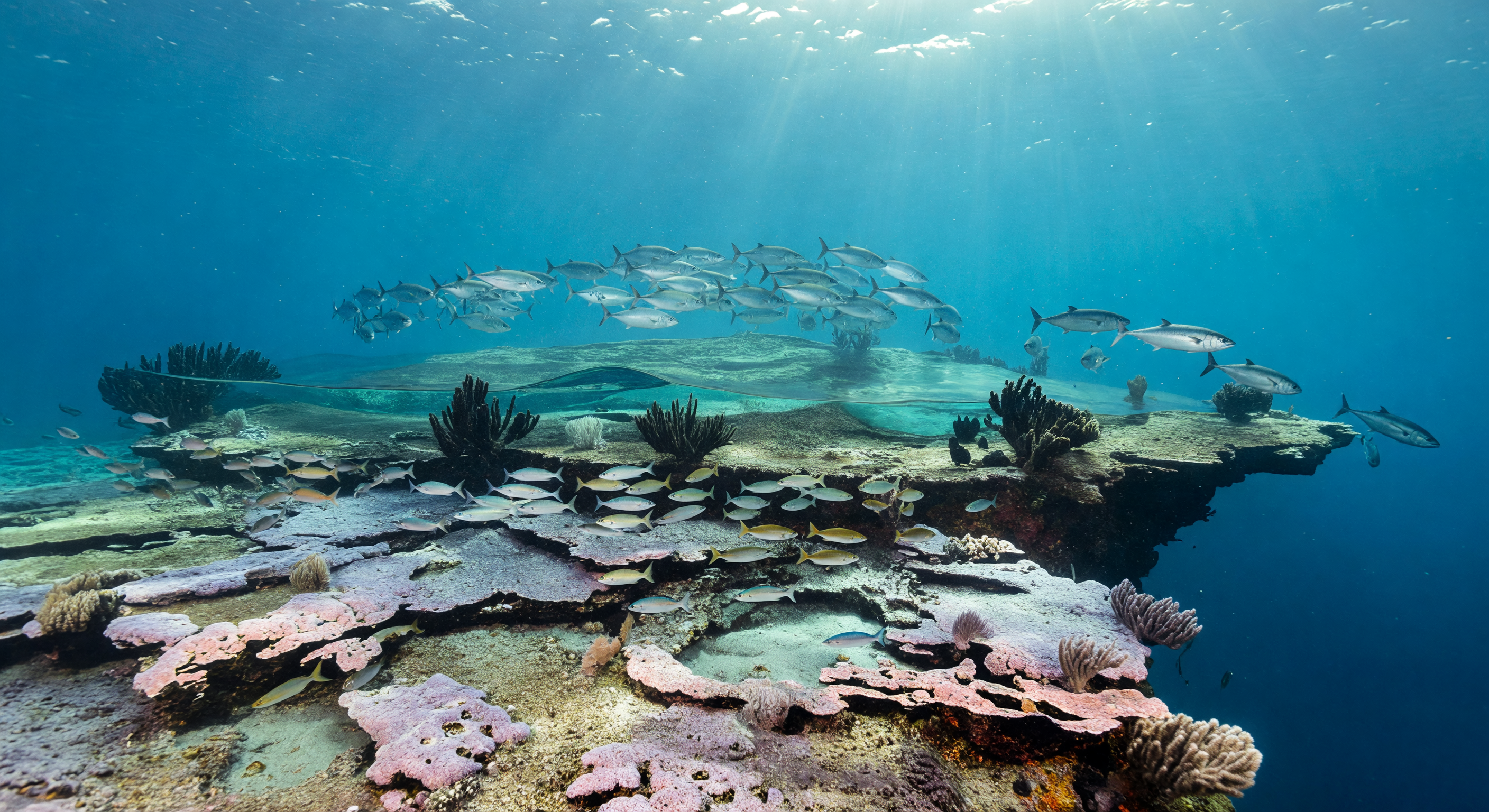
At 40 to 60 metres above the flanks of a submerged volcanic mountain, the seamount's fractured basalt plateau rises into one of the ocean's most productive collisions — between sunlit, nutrient-poor surface water and the cold, dense upwelling that the seamount's own bulk forces upward from below. Here, pink and lavender coralline algae paint the carbonate pavement in muted pastels, while gorgonian fans stream in unison from the summit rim, every polyp extended into the accelerating current to harvest the plankton it carries. A translucent cobalt lens of upwelled water — denser and perhaps three to five degrees cooler than the sunlit layer above — slides across the crest like a slow exhalation, sharpening a vivid colour boundary in the water column as warmer turquoise yields to saturated blue-green and then deep ultramarine where the plateau drops abruptly into open ocean. In that accelerated flow, compact schools of small baitfish hold centimetres above the rock with precise upstream angles, their silver flanks catching the caustic shimmer of sunshafts descending through exceptionally clear oceanic water, while a wheeling bank of jacks and the swift, muscular passes of hunting tuna above them reveal why seamount summits function as offshore oases — hard substrate, concentrated plankton, and channelled current conspiring to pull the entire food web upward into the light.
Seamount summit