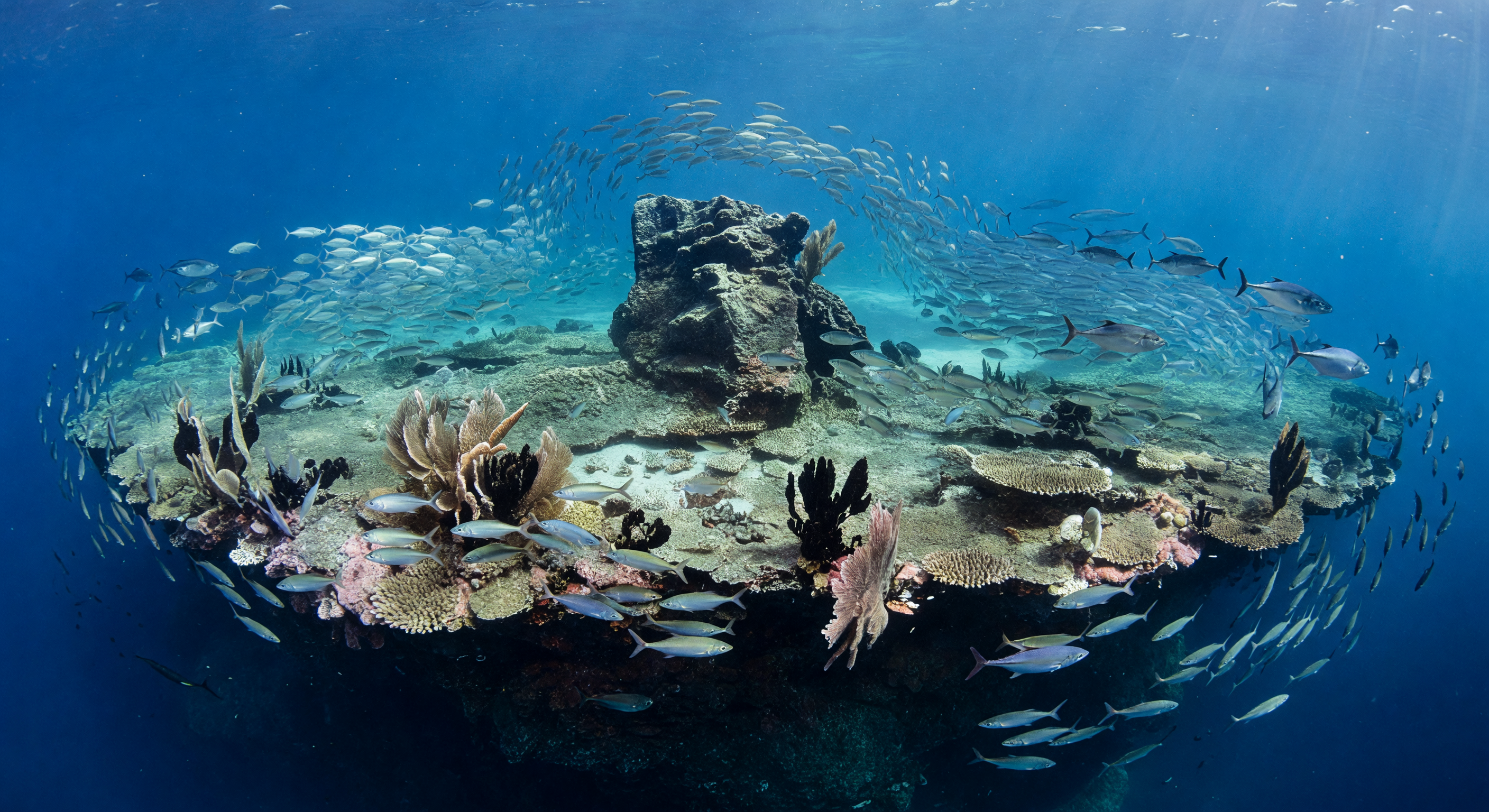
At the crest of a mid-ocean seamount, a blunt spire of fractured basalt cleaves the prevailing current, and in its lee a turquoise eddy spins slowly inward, cradling thousands of small silver fish in a trembling, self-organizing veil. Each individual hangs at the precise tension between shelter and flow, their scales catching the oblique shafts of sunlight that lance down from the bright surface above, refracting into shifting caustic patterns across the volcanic rock below. Where the eddy dissolves at the summit edge, the outer ranks of the school are peeled away by the faster water and swept back over the rim, where the plateau drops without warning into colder, darker cobalt — a sudden vertical wilderness that begins just meters from the sunlit cap. Above, jacks wheel in loose, purposeful arcs, their flanks strobing white when they bank into the light, while larger tunas drive through the bait cloud in tight, explosive passes, each strike sending a pulse of turbulence rippling outward through the column. The seamount summit functions as an open-ocean oasis: hard basaltic substrate, gorgonians streaming from current-facing ledges, pink coralline crusts cementing every horizontal surface, and the perpetual upward flux of nutrient-rich water stirred by tidal pumping and internal waves breaking against the topography — a place where the geometry of the seafloor reaches up to intercept the sunlit world, concentrating life in the otherwise empty blue.
Seamount summit