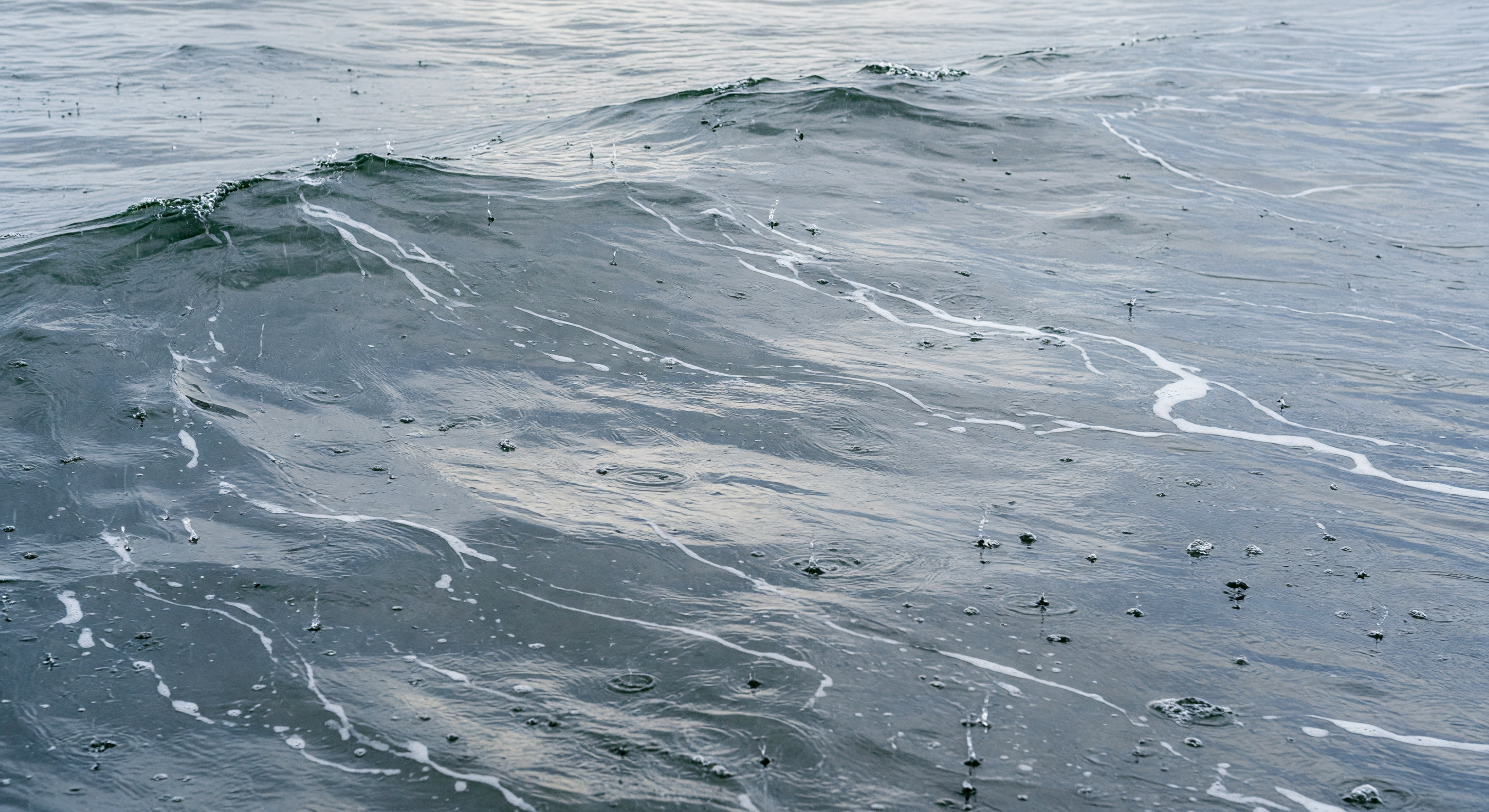
At the skin of the sea, where atmosphere and ocean negotiate their boundary in a language of kinetic energy and surface tension, countless falling drops arrive at oblique angles across the rolling slate-blue wave faces, each impact detonating into a brief asymmetric crown — a microsecond sculpture of stretched stalks, satellite droplets, and concentric ringlets instantly sheared apart by wind and wave motion. The air–sea interface is one of the most physically active layers on the planet: a zone of continuous gas exchange, latent-heat flux, and mechanical coupling where even a moderate rainfall measurably freshens the upper centimeters, depresses local salinity, and imposes a shallow haline stratification that can suppress turbulent mixing and trap heat anomalies in a lens only decimeters thick. Each impact also entrains a microscopic bubble that collapses and re-radiates sound, so that a rain event transforms the upper ocean into an acoustic landscape — a dense, spatially structured field of underwater noise that marine mammals and hydrophone arrays can detect across great distances. Foam streaks and bubble flecks drift between the darker troughs, tracing the surface convergence lines carved by wind and swell, while broken reflections of layered gray cloud slide across wet wave facets in cold overcast light that carries no shadow and casts no beam. The sea exists here entirely on its own terms: stippled, freshened, acoustically alive, and utterly indifferent to any observer.
Other languages
- Français: Pluie sur vagues obliques
- Español: Lluvia en olas inclinadas
- Português: Chuva em ondas oblíquas
- Deutsch: Regen auf schrägen Wellen
- العربية: مطر على أمواج مائلة
- हिन्दी: तिरछी लहरों पर वर्षा
- 日本語: 斜めの波に降る雨
- 한국어: 비낀 파도 위 빗줄기
- Italiano: Pioggia su onde inclinate
- Nederlands: Regen op schuine golven