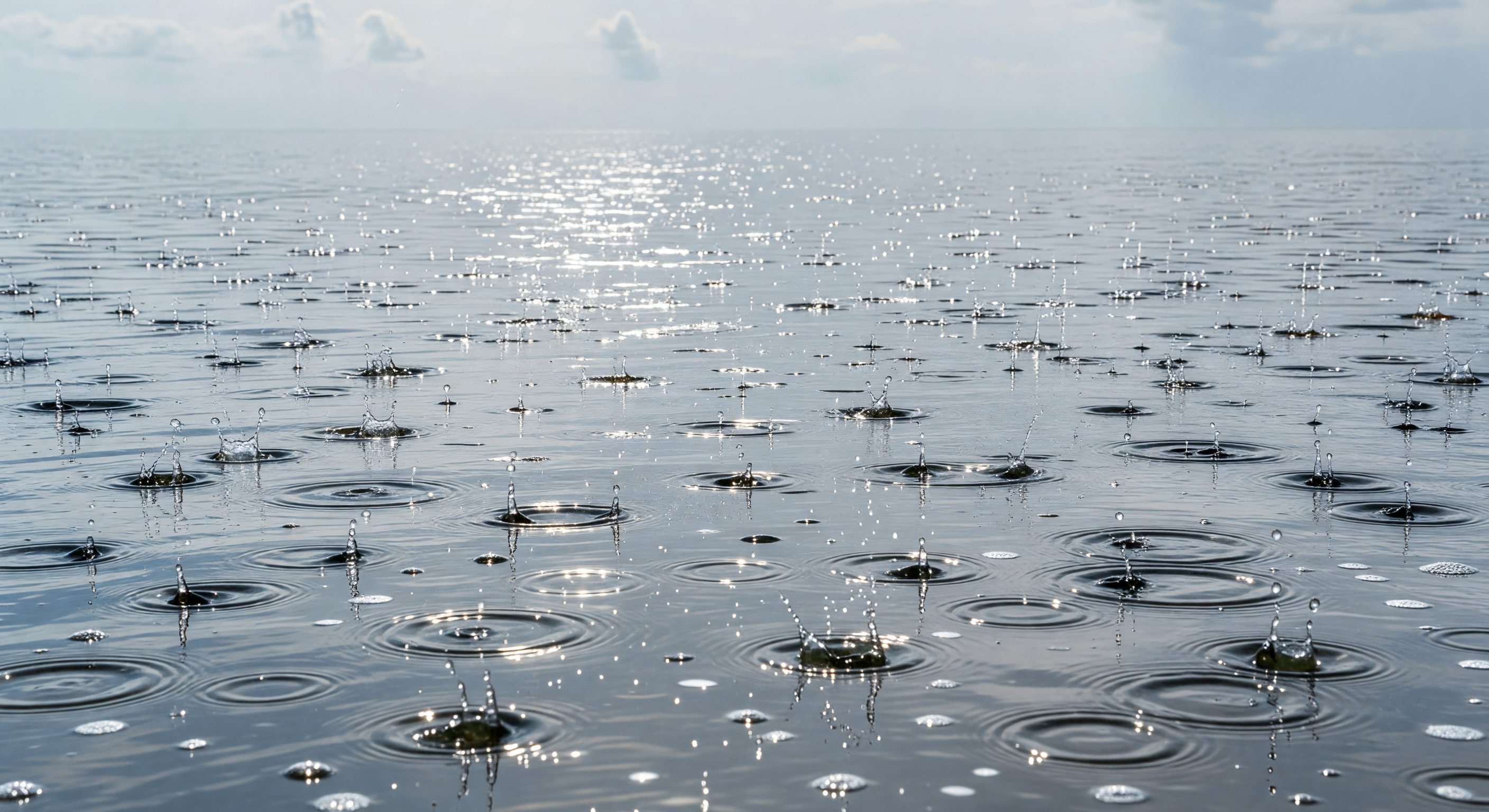
At the very skin of the world's ocean, where atmosphere and sea meet in a plane measured in fractions of a millimeter, a dense tropical downpour transforms the surface into a continuously detonating mosaic of hydraulic sculptures — each raindrop excavating a transient micro-crater whose serrated crown of water flings thin Worthington jets skyward before collapsing back into the expanding rings that collide with a hundred identical neighbors. The energy of each impact, modest in isolation, is collectively immense: rain at this intensity transfers momentum deep enough to shear the diurnal warm layer, freshens the upper centimeters into a haline anomaly measurably distinct from the saline water beneath, and generates a broadband acoustic field — a hissing, crackling sound halo audible to hydrophones tens of meters below — dominated by the resonant oscillation of entrained air bubbles trapped at roughly 1–2 millimeters diameter. Under overcast skies that diffuse photons into a flat silver illumination, the sea surface reads not as a plane but as a living topology of impact bowls, foam flecks, and transient subsurface bubble clouds that scatter light into faint halos visible through the glassy interstices between strikes. Here, the ocean is neither calm nor stormy in any classical meteorological sense, but occupies its own liminal physics — a realm of micrometeorology, capillary hydrodynamics, and acoustic ecology that existed for billions of years before any mind existed to witness it, and continues now, indifferent and intricate, in every rainstorm over every open sea on Earth.
Other languages
- Français: Barrage de Surface Liquide
- Español: Bombardeo de Superficie Marina
- Português: Barragem na Superfície do Mar
- Deutsch: Oberflächenhaut Sperrfeuer
- العربية: قصف سطح البحر
- हिन्दी: समुद्र सतह बौछार
- 日本語: 海面雨粒の猛攻
- 한국어: 해수면 빗살 포격
- Italiano: Bombardamento della Superficie Marina
- Nederlands: Oppervlak Huid Spervuur