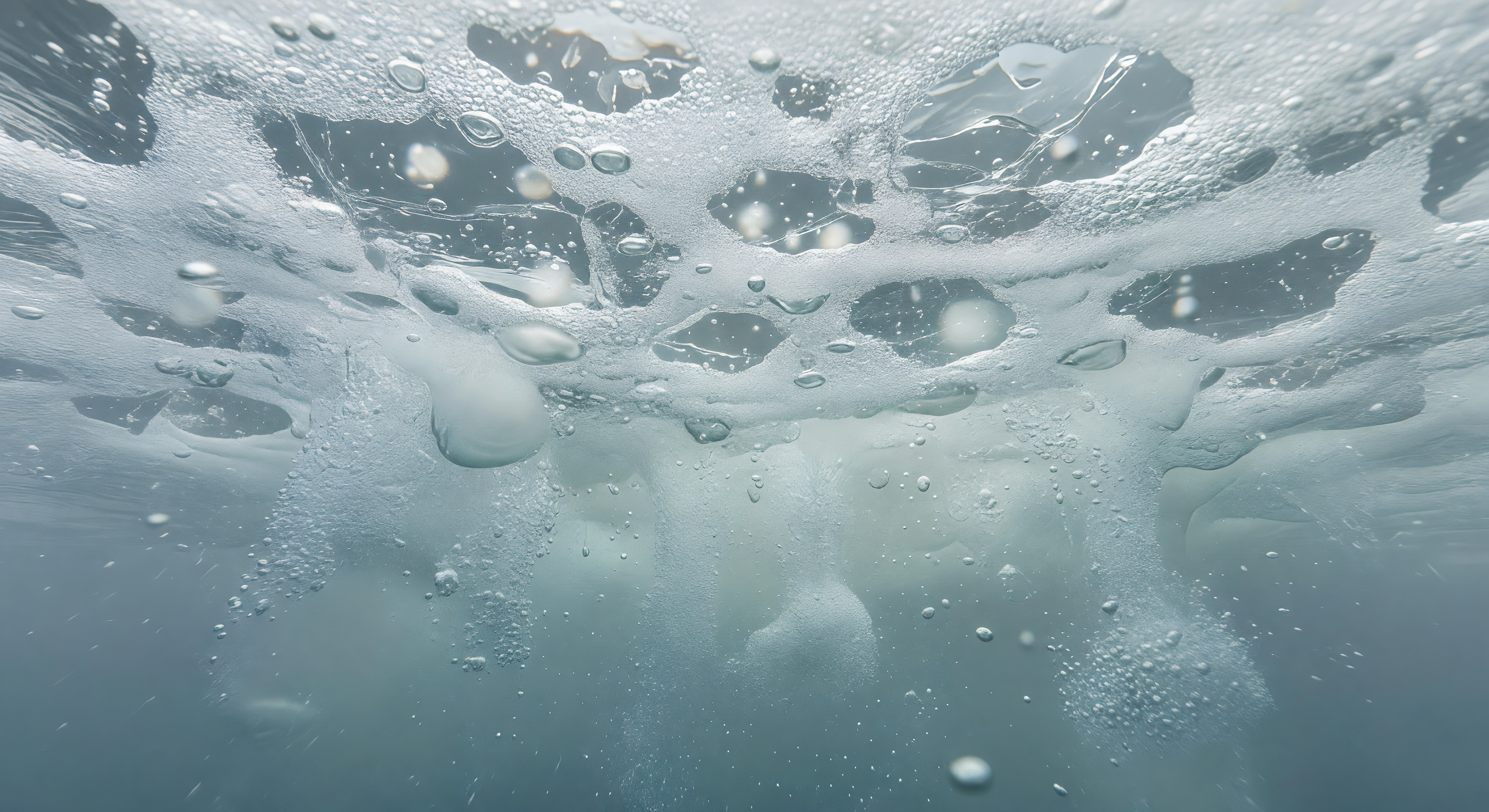
Just beneath the rain-struck surface, the ocean and atmosphere are locked in violent, continuous negotiation — each raindrop punching a fleeting micro-crater through the foam canopy, collapsing inward and sealing itself in a ring of entrained air that immediately fragments into pearl-white bubble veils drifting downward through cold gray-blue water. This uppermost boundary, barely centimeters thick, belongs to the sea-surface microlayer: the thinnest and most chemically distinct skin of the ocean, perpetually remade by wind shear, thermal flux, and the mechanical assault of precipitation, its salinity diluted into transient freshened lenses that float for minutes before turbulence dissolves them. Diffuse overcast daylight filters through the fractured foam raft overhead, scattered and milky rather than focused, robbed of directionality by countless bubble membranes so that the water below glows with a sourceless, pearlescent luminosity reaching only a short distance before the optically noisy column of suspended microbubbles and particulate swallows it entirely. Acoustically, each raindrop impact generates a characteristic double-frequency sound pulse audible for hundreds of meters in all directions — a continuous broadband hiss that pervades the upper ocean during squalls and that marine biologists and oceanographers exploit to measure rainfall rates remotely from hydrophones. Here, in this pressureless, turbulent, perpetually renewed skin, the boundary between two fluid worlds is not a line but a trembling, porous, self-erasing threshold that the ocean continuously reclaims.
Rain on the ocean