At the very skin of the sea, where atmosphere and ocean negotiate their endless exchange, the first scattered raindrops of an approaching tropical system are rewriting the surface one micro-impact at a time. Each falling drop carries enough momentum to punch a transient millimeter-scale crater into the water's elastic membrane, ejecting a delicate crown of displaced fluid before surface tension reclaims it, while concentric capillary waves radiate outward across the near-glass calm — physics playing out at the scale of milliseconds and micrometers. Beneath each impact, a column of entrained air fractures into oscillating microbubbles that ring with a characteristic acoustic frequency near 14–15 kHz, meaning that rain does not merely mark the ocean visually but writes itself into the underwater soundscape as a broadband hiss detectable by marine mammals and passive hydrophone arrays kilometers away. The soft overcast sky above diffuses solar radiation uniformly across the pale silver surface, eliminating shadows and reducing the air–sea interface to a luminous mirror interrupted only by these sparse percussion points, while just below the surface microlayer — that biogeochemically active film only micrometers thick, enriched in lipids, bacteria, and dissolved organics — the first freshwater lenses are forming, marginally cooler and less saline than the tropical water beneath, creating transient haline stratification that will vanish with the first gust of wind. Here the ocean is not scenery but a dynamic boundary where mass, heat, momentum, and sound transfer between two fluid worlds, indifferent and continuous, long before any eye existed to observe it.
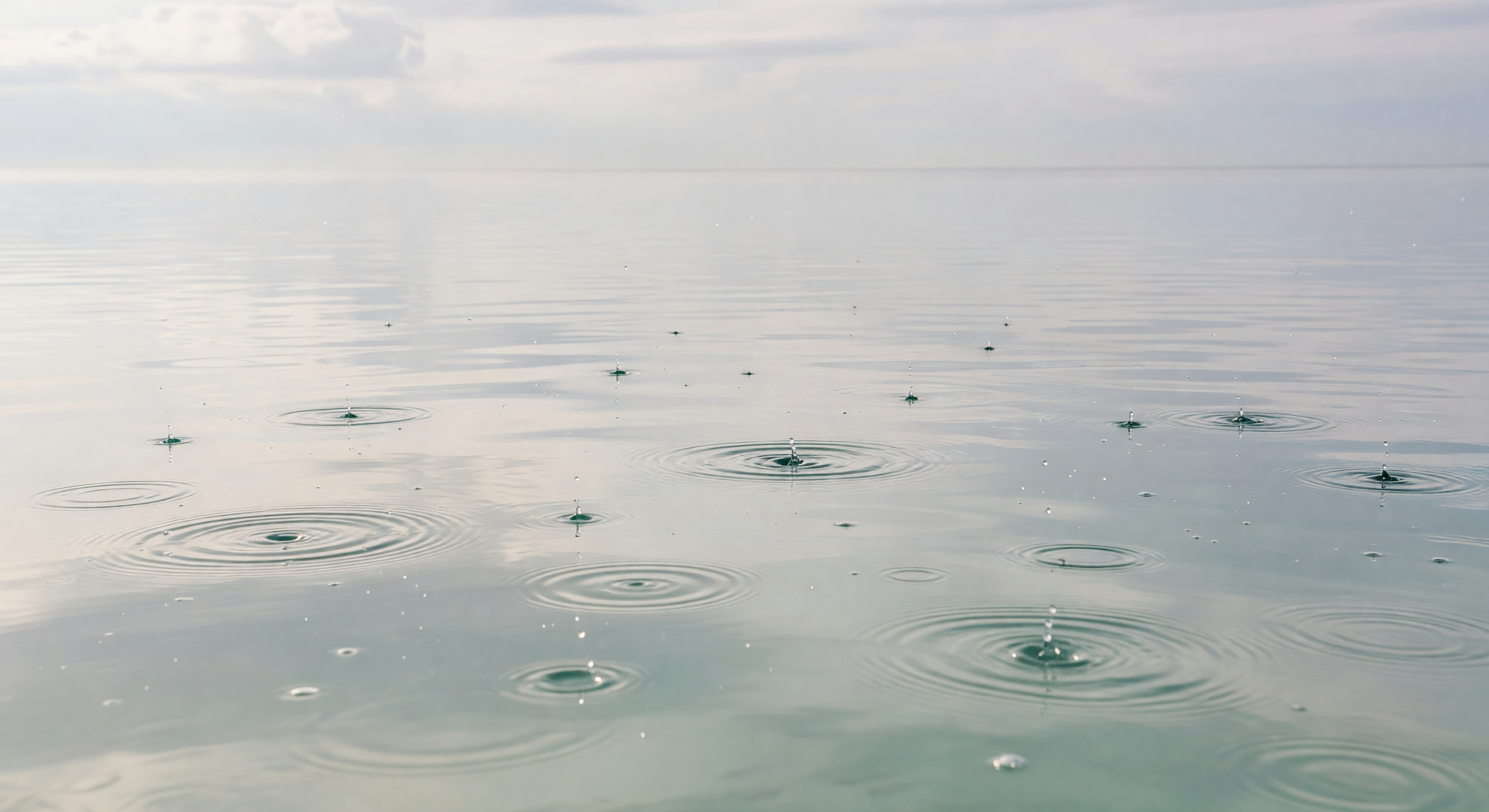
Rain on the ocean