Just beneath the open ocean surface, moderate rainfall transforms the air–sea interface into a living percussion membrane: each descending drop punches a downward dimple, throws a momentary micro-crater crown, and vanishes into a collapsing cup, while entrained air bubbles cling in pearly clusters just below impact points and drift upward in brief vertical traces. Looking upward through this hammered skin, refracted overcast daylight gathers by total internal reflection into a trembling white-silver oval at the center of Snell's window — the entire compressed sky visible within a cone of roughly 97 degrees — grading outward through cool cyan and deep steel-blue into the darker periphery where no skylight penetrates. The sea-surface microlayer, normally a film only micrometers thick and chemically distinct from the water below, is here ceaselessly shredded and renewed, its organic surfactants broken into fragments as rainfall energy cascades through the uppermost centimeters, generating turbulence, transient salinity lenses, and the characteristic broadband underwater acoustic signature of rain — a hiss rich in frequencies between 1 and 50 kHz produced partly by the oscillation of entrapped resonant bubbles. Caustic coherence is shattered by the roughened interface, leaving only faint fragmented flashes and soft wavering highlights, while fine suspended particulates and organic specks drift freely through water of essentially atmospheric pressure — a world of astonishing physical intensity compressed into the thinnest, most energetically charged boundary the ocean possesses.
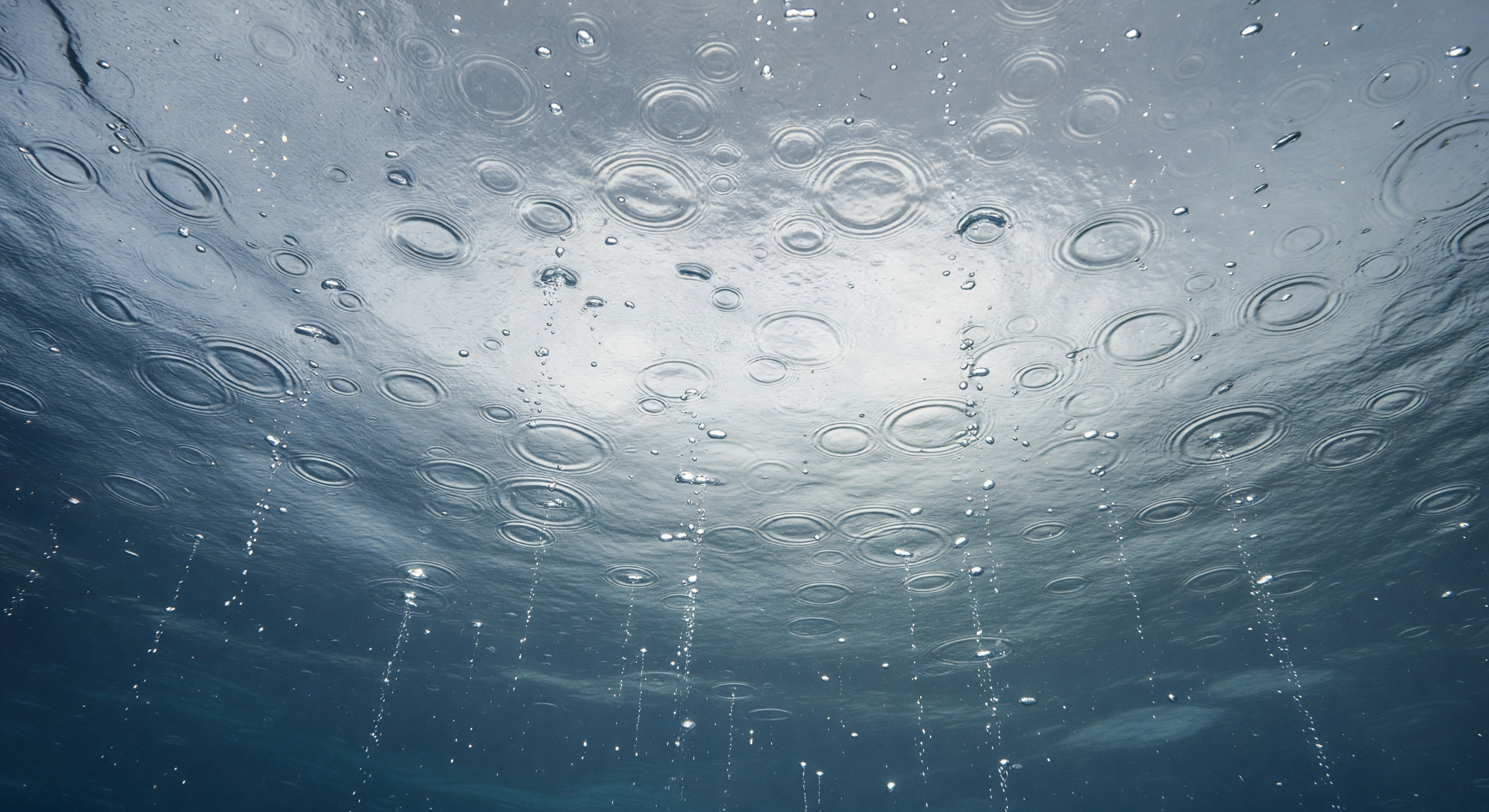
Rain on the ocean