Where the sky releases its weight upon the sea, the ocean surface becomes a living mosaic of competing physics — broad glassy patches of rain-freshened water lie in silent contrast beside actively stippled zones where each falling drop punches a microscopic crater, flings a momentary crown of spray, and seeds a brief bubble before the surface heals itself in milliseconds. These falling drops deliver not only fresh water but kinetic energy that propagates downward as sound, generating a dense acoustic halo of broadband noise radiating through the upper meters — a hidden resonance invisible from above yet measurable far beneath the surface. The thin lens of freshened, slightly cooler water forming in the uppermost decimeters creates a subtle haline stratification, its lower boundary bending transmitted light into soft wavering caustics that shift cyan in the shallows to deep cobalt below, as refractive index gradients trace the boundary between diluted surface water and the saltier, denser ocean beneath. Convergence lines accumulating at salinity and surface-tension boundaries gather films of organic material — transparent exopolymers, lipid monolayers, and minute plankton — the sea-surface microlayer concentrating life and chemistry at this thinnest of interfaces. The overcast sky diffuses tropical sunlight evenly across the whole scene, and the ocean exists entirely in its own terms: a self-organizing system of thermodynamics, acoustics, fluid instability, and biology, continuously renewed by rain it has evaporated into clouds that have only now returned it home.
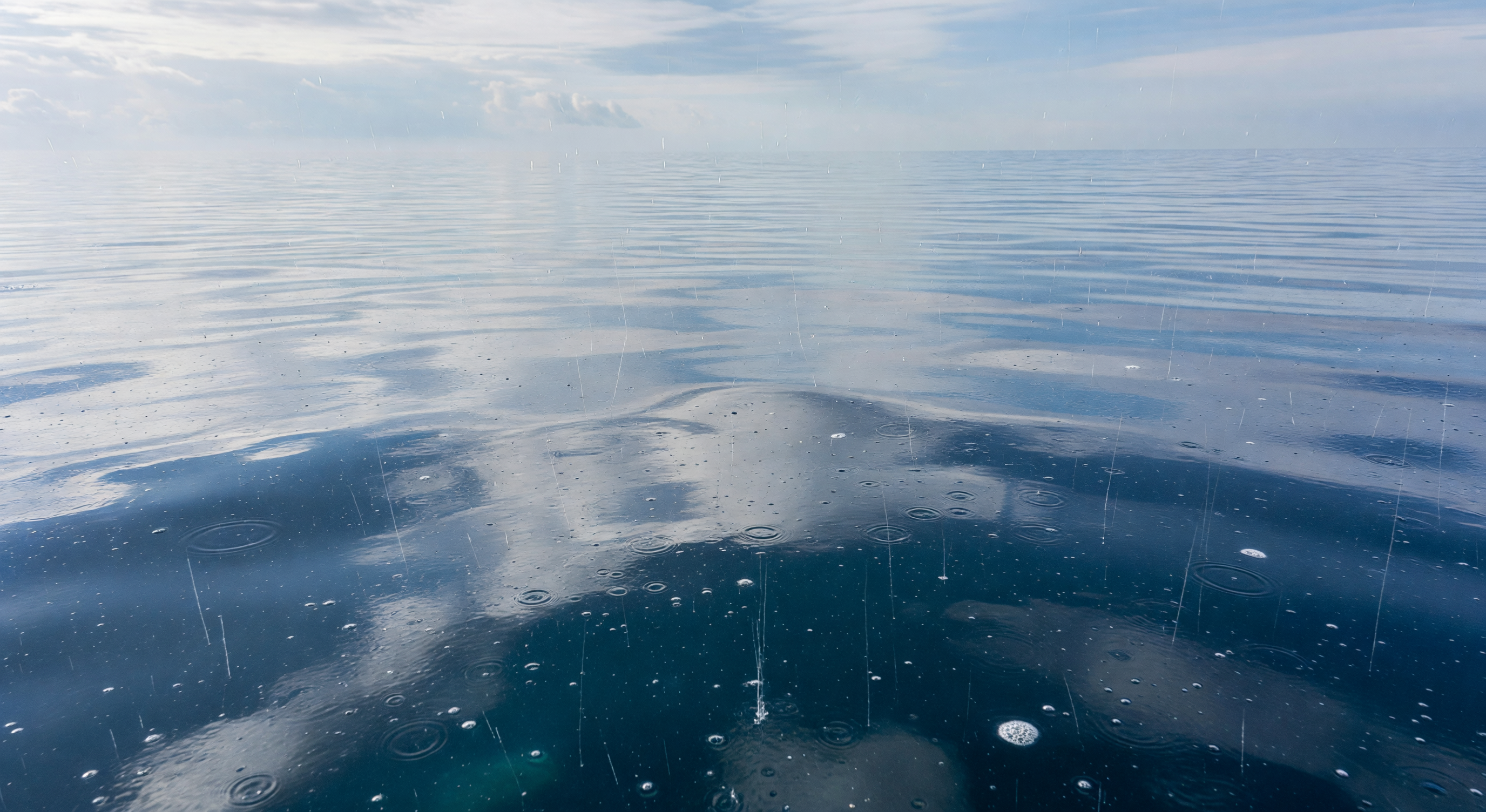
Rain on the ocean