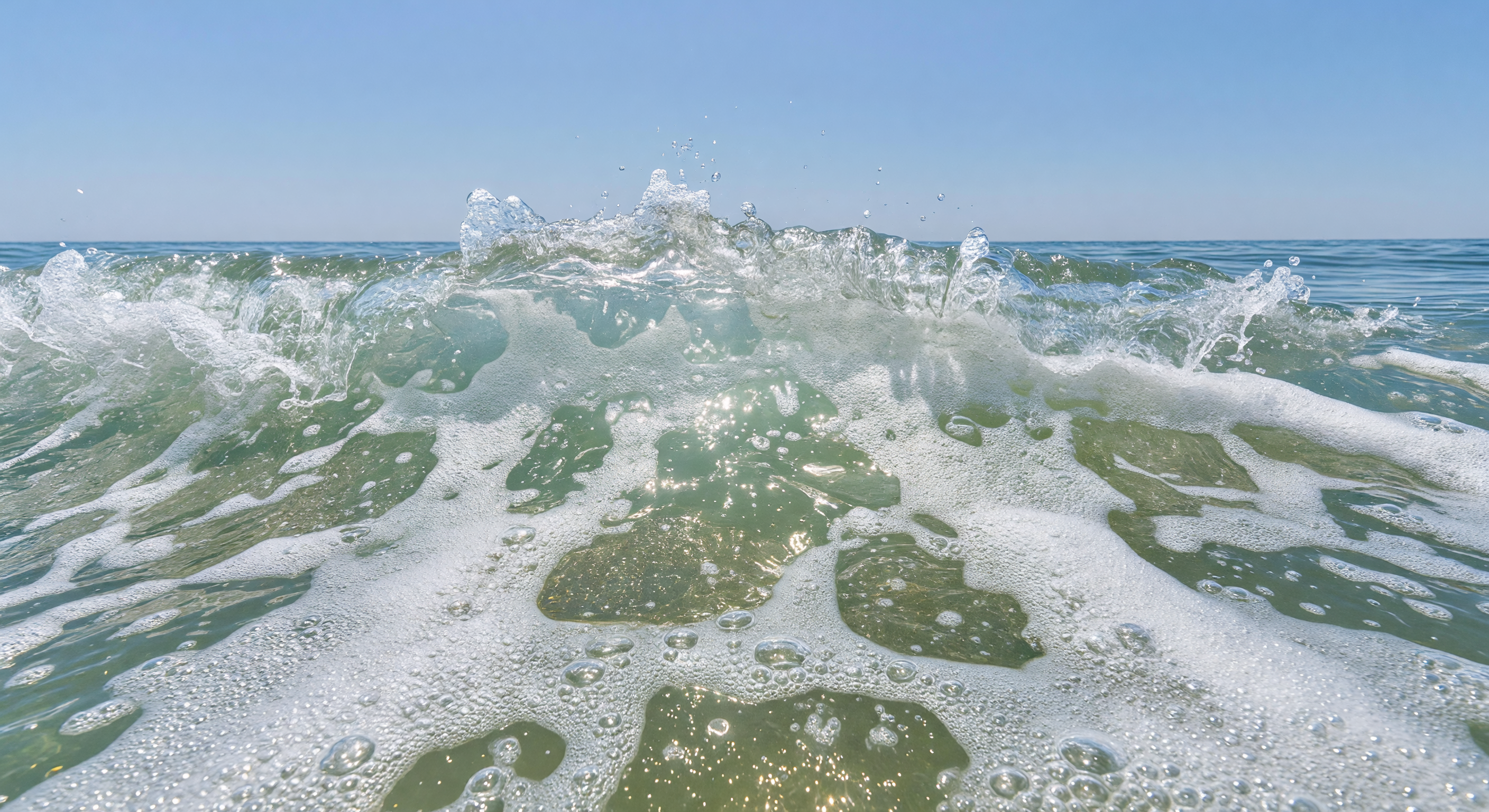
Scientific confidence: Very High
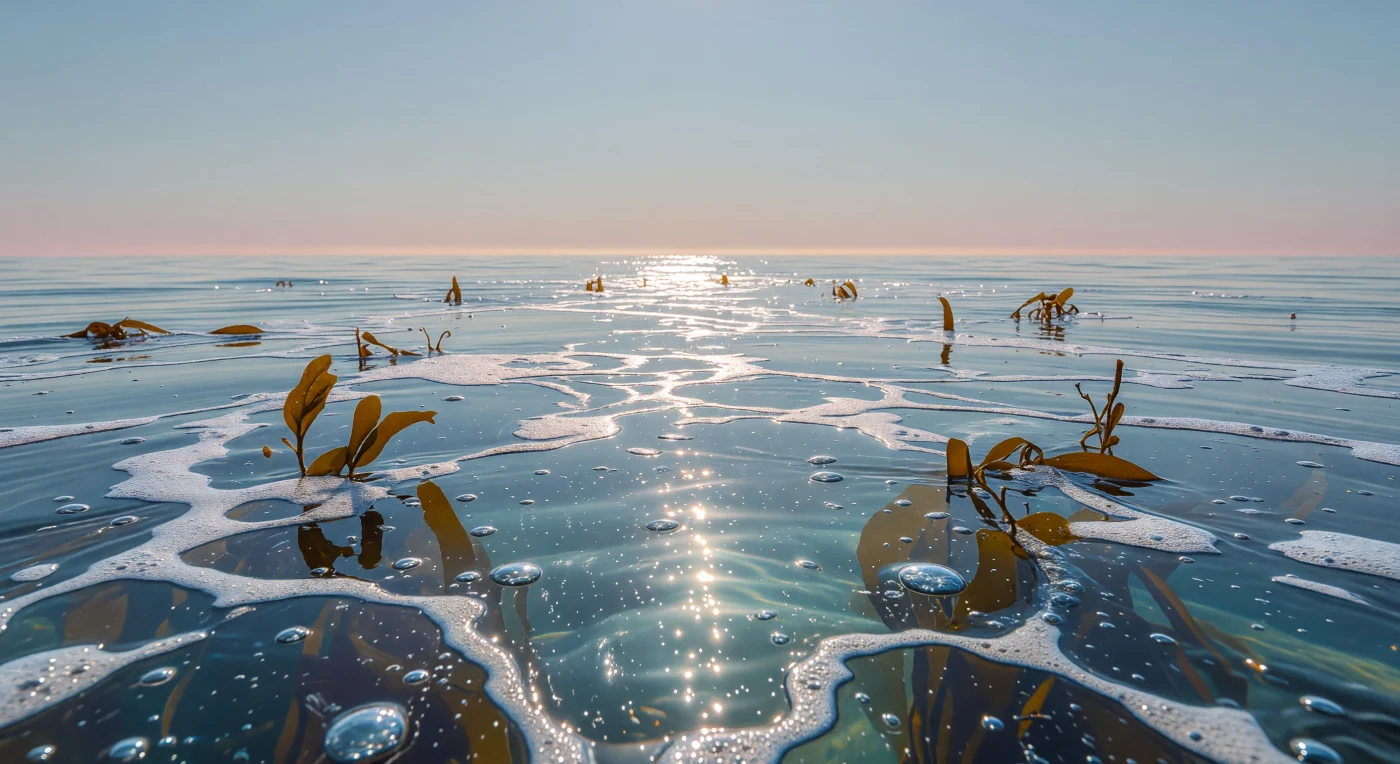
At chin level with the glassy kelp cove, the snorkeler floats suspended between two worlds — above, a rose-and-steel dawn sky reflects perfectly in the undisturbed sea skin, while drifting foam polygons catch the first oblique sunlight and fracture it into pearlescent white highlights and cool blue shadows, each thin bubble film occasionally shimmering with faint iridescence where dissolved organic surfactants — proteins, lipids, and transparent exopolymer particles secreted by phytoplankton and bacteria — have concentrated within the sea-surface microlayer to densities orders of magnitude above the water column below. Below the interface, the uppermost ten to fifty centimeters are anything but empty: amber Macrocystis fronds rise through water visibly alive with copepods threading between diatom-rich films, microbubbles clinging to organic particles and slowly rising to reinforce the foam raft overhead, the whole assemblage backlit by a luminous cone of Snell's window where low-angle sunlight diffracts through the froth into caustic tracery and pearly scatter. This is the ocean's thinnest yet most biochemically concentrated habitat — a place where atmospheric gases are absorbed and released, where primary production and microbial respiration overlap within a layer thinner than a fingernail, and where bubble dynamics operating under only the faintest pressure gradient above ambient atmosphere mediate the exchange of dimethyl sulfide, carbon dioxide, and sea-spray aerosols that ultimately influence regional climate. To hover here at dawn, eyes exactly at the interface, is to occupy the precise boundary where ocean becomes atmosphere.
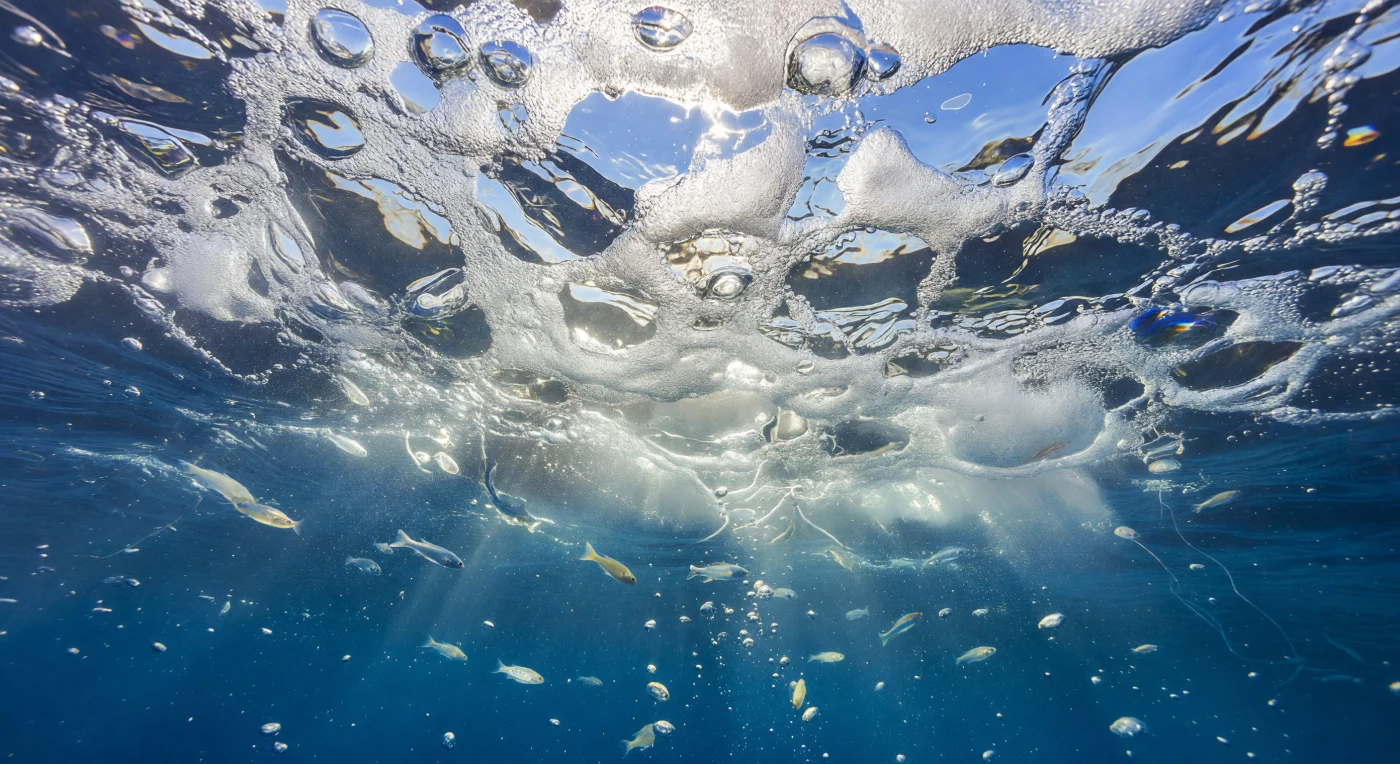
Suspended just half a meter beneath the open ocean's surface, you look straight up into one of the most electrically alive interfaces on Earth: a trembling, polydisperse ceiling of fresh froth where wave-breaking turbulence has folded atmosphere into ocean, producing a bubble matrix so dense it glows milky white with backscattered sunlight. This is the sea-surface microlayer and its immediate sub-surface plume — not a depth but a boundary state, where gas exchange is furious, where surfactant-rich organic films concentrate bacterial mats, transparent exopolymer particles, and photosynthetically active dissolved organics into a chemistry utterly unlike the clear pelagic water just a meter below you. The pressure on your body has barely shifted from what you felt at the surface, yet the optical environment is extraordinary: hard, high sun fractures through gaps in the foam into sharp caustic nets and slanted white shafts, while Snell's window opens like a bright, distorted lens amid a cobalt-dark mirror ceiling, and millions of micro-bubbles drift downward trailing iridescent thin-film halos as they shrink and dissolve, releasing their captured atmospheric gases back into solution. Translucent salps pulse silently through the light columns, their gelatinous bodies nearly invisible except where refracted edges and faint internal organs catch the angle, and larval fish hover rim-lit in the backscatter haze, using this bubble-rich, organically concentrated upper stratum as both a feeding ground and a sensory shelter. The foam overhead is not merely beautiful; it is a site of planetary-scale gas flux, aerosol production, and microbial metabolism — a membrane barely thicker than your hand that mediates a significant fraction of the ocean's conversation with the atmosphere.
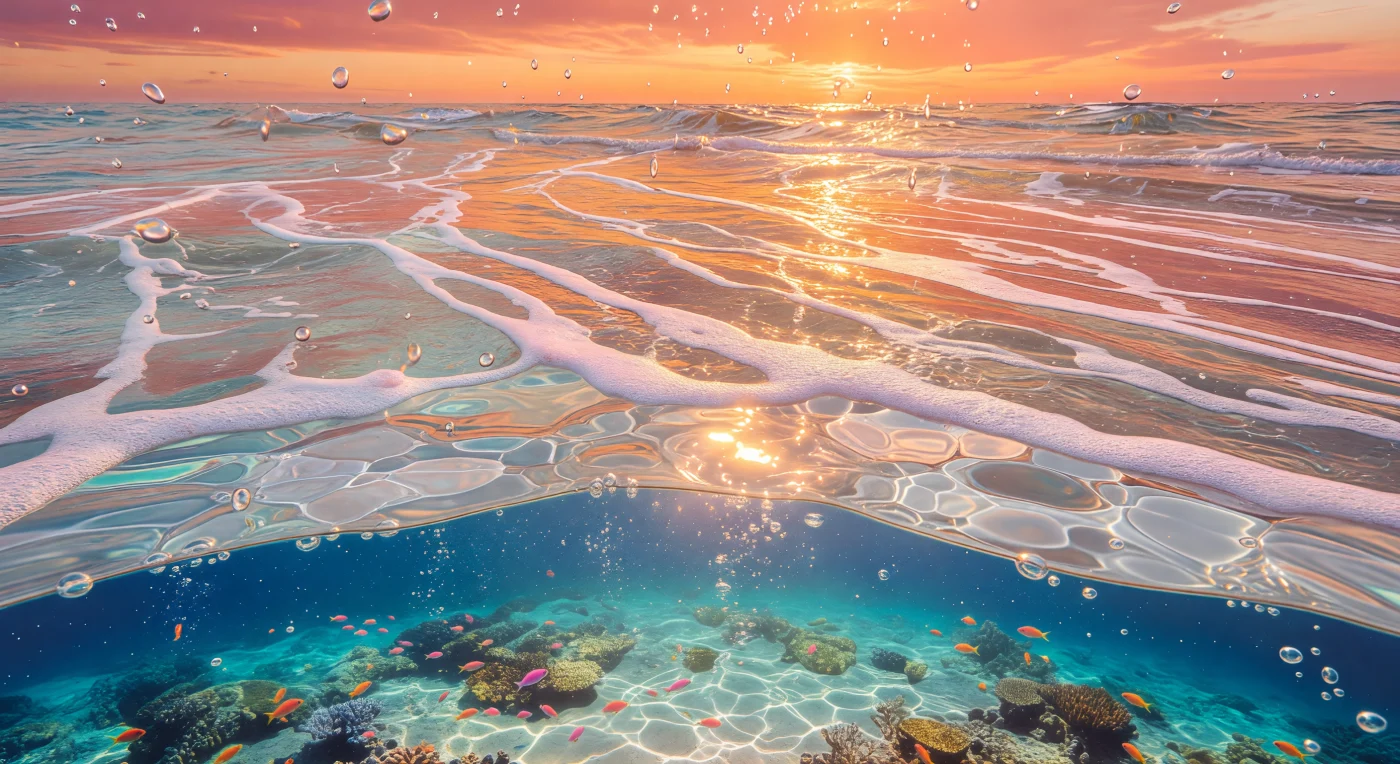
At the very skin of the sea, where ocean and atmosphere negotiate in sheets of pink-gold light, the snorkeler hangs suspended in a world measured not in fathoms but in millimeters—mask lens bisecting the air-water interface as trade winds herd long windrows of surfactant-rich froth toward a blazing horizon. Above, pearly bubble rafts and lace-like streaks of spume drift in converging lines known as Langmuir circulation cells, where wind-driven surface currents spiral downward in shallow helical rolls, concentrating buoyant organic matter, neuston organisms, and sea-surface microlayer films into these luminous corridors. Below the wavering meniscus, the upper meter glows with warm turquoise backscatter, microbubbles catching the oblique sunset light as they migrate upward through the water column, each one a tiny gas-exchange reactor transferring oxygen and carbon dioxide between ocean and atmosphere at rates that scale globally to influence climate itself. Snell's window opens warm and wide on the horizon side of the view, its circular portal framing the blazing sky while caustic light nets slide over coral rubble and the atoll's upper slope, and tight flashes of orange-pink anthias pulse beneath the foam ceiling—fish exploiting the turbulent productivity that breaks at this luminous, evanescent frontier between worlds. Here, at a depth that can be measured in centimeters rather than meters, the ocean is at its most chemically active, biologically dense at the microbial scale, and visually electric—a threshold zone of extraordinary consequence dressed in iridescent soap-film beauty.
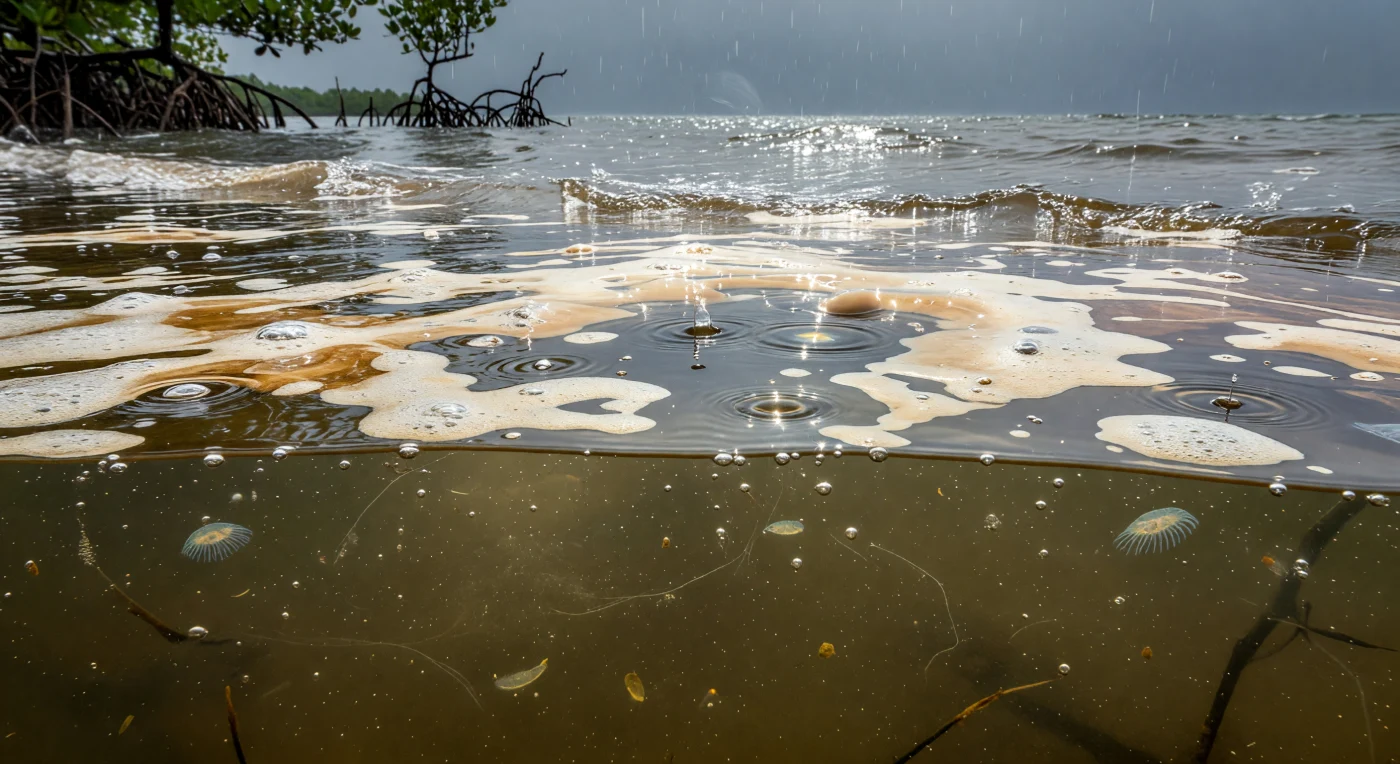
The camera hangs suspended at the precise boundary where rain-pocked estuary meets pewter sky, the horizon a raw seam just centimeters away, every raindrop detonating into a brief coronet of fresher water before the river's organic surfactants knit the foam back into amber and cream rafts. Below the half-submerged lens, tannin-stained water glows olive-brown for a shallow breath of depth, then dissolves into a luminous bacterioplankton fog threaded with transparent exopolymer strands and colloidal particles — the sea-surface microlayer here is not empty space but a chemically saturated living film where gas exchange, microbial activity, and photochemistry occur at rates far exceeding those of the open water column beneath. The underside of the foam reads as a broken milky ceiling, its bubble walls acting as tiny lenses that scatter the last diffuse daylight into pearly polygons and faint caustic flickers, the surface tension of each film holding a concentrated archive of dissolved organics, lipids, and microbial biofilms enriched tenfold over the water below. Translucent ctenophores drift beyond the foam edge, their comb rows igniting in brief iridescent pulses, while mangrove root shadows press inward and the bacterioplankton haze swallows distance entirely, collapsing depth into intimacy. This is the ocean's most volatile threshold — a membrane measured in micrometers that mediates the exchange of gases, heat, and biology between two vast atmospheric systems.
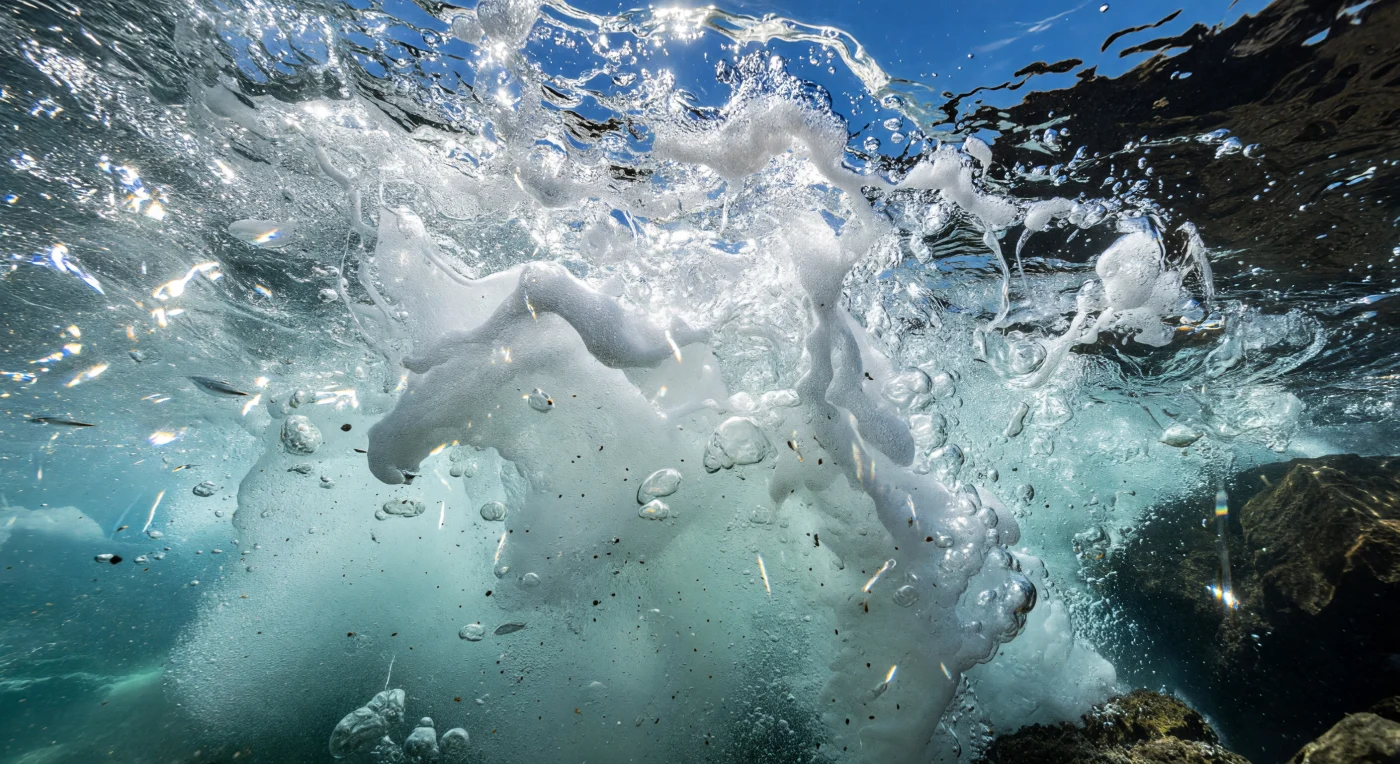
The free diver hovers in a violent, milk-white universe just centimeters below the surface as a plunging breaker collapses overhead, the entire field of view consumed by a roaring plume of pearly foam cells, torn froth rafts, and countless microbubbles whose collective backscatter transforms noon sunlight into brilliant silver flares and blue-green gradients that pierce the turbid interior. This is the ocean's most chemically and biologically active frontier — the air-sea interface and sea-surface microlayer — where breaking wave energy drives intense gas exchange, concentrates surfactant-rich organic films, and accelerates the biological and physical processes that link atmosphere to ocean. Pressure here differs from the open air by mere kilopascals, yet the bubble dynamics are exquisite: individual spheres grow, oscillate, and collapse according to the same physical laws that govern acoustics and cavitation, while sand grains ripped from the basalt headland, fine volcanic dust, and suspended marine detritus streak through turbulent channels in dense, glittering swarms. Juvenile mullet thread the brighter, less turbid edges of the plume, exploiting the disorienting chaos to pick off prey suspended in the surge, their slim silver flanks catching caustic shards of refracted light as Snell's window overhead flashes cobalt sky and the dark volcanic headland before collapsing again into white. To be inside this ephemeral, roaring matrix of foam and water is to inhabit one of the shallowest yet most energetically extreme environments on Earth.
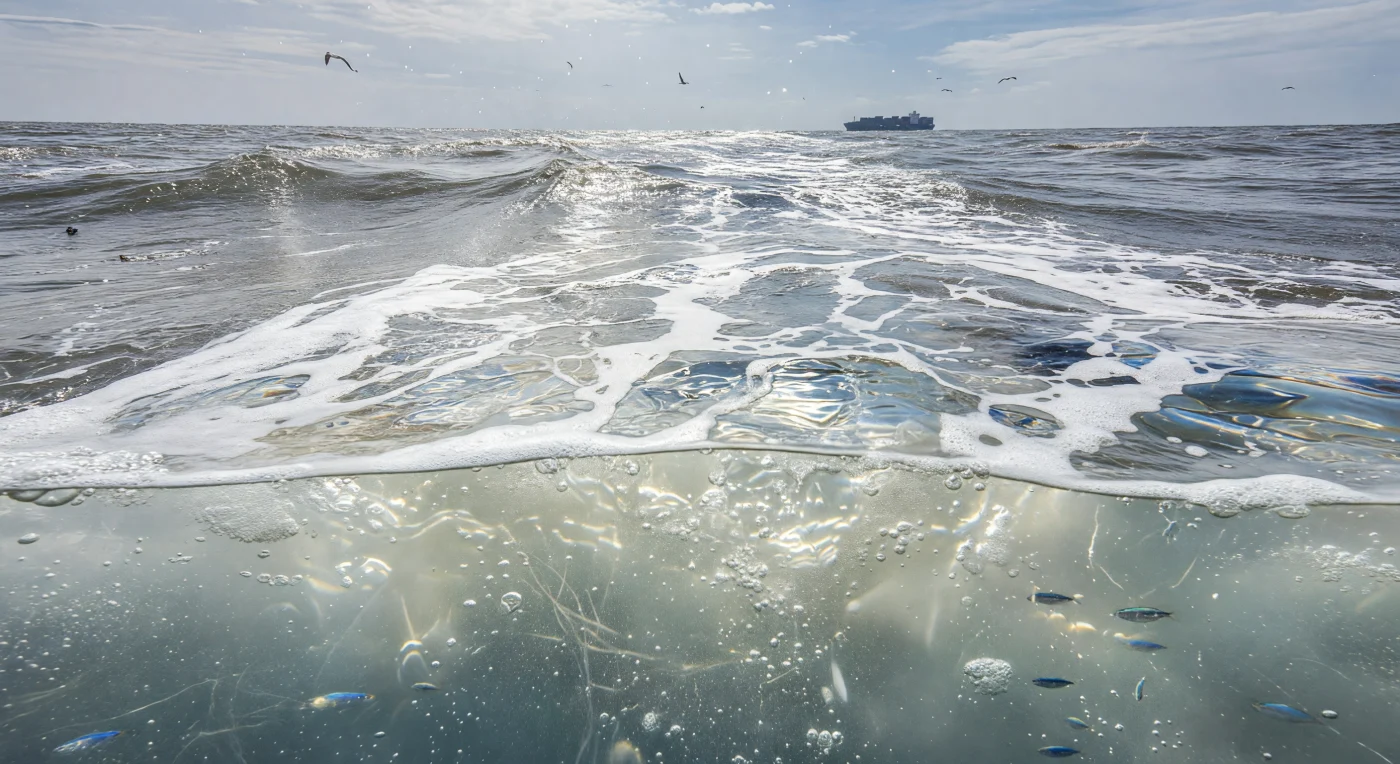
The diver hangs motionless at the chop line, mask pressed into the exact threshold where ocean becomes sky, watching the surface shatter and reassemble in a restless mosaic of pearlescent foam cells and mirror-bright polygons — each bubble a fleeting sealed chamber of compressed air hovering a breath above true atmosphere, where pressure differs from the air above by fractions of a kilopascal yet those fractions govern whether each micro-bubble collapses, rebounds, or persists long enough to ferry a cargo of concentrated surfactants, exopolymer threads, and microbial film downward into the plume. Below the churning ceiling, fractured caustics strobe through suspended particulates and iridescent organic slick, the water turbid not from depth but from the extraordinary biological richness of the sea-surface microlayer — a skin measured in micrometers yet dense with lipids, transparent exopolymer particles, and bacteria orders of magnitude more concentrated here than in the water column a single meter beneath. Chrome-blue baitfish pulse and vanish along the convergence band, drawn by the organic aggregation the foam line delivers, while gull shadows rake the wave faces above and diesel-gray swells drag white streaks toward a container ship whose hull-generated turbulence helped seed this very slick. Everything here is energy, exchange, and interface — the ocean breathing.
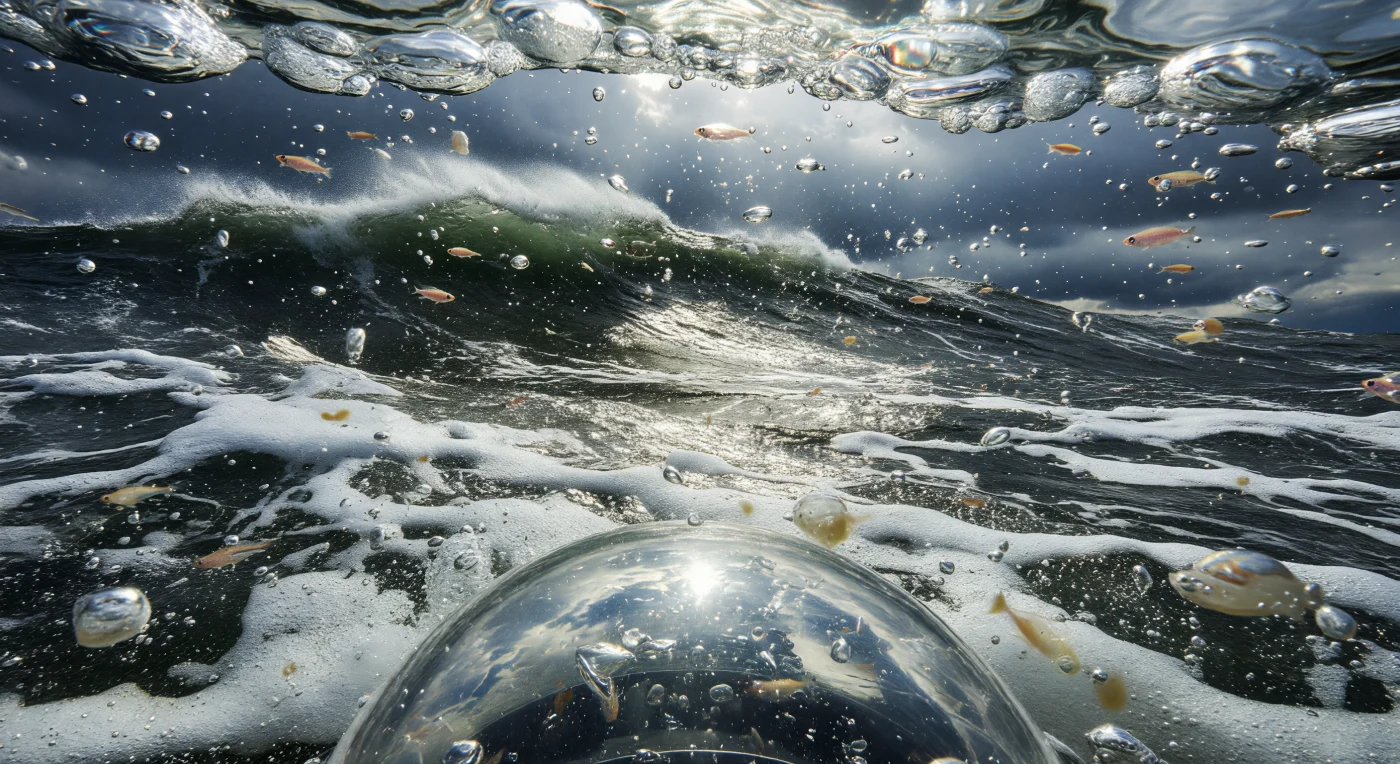
The submersible's forward viewport plunges through a churning architecture of breaking crests, its acrylic dome barely clearing the torn green-black wave faces as horizontal spume lashes across the frame and elongated foam lanes race past at arm's length. This is the ocean's most chemically and biologically active frontier — the sea-surface microlayer, a film measured in micrometers yet disproportionately enriched with surfactant proteins, lipopolysaccharides, and microbial films that stabilize each bubble wall into a pearlescent, rainbow-fringed membrane before it collapses back into the churning mass. Beneath the glowing ceiling of backscattered silver light, swarms of krill hang suspended in the upper meter, their amber-pink bodies and reflective black eyes sharp against the bottle-green void, feeding opportunistically on the organic matter concentrated by wave-driven Langmuir circulation into these same luminous froth lanes. At Beaufort 9, breaking waves inject dense microbubble plumes meters deep, dramatically accelerating air-sea gas exchange — CO₂, oxygen, dimethyl sulfide — and the acoustic roar of collapsing bubble clouds would be audible through the hull even as the viewport frames this cold, fractured, silver-white matrix of light diffraction, organic slicks, and living storm chemistry pressing intimately against the glass.
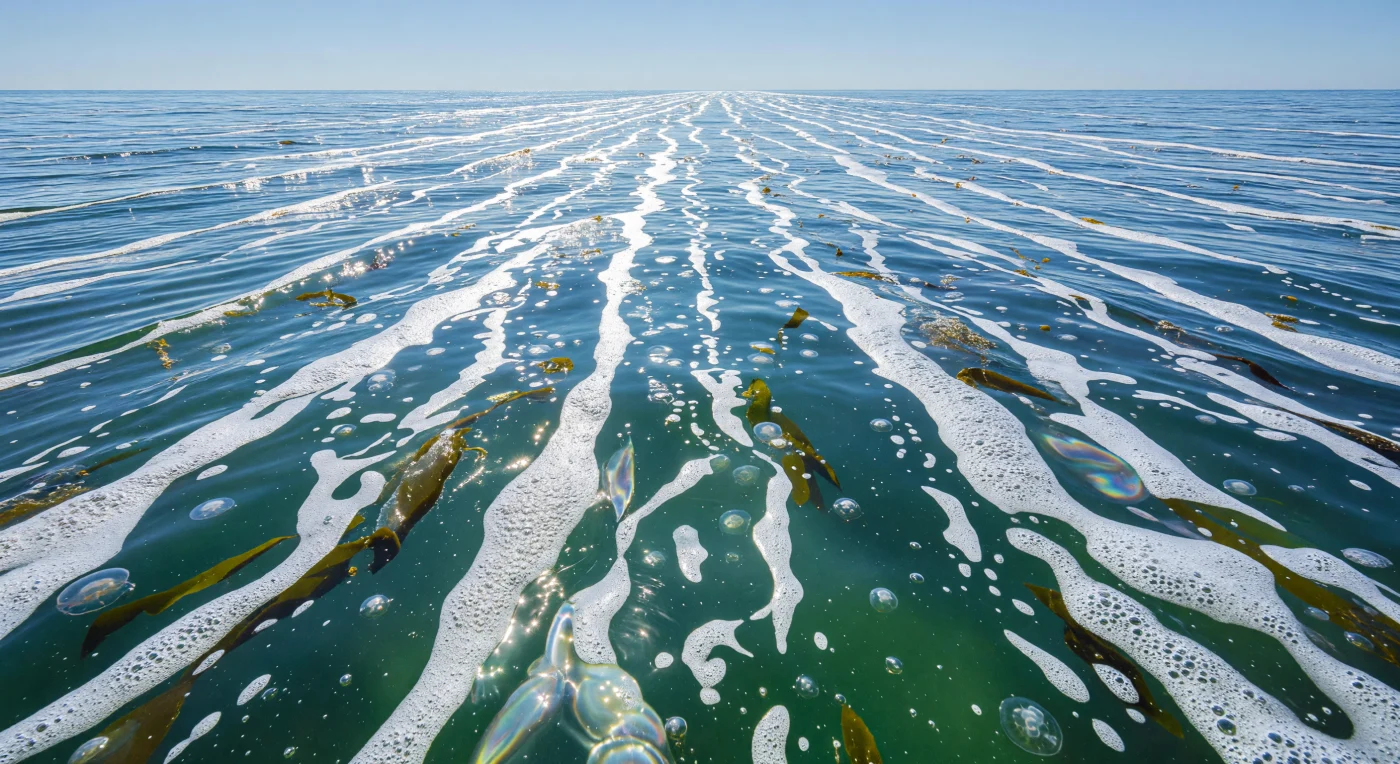
Skimming just thirty centimeters above the choppy surface of a temperate continental shelf, the AUV's camera resolves the sea into a living mosaic of parallel Langmuir convergence lines — wind-driven helical circulation cells that methodically sweep the surface layer, concentrating buoyant material into these long, orderly windrows of foam, froth, and biological debris. Between the pearlescent bubble rafts, translucent moon jellies drift half-submerged, their bells mirroring the hard noon sky, while torn olive kelp fronds and microbe-rich brown slicks of polysaccharide gel mark where dissolved organic matter and bacterial films have accumulated at concentrations orders of magnitude higher than the water a meter below. This is the sea-surface microlayer — a zone measured in micrometers to millimeters, yet disproportionately important: it governs the exchange of carbon dioxide, oxygen, and volatile organic compounds between ocean and atmosphere, hosts specialized neuston communities adapted to life at the very boundary of two fluid worlds, and generates the marine aerosols that seed distant clouds. The foam itself is no simple by-product of turbulence but a stabilized matrix of surfactant-coated bubbles that scatter sunlight into pearly, iridescent filaments, each thin film a temporary window into the intense photochemistry and gas dynamics occurring where ocean and atmosphere are, for a brief and brilliant moment, the same thing.
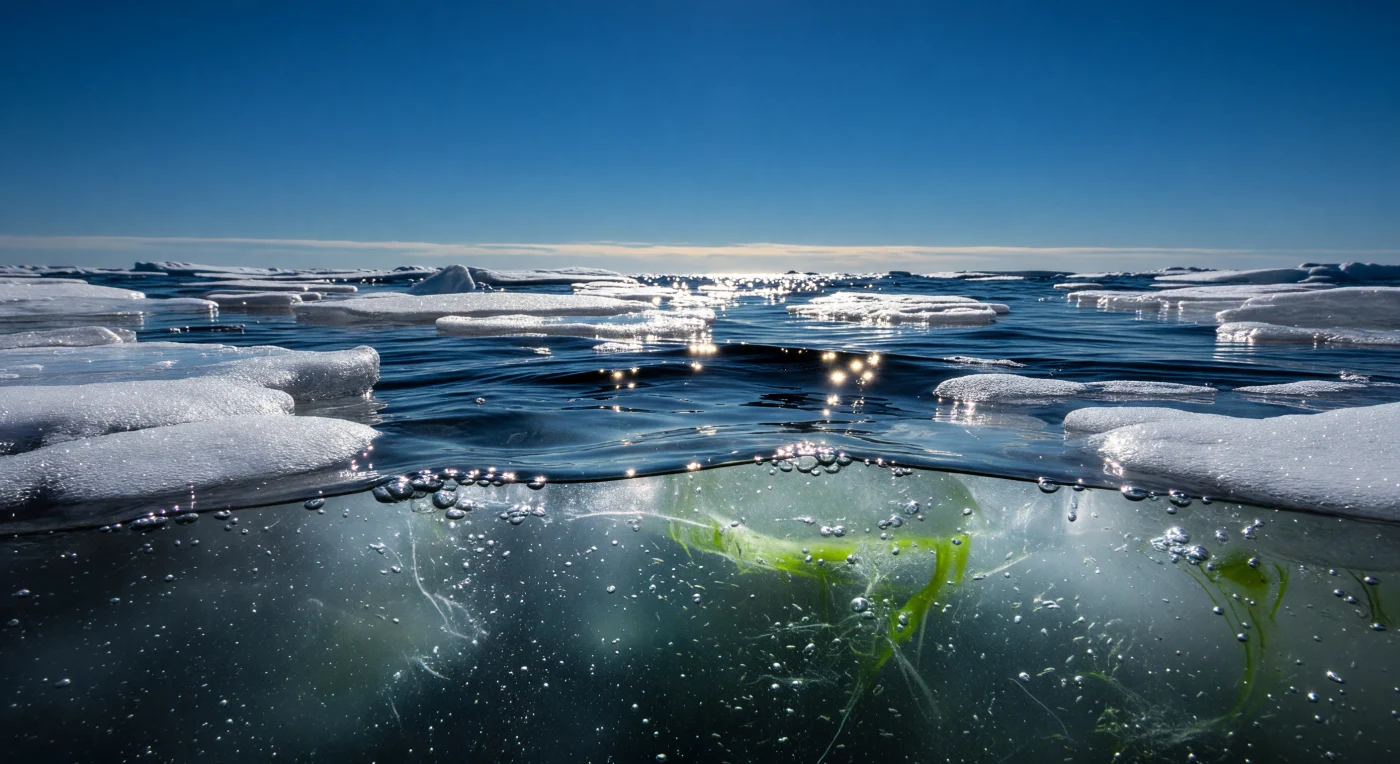
The snorkeler's face barely breaks the surface as a raft of creamy, surfactant-stiffened foam presses against the pancake ice, its thinnest bubble films refracting the polar twilight into fleeting violet and magenta arcs before collapsing in slow, silent succession. Above the waterline, the sky burns a deep cobalt rimmed with the last pale amber of a sun that never fully rises here, while below, the upper half-meter of water is luminous and strange — milked with microbubbles and exopolymer threads, the underside of nearby ice glowing blue-green where thin curtains of sympagic algae have colonized the frozen ceiling, drawing in every photon the atmosphere allows. Copepods hang suspended among drifting marine snow, their translucent bodies catching caustic glints as Snell's window fractures the surface into bright polygons and mirrored voids above. This extreme air-sea interface is one of the most chemically and biologically productive skins on the planet — concentrated with surface-active organic matter, microbial films, and dissolved gases exchanging furiously between water and atmosphere — yet pressure here is barely a whisper above one atmosphere, and the only cold that registers is absolute, the seawater held just above its own freezing point by salt. To hover at this threshold is to occupy the planet's own breath, the exact boundary where ocean becomes sky.
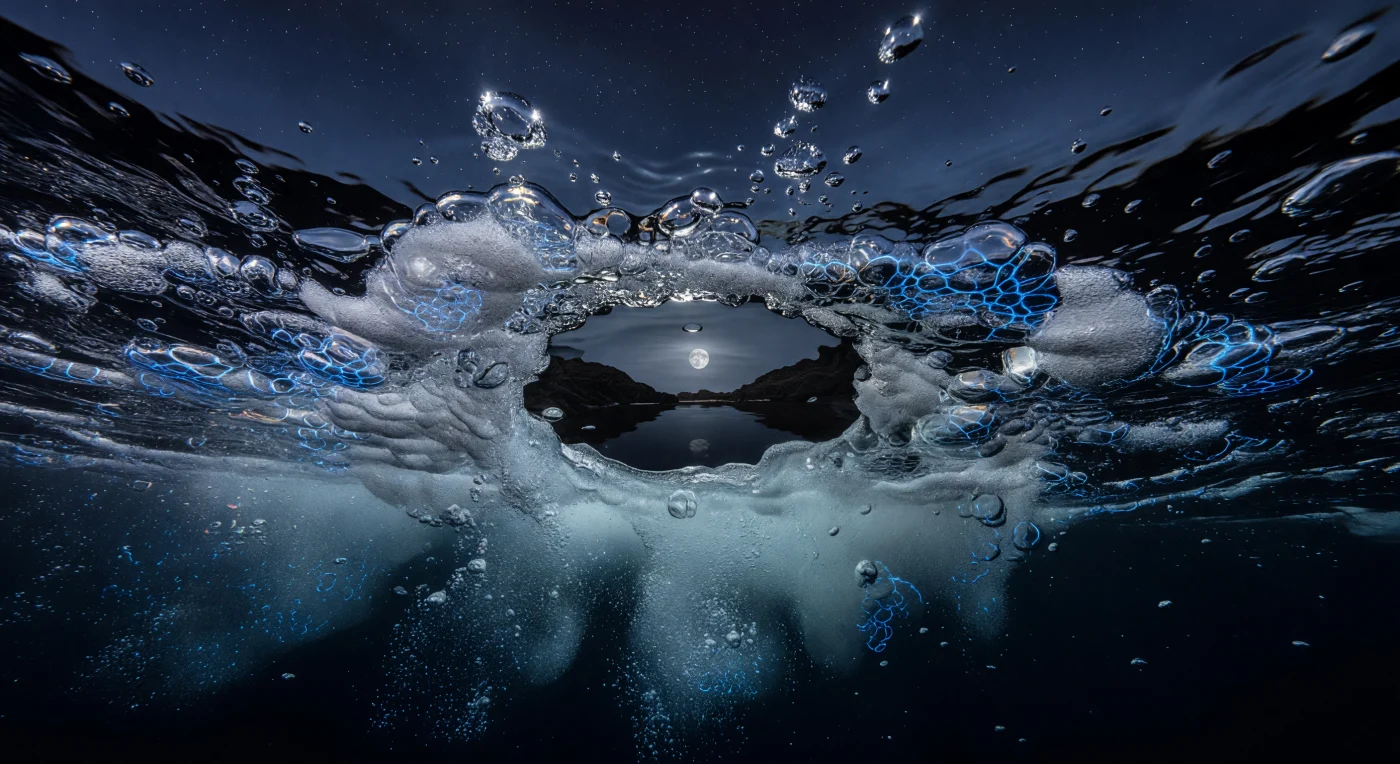
Suspended barely a hand's breadth below the moonlit surface, the free diver drifts inside a living architecture of collapsing froth, where each bursting bubble pocket releases a flash of electric blue as the dinoflagellates—likely *Noctiluca scintillans* or *Lingulodinium polyedra*—mechanically trigger their luciferase-mediated bioluminescence in response to the wave-driven shear. This is the sea-surface microlayer at its most spectacular: a chemically distinct, surfactant-enriched interface where dissolved organic carbon concentrates up to 1,000 times relative to the water below, forming the thin gelatinous films that give these bubble walls their iridescent, soap-film diffraction fringes. The volcanic island upwelling nearby enriches these nearshore waters with nutrients that fuel phytoplankton blooms, and under breaking surf the bubble plume acts as a bioreactor, intensifying gas exchange between ocean and atmosphere at rates far exceeding calm-water conditions. Looking up through Snell's window, the cold silver moon warps through the swell's lens while everything outside that cone of acceptance becomes a perfect mirror of total internal reflection—the physics of light at a refractive boundary making the shallow world feel simultaneously open and sealed. The pressure here barely registers against a diver's body, yet the scene pulses with biological and chemical complexity that rivals any deeper realm: a milky veil of microbubbles carrying surfactant-coated microbes skyward with every collapsing crest, the ocean's own breathing made visible in blue fire.