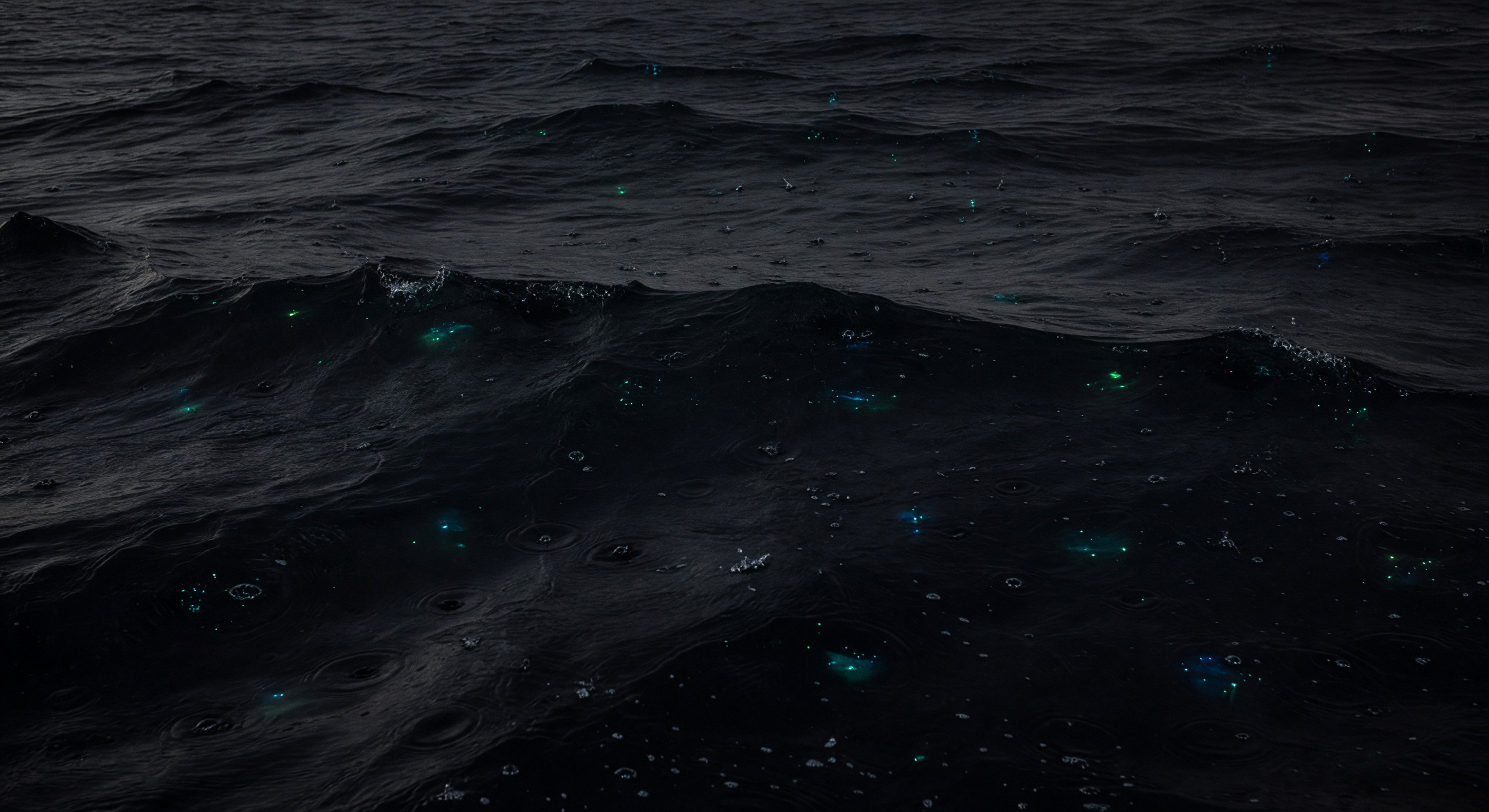
Where the open ocean breathes against a moonless sky, rain falls without witness onto three hundred million square kilometers of living water. Each droplet strikes with enough force to punch a momentary crater a few millimeters across, ejecting a symmetrical crown of displaced seawater that collapses back within milliseconds — a choreography of hydraulic mechanics repeated millions of times per second across the storm's footprint. The true spectacle belongs to the organisms just beneath the skin: dinoflagellates, those single-celled, bioluminescent plankton that respond to mechanical disturbance with bursts of cold blue-green light produced through the oxidation of luciferin, fire in isolated sparks and smears wherever a raindrop impact sends pressure waves radiating downward through the first centimeters of seawater. Acoustically, each raindrop also entrains a microscopic air bubble as it penetrates the surface microlayer, and these bubbles oscillate at frequencies between roughly 1 and 20 kilohertz, generating a broadband underwater sound field that marine bioacousticians can use to estimate rainfall rates remotely — the ocean is, in this sense, listening to itself. Here at the surface, salinity drops fractionally in a thin lens of fresher water, temperature shifts by tenths of a degree, and the sea-surface microlayer — that chemically distinct film only micrometers thick that mediates the exchange of gases including carbon dioxide and oxygen between ocean and atmosphere — is continuously disrupted and reformed, the planet's largest breathing surface endlessly renewing itself in the dark.
Rain on the ocean