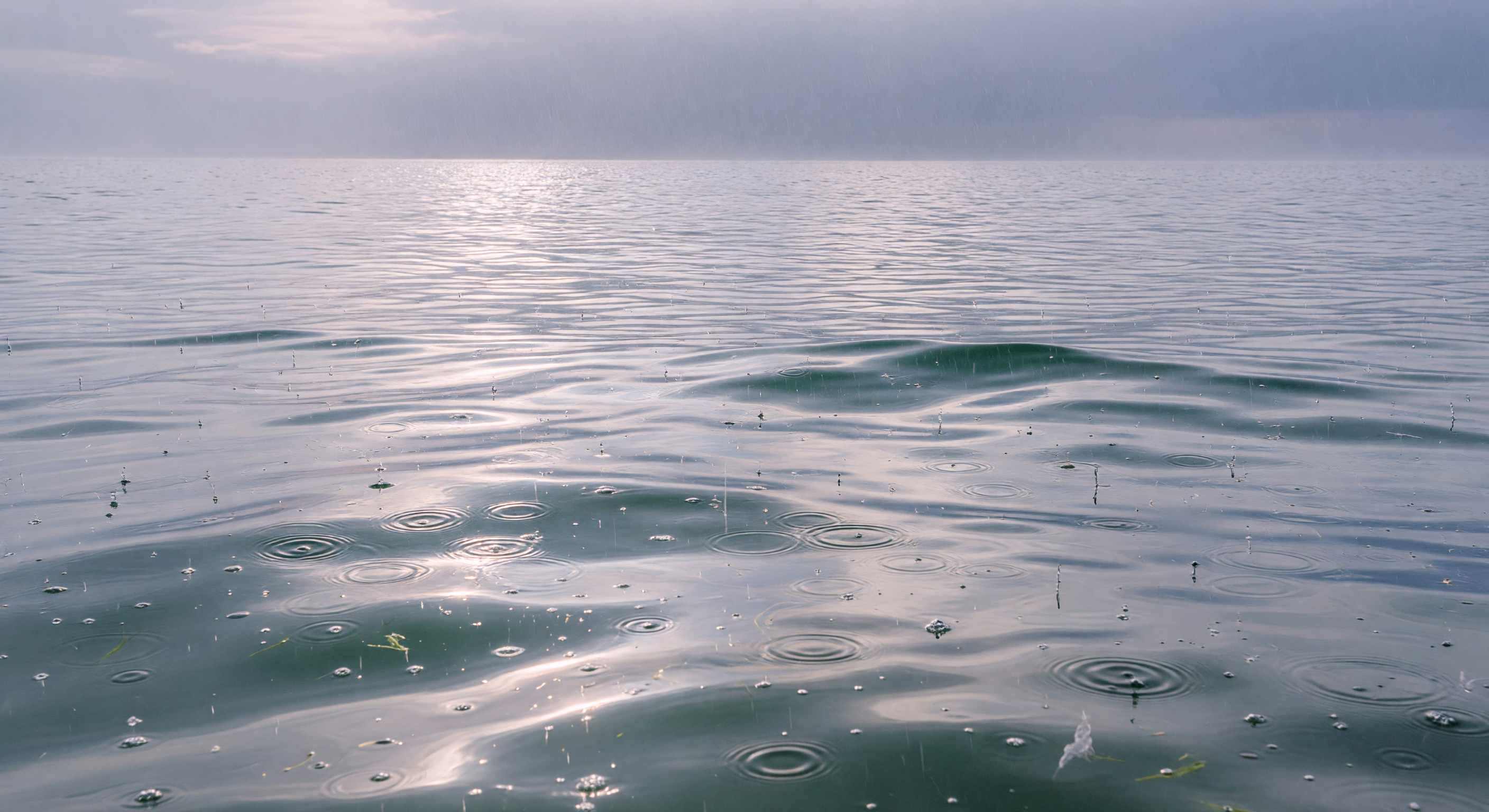
At the ocean's uppermost skin — a boundary measured in millimeters yet governing exchanges between atmosphere and sea — fine rain dismantles the surface microlayer one drop at a time, each impact excavating a momentary crater, flinging a crown of tiny droplets, and releasing a trapped air bubble that descends as a resonating sphere, producing the characteristic broadband hiss that propagates downward through the water column as a dense acoustic field. The sea-surface microlayer itself, that gossamer film enriched with dissolved organics, lipids, and gelatinous neuston — organisms that spend their entire lives at this precise boundary — is rhythmically disrupted and reconstituted between impacts, its translucent residents rocking on the interference rings crossing the broader swell geometry beneath a pre-dawn sky diffusing cool silver-lilac light. Where clusters of drops strike together, bubble plumes carry freshened, slightly cooler water downward, creating transient haline lenses only centimeters thick that float above the saltier ocean below, a microstratification that will persist only until wind or breaking waves erase it. This is where the hydrological cycle closes its loop, where evaporated ocean water returns as precipitation to locally freshen the surface, cool the skin, seed acoustic turbulence, and nourish the invisible community of organisms riding the interface — a world of extraordinary physical complexity existing at the thinnest possible margin between sky and sea.
Other languages
- Français: Pluie d'Aube sur la Houle
- Español: Lluvia del Alba sobre Oleaje
- Português: Chuva do Amanhecer sobre Ondas
- Deutsch: Morgenregen über der Dünung
- العربية: مطر الفجر فوق الأمواج
- हिन्दी: भोर की वर्षा लहरों पर
- 日本語: 夜明けの雨と大波
- 한국어: 새벽 비 너울 위로
- Italiano: Pioggia dell'Alba sul Moto Ondoso
- Nederlands: Dageraadsregen over de Deining