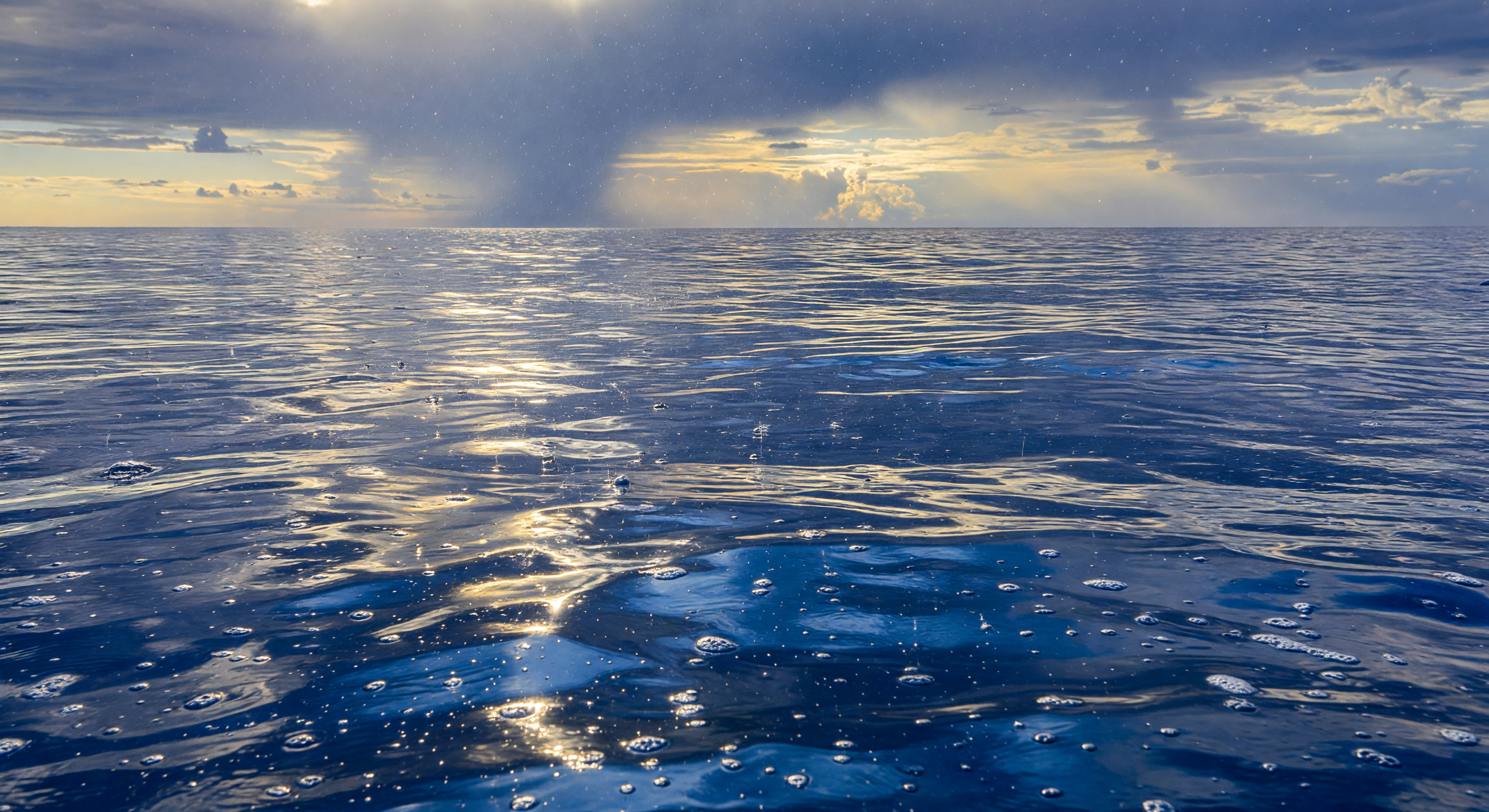
At the sea's uppermost skin — the few millimetres where atmosphere surrenders to ocean — a passing rain shower rewrites the surface in real time. Each raindrop arrives carrying kinetic energy sufficient to punch a concave crater several times its own diameter, eject a thin Worthington jet, and collapse back into a ring of capillary wavelets within fractions of a second; multiplied across millions of simultaneous impacts, this generates a continuous broadband acoustic field that propagates downward through the upper mixed layer as an invisible percussive halo, detectable by cetaceans and fish far below. The freshwater delivered by rainfall creates a transient haline lens only centimetres thick yet measurably lighter than the saline water beneath it, briefly stratifying the surface microlayer and suppressing turbulent exchange of heat and gas between ocean and atmosphere until wind stress eventually erases the anomaly. Low-angle sunlight breaking beneath the retreating cloud mass catches the roughened capillary texture at oblique incidence, fracturing into irregular caustic ribbons that tremble and split just centimetres below the interface, their geometry encoding the surface's constantly renegotiated topography of impact craters, ringlets, wind-driven capillary waves, and ephemeral foam streaks. This is the ocean at its most dynamically alive and least witnessed — a self-organizing boundary where rainwater mixes into seawater, acoustic energy dissipates into depth, and sunlight is scattered back toward a sky that holds no observer.
Rain on the ocean