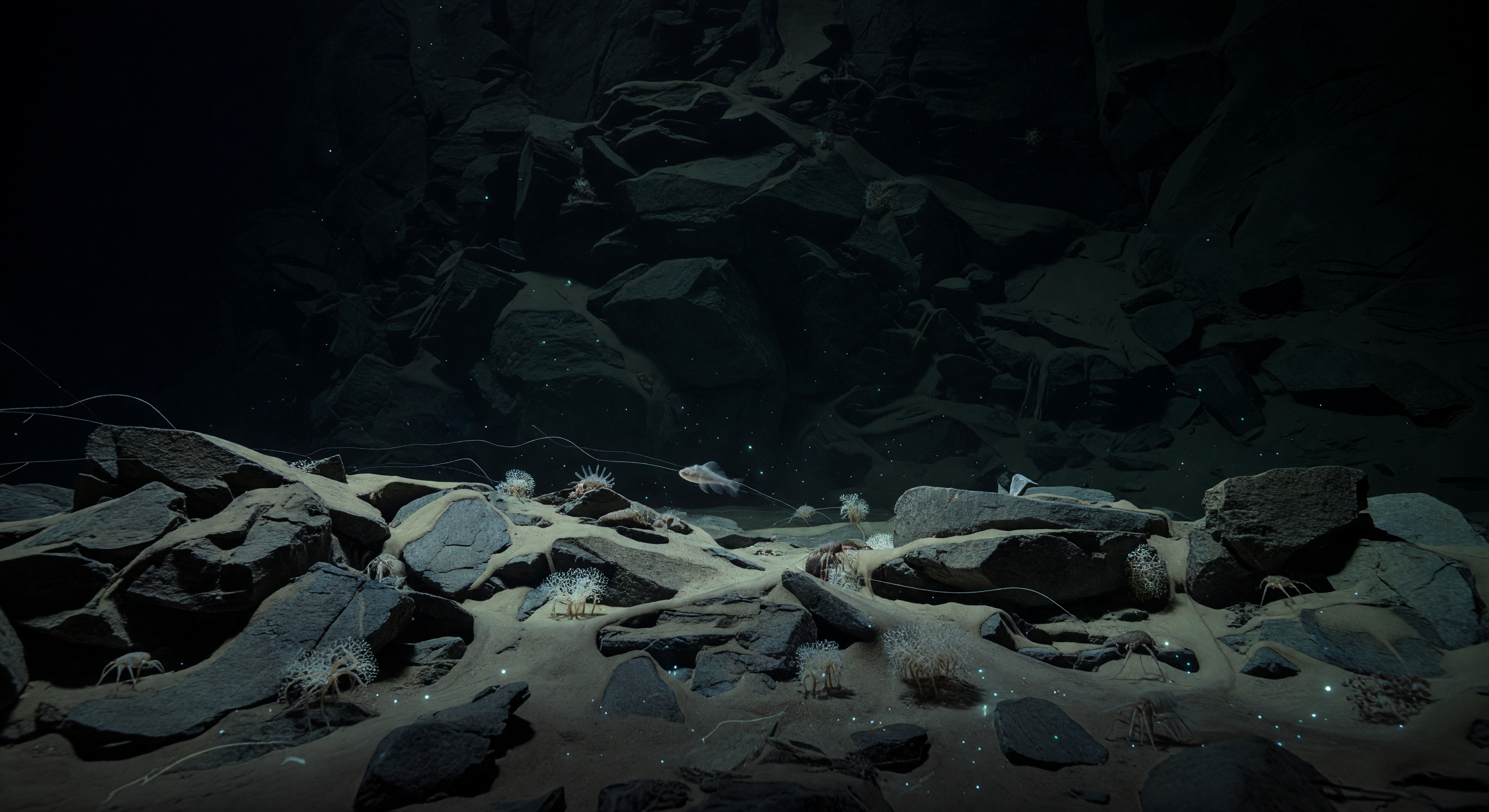
At the foot of the Kermadec Trench wall, angular slate-colored blocks and fractured rock shards form a rugged talus apron draped in fine organic-rich mud, where sediment tongues pool between stones at depths approaching ten thousand meters and pressures exceeding eight hundred atmospheres — a physical environment that crushes conventional biochemistry and demands extraordinary molecular adaptation from every organism present. Isolated xenophyophores, among the largest single-celled organisms on Earth, occupy sheltered pockets between the rubble, their pale reticulate forms partly embedded in the soft substrate, filtering the sparse organic particles that the trench's topographic geometry funnels relentlessly downslope. Thin threads of marine snow and resuspended particulate drift in weak bottom-guided currents across the apron, tracing the faint nepheloid haze that persists close to the sediment surface in this near-freezing, perfectly dark water. A translucent hadal snailfish — likely *Notoliparis* or a related liparid whose tissues are biochemically braced against collapse by piezolytes such as TMAO — drifts ghostlike above the talus, its pale body barely distinct from the surrounding blackness, while giant amphipods of the genus *Hirondellea* move purposefully among crevices where organic matter accumulates. Sparse cold points of cyan and blue-green bioluminescence from drifting microscopic organisms offer the only light this world has ever known, glinting faintly off wet rock surfaces as the trench wall rises into unseen darkness above — a tectonic scar in the lithosphere, utterly indifferent, ancient, and complete in itself.
Kermadec Trench