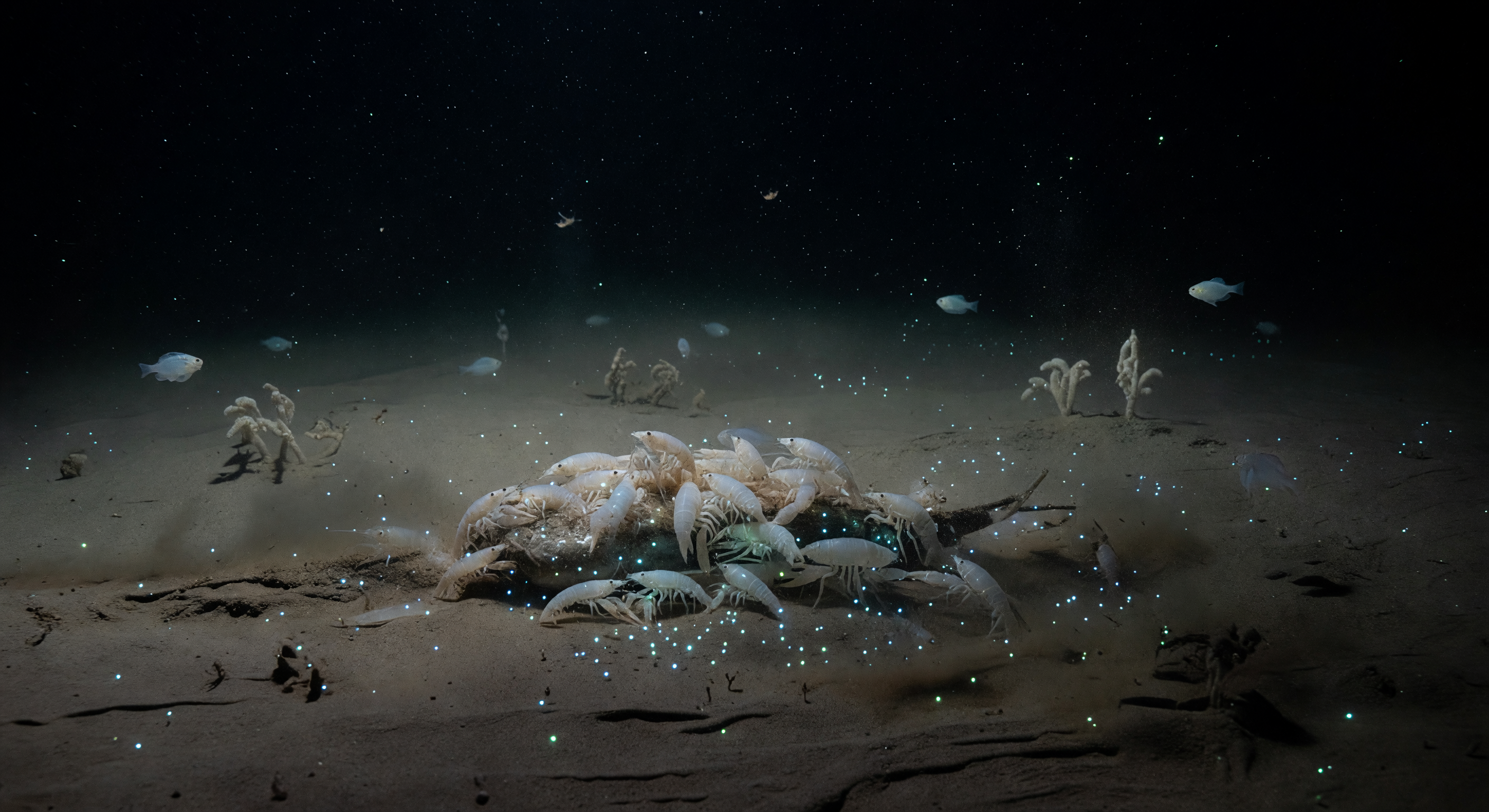
At roughly eight to ten kilometres beneath the surface of the southwest Pacific, where the Pacific Plate bends downward into the mantle and hydrostatic pressure exceeds 800 atmospheres, a carcass has come to rest on the soft taupe-gray sediment of the Kermadec Trench floor — and the hadal world has answered with extraordinary swiftness. Dense masses of *Hirondellea gigas*, giant pale amphipods whose translucent to milky-white bodies are exquisitely adapted to near-freezing water and crushing pressure through elevated concentrations of piezolytic compounds, move across the carcass in a frantic living mantle, their chitinous appendages stirring a low nepheloid cloud of fine silt that drifts outward and upward in the near-motionless water column. Scattered cyan and green bioluminescent pinpricks — produced within the swarm itself and by tiny organisms suspended in the darkness — catch on wet tissue, on individual grains of lifted sediment, and on the marine snow particles that descend constantly through this absolute aphotic void, the only light this world has ever known. In the quieter sediment beyond the carcass, the crinkled forms of xenophyophores — giant single-celled foraminifera that can reach tens of centimetres across — punctuate undisturbed patches of the trench floor, while a few translucent hadal snailfish, their skeletons reduced and their flesh gelatinous under evolutionary pressure, hover just above the bottom at the edge of the disturbance, their bodies barely resolved by the cold bioluminescent glow. This scene unfolds without witness, as it has across geological time: a closed, pressurized, primordial system cycling organic matter downward into the deepest crease of the ocean.
Kermadec Trench