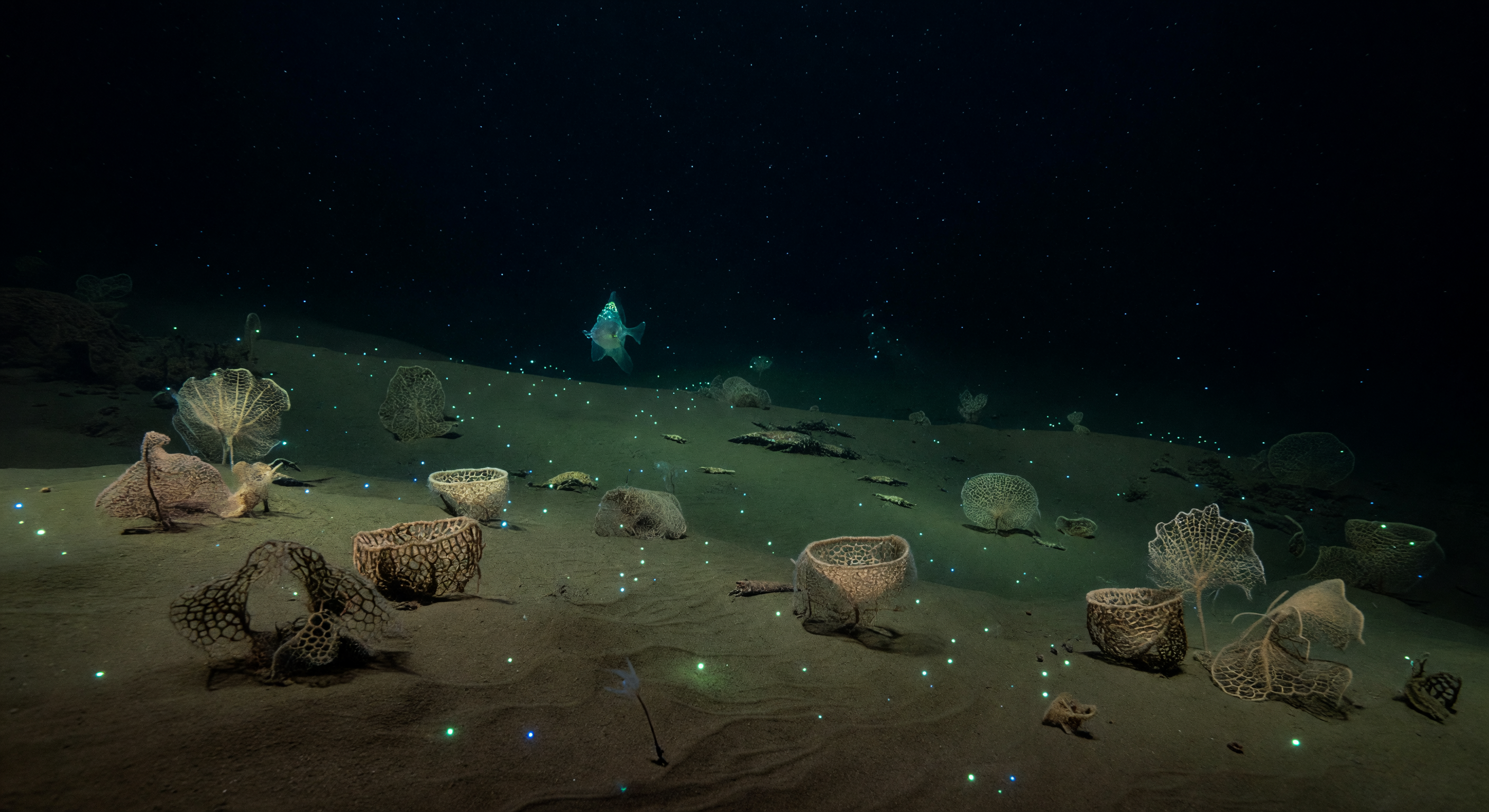
Along the lower flanks of the Kermadec Trench, at depths where hydrostatic pressure exceeds 800 atmospheres and temperatures hover near 1–2 °C, a gently sloping bench of olive-brown silt stretches into absolute darkness, its surface softened by centuries of accumulated marine snow and finely rippled by the weakest of bottom currents. Rising from this sediment in scattered, improbable gardens are xenophyophores — among the largest single-celled organisms on Earth — their reticulate fans and tangled lattice forms standing as pale tan filigree against the black water, some intact, others partly subsided into the mud they have colonized, all of them silently concentrating heavy metals and organic particles in a chemistry the hadal zone has refined over geological time. Faint cyan and green points of bioluminescence drift through the near-bottom nepheloid layer, briefly tracing the edges of xenophyophore fans and catching suspended particles in transit — the only illumination this world has ever known, produced entirely by the organisms passing through it. A ghost-pale hadal snailfish, its body gelatinous and pressure-adapted, its skeleton reduced to near transparency, glides just above the slope with unhurried lateral sweeps, its tissues stabilized against molecular collapse by elevated concentrations of piezolytic compounds, while farther along the bench, *Hirondellea gigas* amphipods move across darker patches of sunken organic detritus, dismantling what the water column above has slowly surrendered downward. This is the Kermadec hadal system as it has always been: a world of immense pressure, near-freezing stillness, and quiet biological purpose, existing entirely without witness.
Kermadec Trench