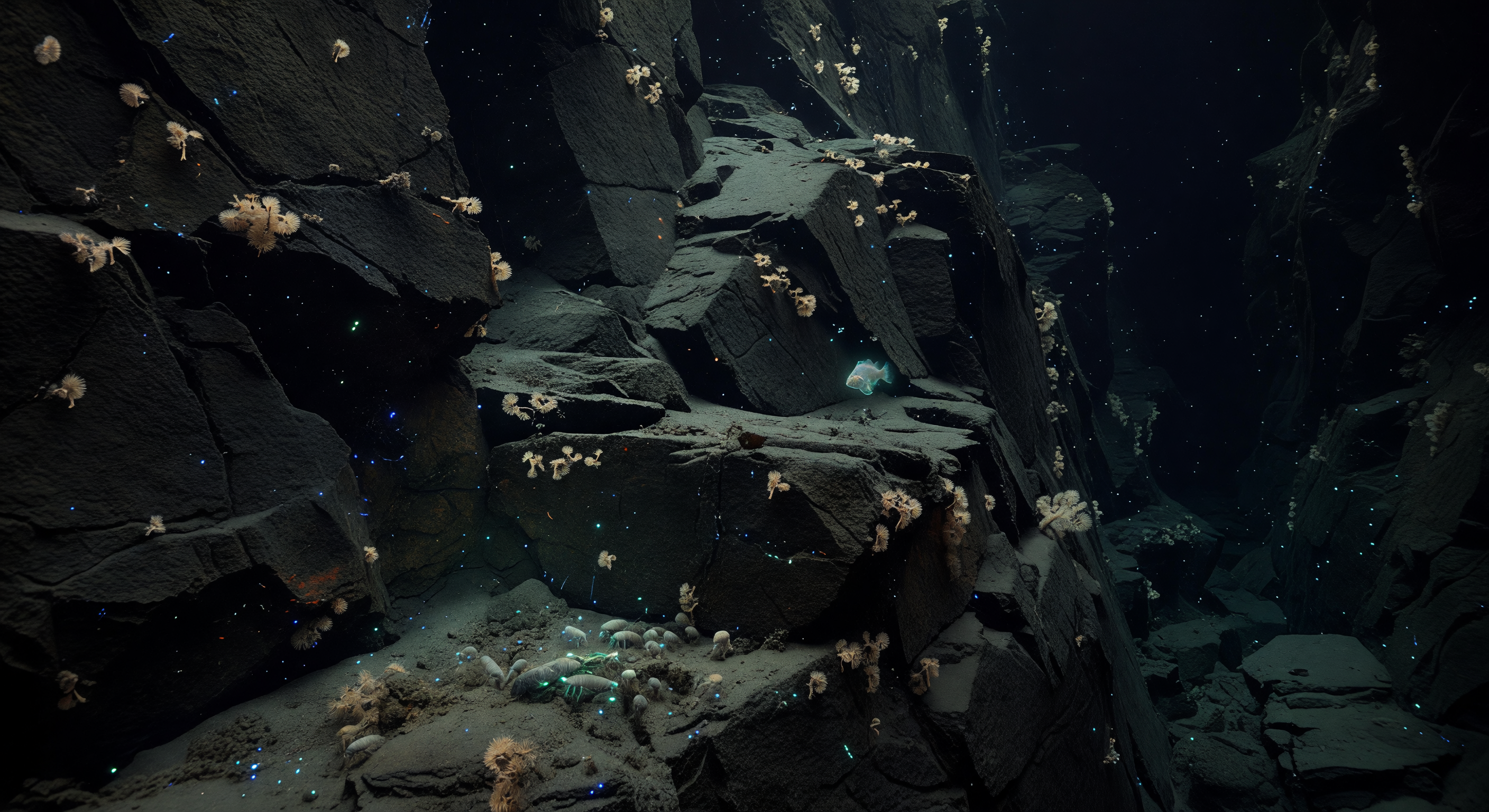
The near-vertical face of the Kermadec Trench wall descends without apparent end, a colossal tectonic wound where the Pacific Plate bends downward into the mantle at pressures approaching 1,000 atmospheres, cold water locked at barely 1–2 °C, every cubic centimeter of it bearing a crushing stillness that has persisted for millions of years. Fractured charcoal-black basalt and ash-gray sediment ledges stack upon one another in receding scarps, their surfaces veneered in organically enriched silt and punctuated by sparse xenophyophores — among the largest single-celled organisms on Earth — clinging to softer ledges in pale beige rosettes, filtering the slow fall of marine snow that drifts down from a sunlit surface world impossibly remote above. A ghost-pale hadal snailfish, gelatinized and pressure-adapted, holds position near a fractured ledge in the middle distance, its translucent body barely distinguished from the black water except where distant bioluminescent pinpricks — tiny flashes from drifting organisms scattered through the aphotic column — intermittently trace the contours of rock and sediment in cold blue-green light. Below, where organically enriched sediment collects against the base of the wall, a loose swarm of outsized amphipods works the soft substrate around a naturally sunken carcass, their pale segmented bodies catching faint cyan highlights, part of the hadal scavenging community that thrives precisely because this topographic funnel concentrates food falling from far above. The wall continues beyond all visibility into an ancient, witnessless dark, a world complete in itself, indifferent to observation, shaped entirely by pressure, tectonics, cold, and the slow chemistry of the deep.
Kermadec Trench