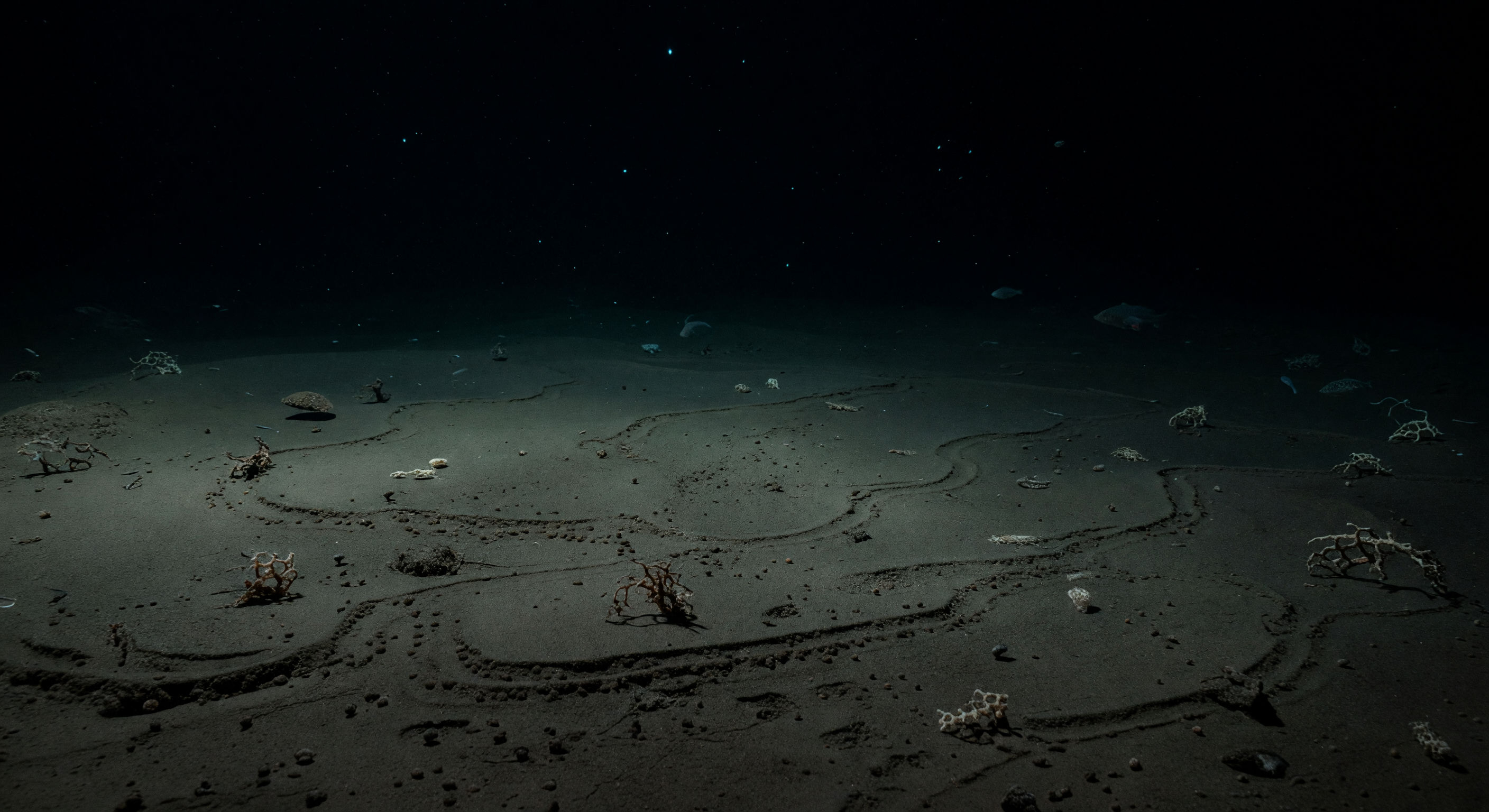
At roughly eight to ten thousand metres beneath the southwest Pacific surface, where the Pacific Plate bends into the mantle beneath the Kermadec subduction system, hydrostatic pressure exceeds eight hundred atmospheres and the water temperature hovers near one to two degrees Celsius — conditions that have shaped an ecology of extraordinary biochemical ingenuity. The sediment floor recorded here is not inert; it is a written archive of hadal life, its velvety silty surface inscribed with meandering foraging trails left by deposit-feeding invertebrates, punctured by tiny feeding pits, raised into low pelletized ridges by organisms processing organic-rich detritus, and scattered with the broken pale lattices of xenophyophore fragments — giant single-celled foraminifera whose delicate tests have collapsed under time and pressure into half-sunken ruins. The trench acts as a topographic funnel, concentrating phytodetrital marine snow and carcass fall from the abyssal plains above, producing sediment measurably enriched in organic carbon relative to surrounding seafloor and sustaining scavengers and deposit feeders at densities unusual for such depth. Rare cyan sparks suspended far above the bottom and cold-blue glimmers from drifting organisms provide the only light in this absolute darkness, enough to separate texture from surrounding blackness but no more, while ghostlike hadal snailfish — their tissues stabilized against pressure collapse by elevated concentrations of the piezolyte TMAO — drift through the farther gloom above a floor that corrugates faintly with the micro-relief of weak bottom currents and episodic sediment settling. This world proceeds in crushing stillness, wholly indifferent to observation, its ecology written only in mud.
Other languages
- Français: Mosaïque de sédiments écrits
- Español: Mosaico de sedimento escrito
- Português: Mosaico de sedimento escrito
- Deutsch: Geschriebenes Sediment-Mosaik
- العربية: فسيفساء الرواسب المكتوبة
- हिन्दी: लिखित तलछट मोज़ेक
- 日本語: 堆積物の文様模様
- 한국어: 기록된 퇴적물 모자이크
- Italiano: Mosaico di sedimenti scritti
- Nederlands: Geschreven sedimentmozaïek