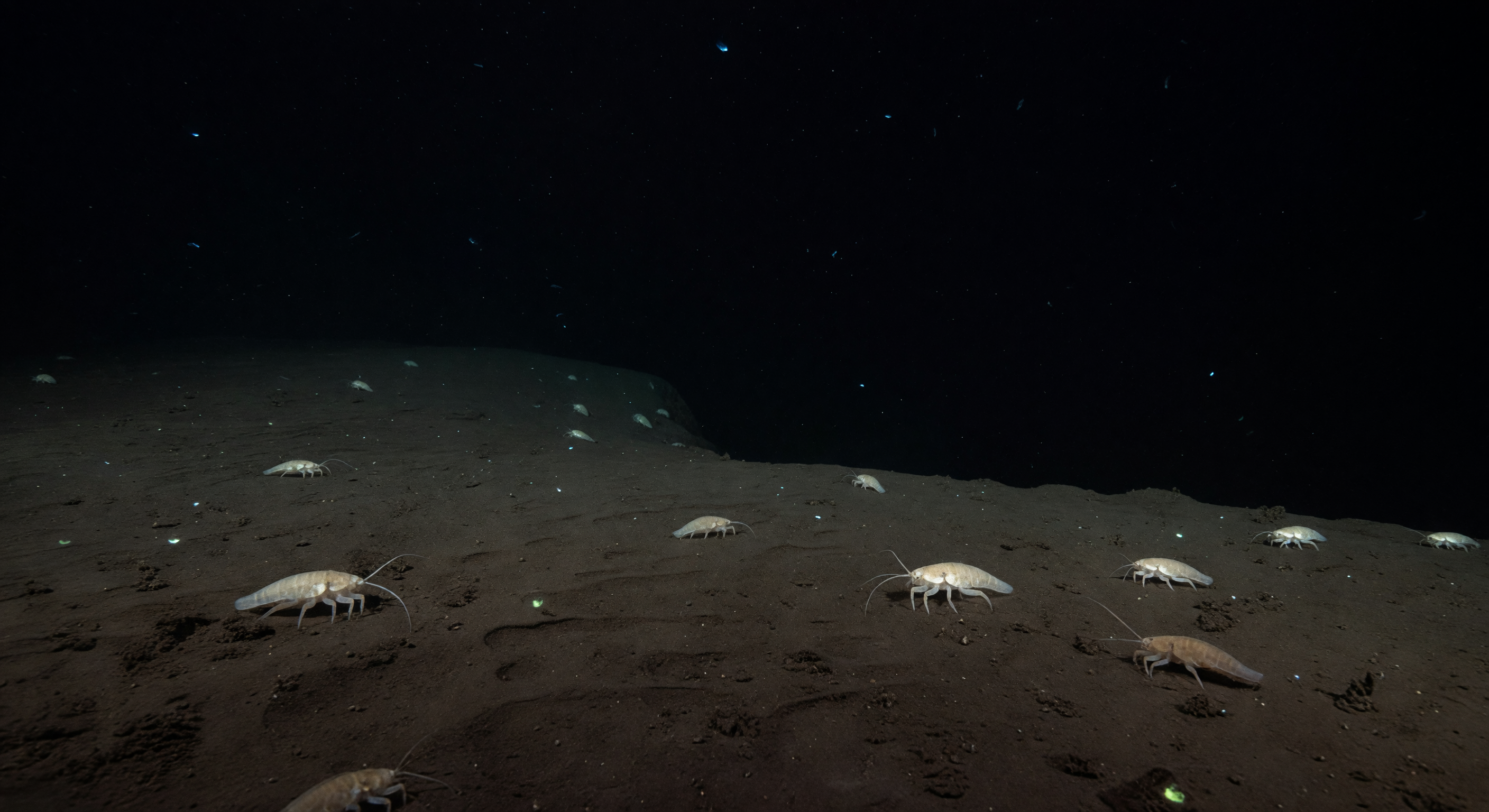
At depths approaching 9,000 meters beneath the southwest Pacific, the floor of the Kermadec Trench lies under roughly 900 atmospheres of hydrostatic pressure — a crushing force that has shaped every biochemical adaptation present in the sparse but specialized life found here. The sediment plain is a slow accumulation of millennia: fine clay particles, siliceous microfossil fragments, and a continuous drizzle of organic detrital aggregates that funnel down the trench's steep walls by a topographic effect, concentrating food energy along the axial floor in quantities exceeding those on the surrounding abyssal plains. Across this chocolate-gray expanse, several individuals of *Hirondellea gigas* — giant lysianassoid amphipods reaching several centimeters in length — move with purposeful, low-amplitude locomotion, their translucent cream exoskeletons revealing segmented musculature and pale visceral structures beneath, bodies biochemically stabilized against pressure collapse by elevated concentrations of trimethylamine N-oxide in their tissues. The water column above is near-freezing, close to 1–2 °C, and utterly devoid of solar photons — any faint photonic presence here originates entirely from the sparse bioluminescent chemistry of drifting mesopelagic organisms sinking far beyond their living depth, their dim cyan-blue emissions the only light this sediment has ever known. This is a world that has persisted in its silence across geological time, indifferent to the surface above, organized entirely by pressure, cold, gravity, and the slow rain of the dead.
Kermadec Trench