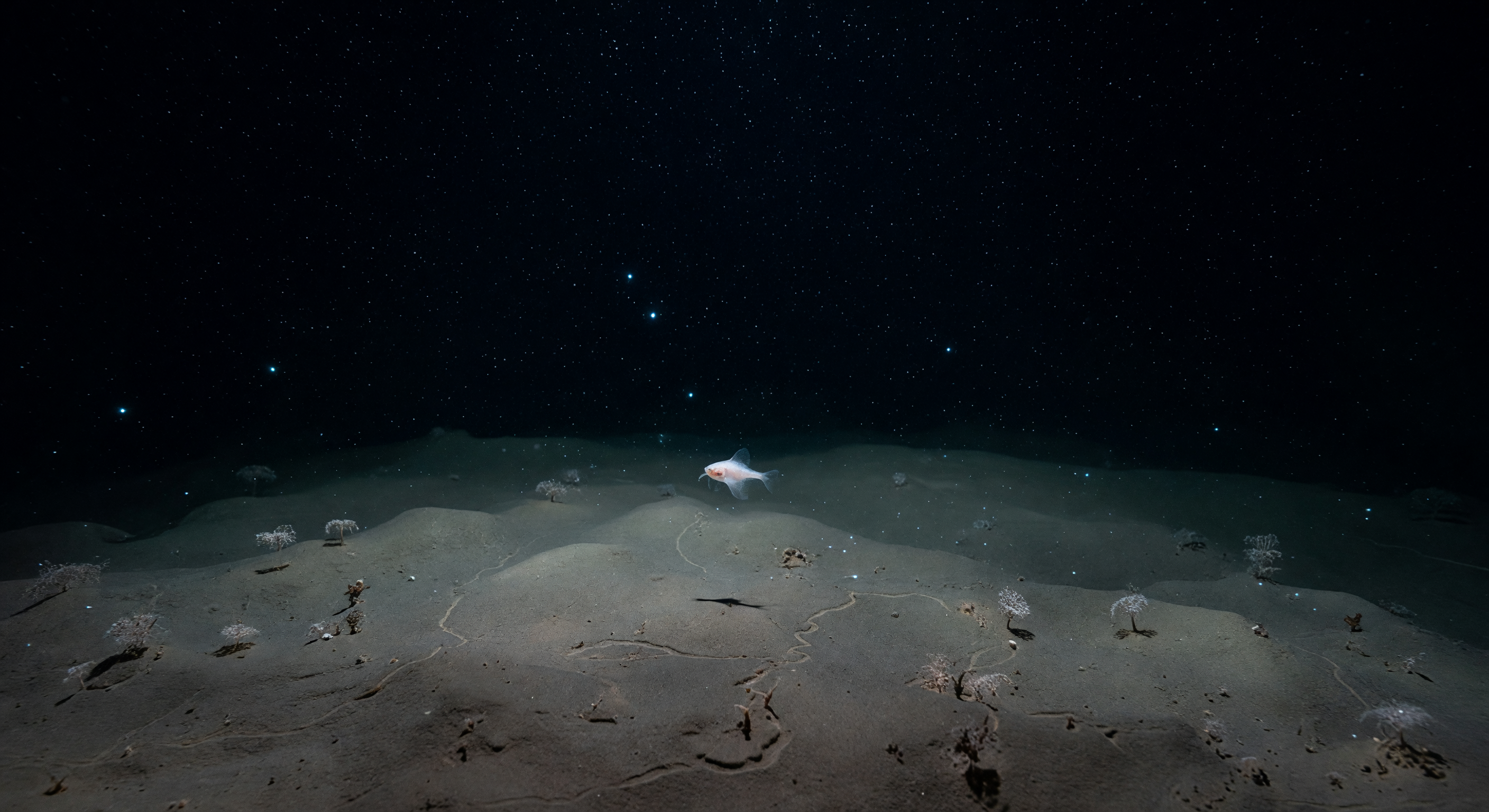
At roughly eight to ten thousand meters beneath the surface of the southwest Pacific, within the narrow axial floor of the Kermadec Trench, a solitary snailfish — *Notoliparis kermadecensis* or close kin — drifts in near-weightlessness above sediment that has accumulated over geological time as a slow rain of organic particles funneled downslope by the trench's own topography. The hydrostatic pressure here approaches eight hundred to one thousand atmospheres, enough to compress cellular membranes and denature unprotected proteins, yet this fish persists through biochemical adaptation: elevated concentrations of trimethylamine oxide stabilize its enzymes against pressure-induced deformation, while the reduction of mineralized bone renders its gelatinous body neutrally buoyant in water just above freezing, near one to two degrees Celsius. The sediment below it is soft, organically enriched relative to the surrounding abyssal plain, dimpled by feeding traces left by amphipods and deposit feeders, and studded at intervals with xenophyophores — giant single-celled foraminifera whose lace-like tests rise from the mud as among the largest individual cells known to exist on Earth. No sunlight has reached this depth in any geological era of life's history; what faint illumination exists comes only from the bioluminescent chemistry of organisms themselves, transient cyan sparks drifting through a suspension of marine snow that falls without destination through water that has not seen the sky for centuries. The trench exists entire and indifferent, its pressures absolute, its silences older than any record of it.
Other languages
- Français: Dérive du Poisson Fantôme
- Español: Deriva del Pez Fantasma
- Português: Deriva do Peixe Fantasma
- Deutsch: Geisterschneckenfisch Drift
- العربية: انجراف سمكة الحلزون الشبح
- हिन्दी: भूत घोंघा मछली प्रवाह
- 日本語: 幽霊クサウオの漂流
- 한국어: 유령 달팽이물고기 표류
- Italiano: Deriva del Pesce Fantasma
- Nederlands: Spookslakvis Drift