At depths where hydrostatic pressure exceeds 800 atmospheres and water temperatures hover near 1–2 °C, the hadal interior of the Kermadec Trench exists in a state of absolute, sunless permanence — a narrow tectonically-sculpted corridor where the Pacific Plate's descent into the mantle has carved one of the deepest environments on Earth. Suspended throughout the water column, a perpetual drift of marine snow — disaggregated fecal pellets, fragmented phytodetrital flakes, and fine organic dust — descends through layered nepheloid veils, concentrated here by the trench's funnel geometry into a richer organic flux than the surrounding abyssal plains ever receive. Through this living sediment drift, microscopic bioluminescent organisms — gelatinous zooplankton, planktonic bacteria, and perhaps the faint metabolic pulses of unseen hadal fauna adapted through piezolytic biochemistry — leave thin, broken filaments of cold blue and cyan light that dissolve within centimeters, written and immediately erased in water so dark it registers as a gradient from blue-black to absolute nothing. Far below, barely distinguishable from the darkness itself, the trench floor accumulates organic-enriched sediment where Hirondellea gigas amphipods and translucent snailfish navigate a world defined entirely by pressure, chemical gradients, and the slow rain of matter from a sunlit ocean eleven kilometers overhead. This place does not wait — it simply continues, indifferent and immeasurable, as it has for millions of years of subduction.
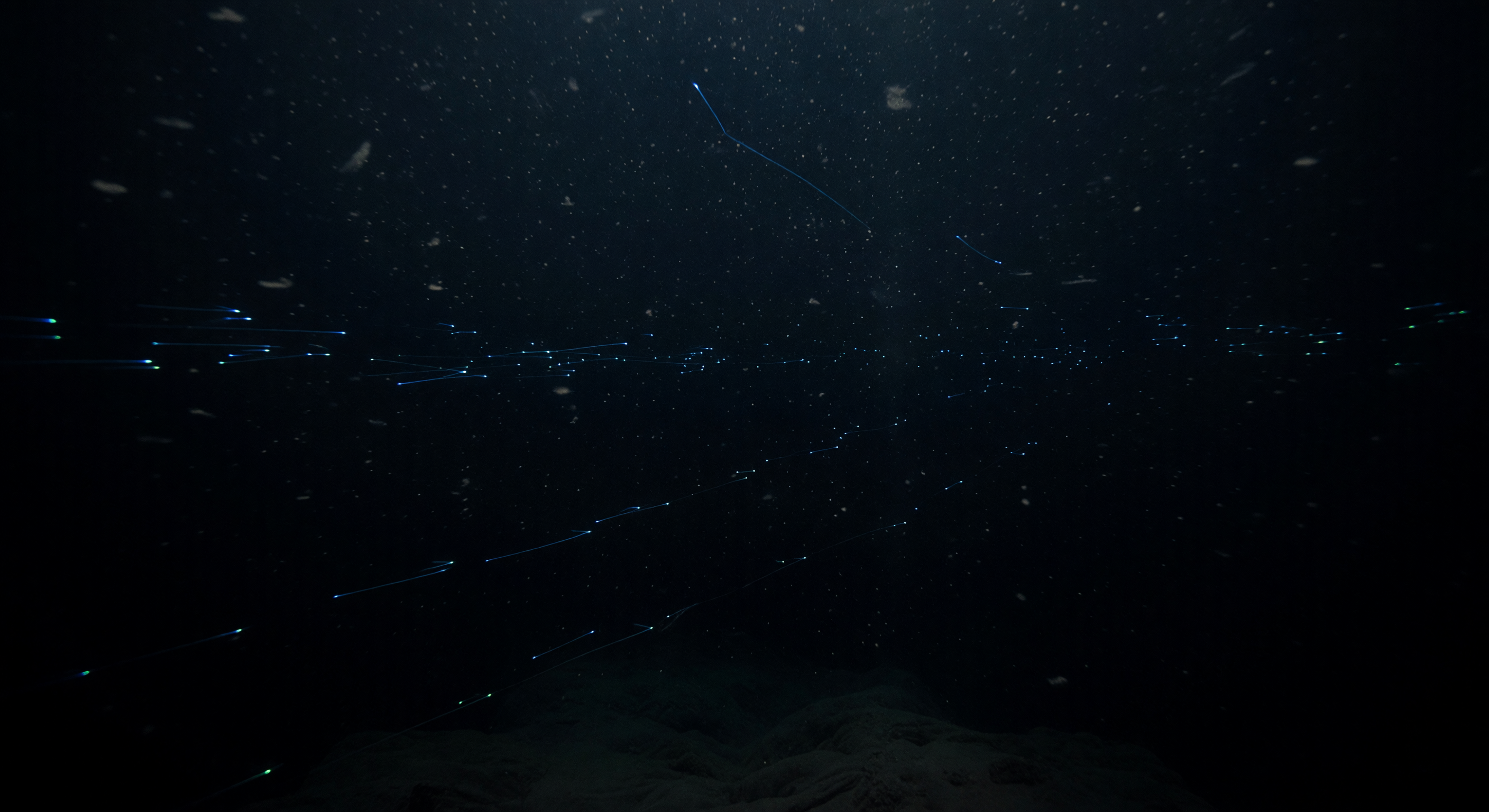
Kermadec Trench