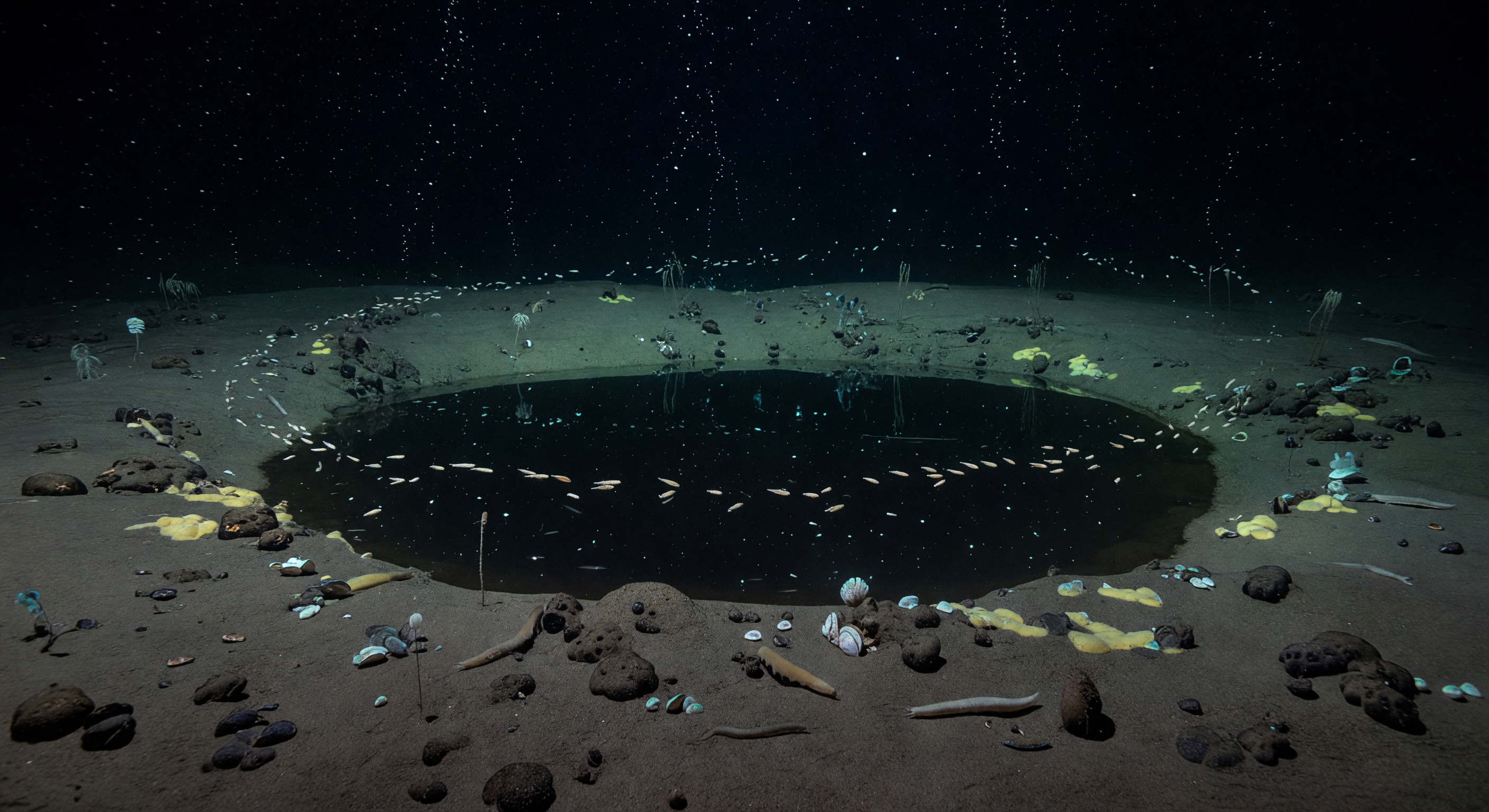
At depths where pressure exceeds four hundred atmospheres and the water temperature hovers near freezing, a shallow depression in the grey-brown sediment holds one of the ocean's most alien phenomena: a brine pool, its hypersaline body so dense — two to eight times the salinity of the surrounding seawater — that it rests as a discrete liquid mass with a razor-defined halocline marking the boundary between worlds. Above this mirror-like interface, an unbroken rain of marine snow descends from the sunless water column above, each particle a fragment of dead plankton, fecal pellets, and organic detritus that has fallen for weeks through kilometers of darkness, only to stall abruptly at the density boundary and drift laterally, accumulating into a suspended horizontal veil that catches vanishingly faint bioluminescent glimmers from drifting microorganisms. Along the pool's margins, sulfur-yellow bacterial mats and pale Bathymodiolus mussels — their tissues threaded with chemosynthetic symbionts that fix energy from methane and hydrogen sulfide rather than sunlight — form a chemosynthetic oasis, while holothurians move at imperceptible pace across the surrounding sediment and sea pens rise like pale antennae from the silt, filtering what little organic matter the current carries. Scattered across the abyssal plain, manganese nodules accreted over millions of years sit undisturbed in the mud, their slow geological time entirely indifferent to the chemical theater of the brine below — a world of extreme salinity, anoxia, and primordial chemistry that has operated in complete darkness and utter silence long before and entirely without witness.
Abyssal brine pools