Scientific confidence: High
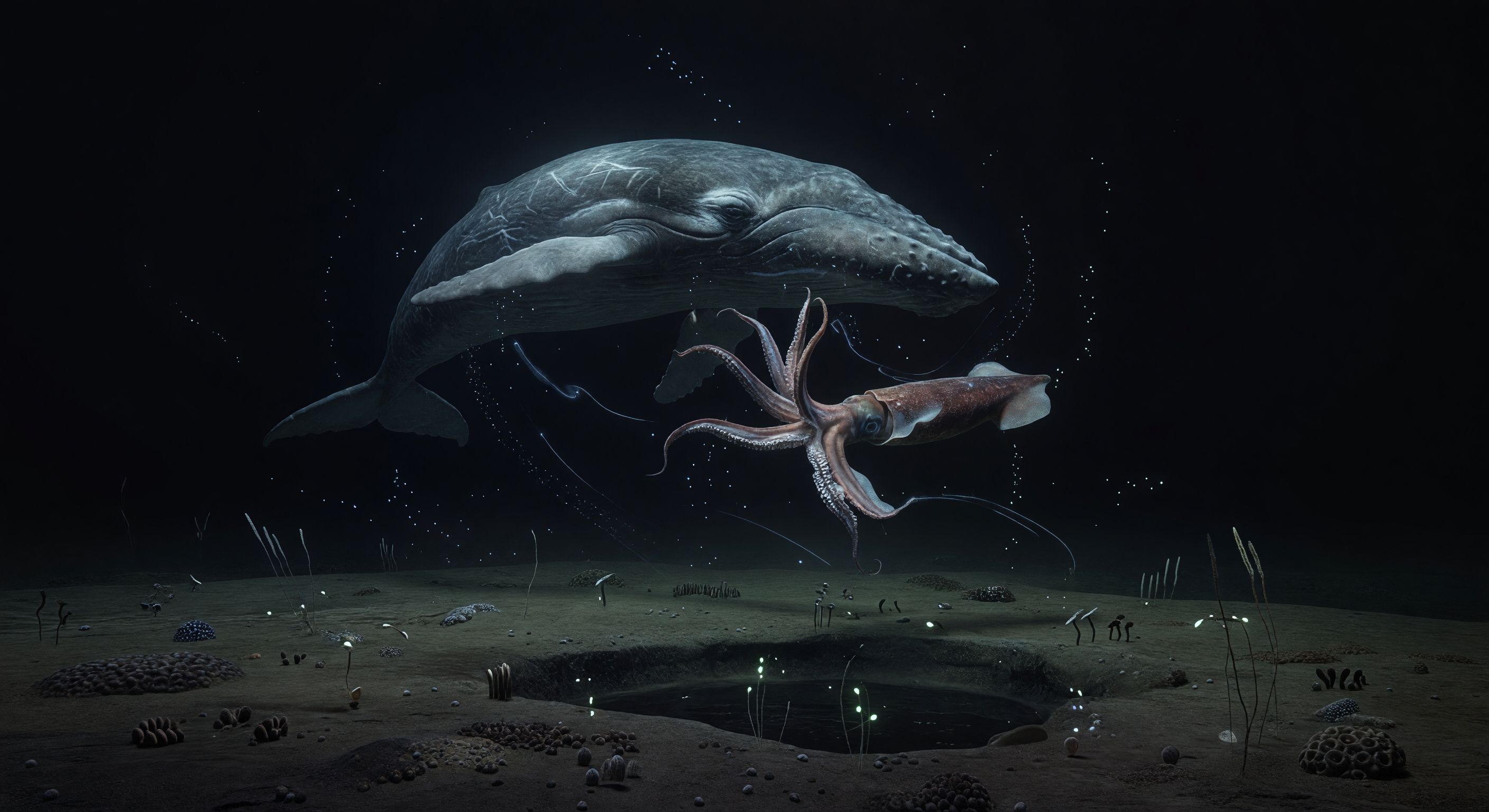
In the absolute darkness above a vast abyssal plain, two of the ocean's most formidable organisms meet in silent, crushing violence: a scarred adult sperm whale (*Physeter macrocephalus*), capable of diving beyond 2,000 meters on a single breath and withstanding pressures exceeding 400 atmospheres through collapsed lungs and pressure-adapted tissues, locks against a giant squid (*Architeuthis dux*) whose hooked tentacular clubs rake pale circular scars into skin already mapped with the evidence of previous encounters. The squid's chromatophores, dampened by cold and depth, render its tissues a dusky reddish-brown against the charcoal water, while blue-green bioluminescent wakes bead and ribbon outward from the turbulence — photophores and agitated dinoflagellates tracing vortices around flukes, arms, and fins in the only light this world has ever known. Far below, the polymetallic nodule field stretches across muted gray abyssal mud, those fist-sized manganese-iron concretions accumulating at geologically glacial rates of millimeters per million years, while solitary sea pens extend their plumes into near-still bottom water to intercept the sparse marine snow drifting down from a sunlit surface four to six kilometers overhead. This is an oligotrophic realm of near-freezing temperatures, crushing hydrostatic pressure, and profound chemical stability — a place that requires nothing of us to exist, and has existed without us for longer than our lineage can measure.
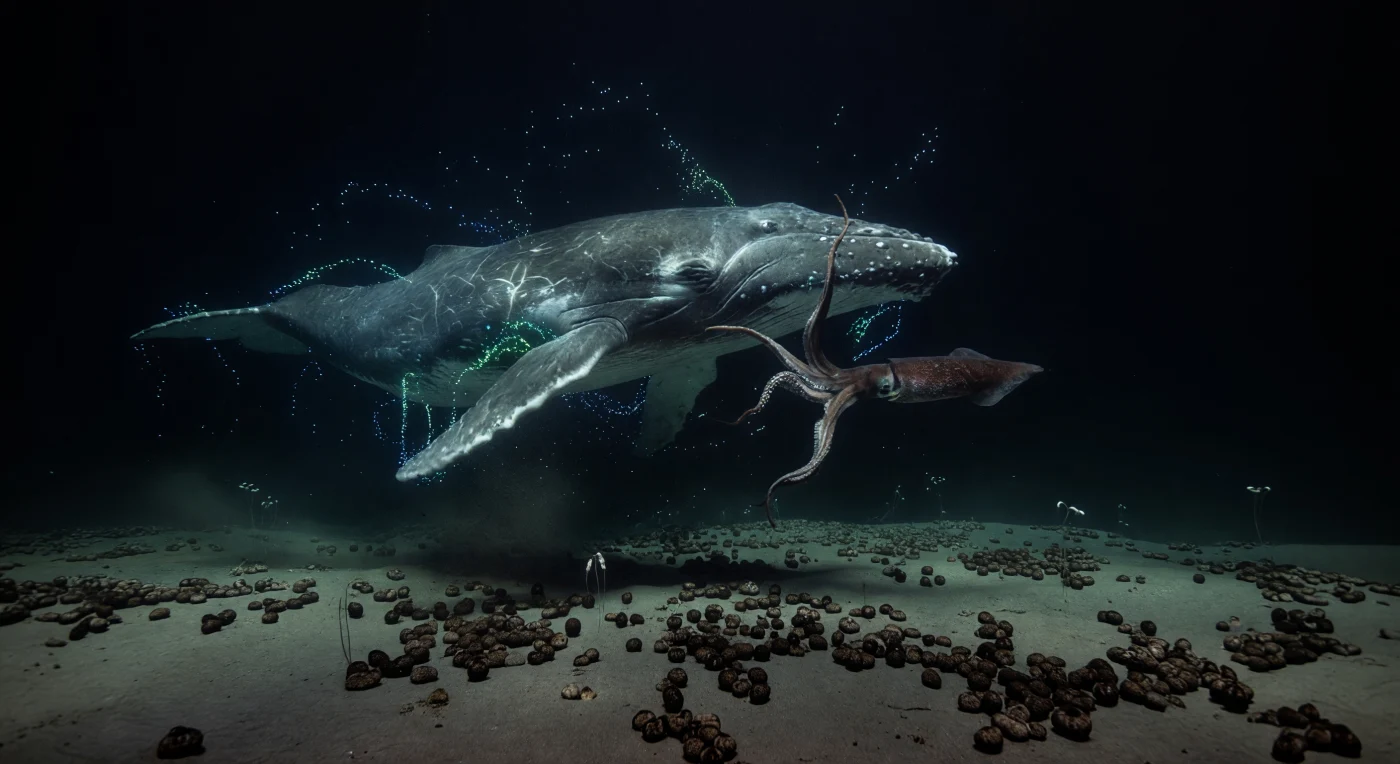
At roughly 4,000 to 6,000 metres beneath the surface, where pressure exceeds 400 atmospheres and temperature barely clears 1 °C, a sperm whale (*Physeter macrocephalus*) descends through absolute darkness like a living mountain, its skin mapped with pale circular scars — the healed signatures of countless prior encounters with animals exactly like the one now recoiling beneath it. The giant squid (*Architeuthis dux*) throws its long feeding tentacles wide, the hook-ringed suckers along their clubs momentarily catching cold blue flashes from gelatinous drifters disturbed by the violence of the confrontation, each brief bioluminescent pulse the only illumination in a world that has never known sunlight. Sperm whales are among the deepest-diving air-breathing vertebrates on Earth, their clicks and codas propagating for kilometres through frigid water while specialized wax-filled organs in their enormous heads act as acoustic lenses for echolocation, allowing them to detect soft-bodied prey in conditions of total darkness that would render any other sensory system useless. Below this suspended battle, the abyssal plain lies patient and indifferent — fine grey-brown silt textured by slow-moving holothurians and polychaetes, scattered manganese nodules accreted over millions of years at the rate of a few millimetres per millennium, and stalked crinoids rising like ancient candlesticks from the sediment, filter-feeding the marine snow that drifts ceaselessly downward as a fine rain of organic particles from the sunlit world impossibly far above. This is a place that has existed, and will continue to exist, in complete sovereign indifference — a cold, crushing, biologically dense darkness that needs no witness to be fully, violently alive.
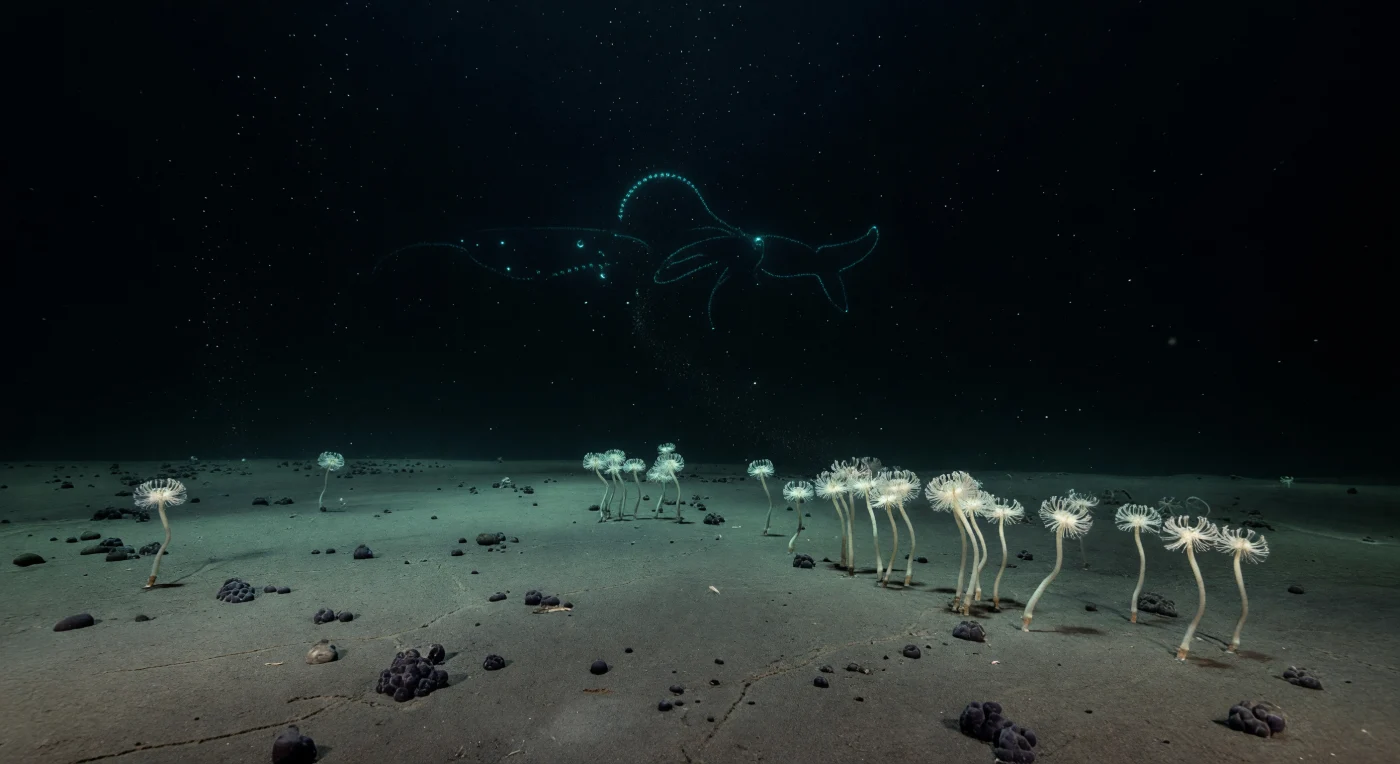
At the uttermost remove from sunlight, the abyssal plain stretches in every direction as an immense grey-brown sediment sheet, its surface interrupted only by scattered manganese nodules accreted over millions of years and the hair-fine traces of burrowing infauna pressing through the ooze below—organisms adapted to roughly 500 atmospheres of pressure and water barely above freezing, where biochemistry itself has been reshaped by evolution to function in a world of crushing cold and absolute dark. Rooted in this silty substrate, a colony of cream-colored sea pens (*Pennatulacea*) bends in synchronized submission to a weak, persistent abyssal current, their fleshy rachises and filter-feeding polyps oriented as living current meters, drawing suspended organic particles from the slow drift of marine snow that descends perpetually from the productive waters thousands of meters above. Tonight that snow thickens almost imperceptibly: a particulate veil, the dispersed debris of a catastrophic encounter between *Physeter macrocephalus* and *Architeuthis dux* far overhead, sifts downward through the water column in a slow, widening plume. High above the plain, brief turquoise-blue pulses fracture the blackness—bioluminescent discharges from chromatophores and photophores stressed or ruptured during the struggle—ghosting the circular geometry of hooked sucker rings and the broad, sweeping arc of a sperm whale fluke through ink-dark water before fading entirely, leaving only the cold, pressured silence of a world that has never needed a witness.
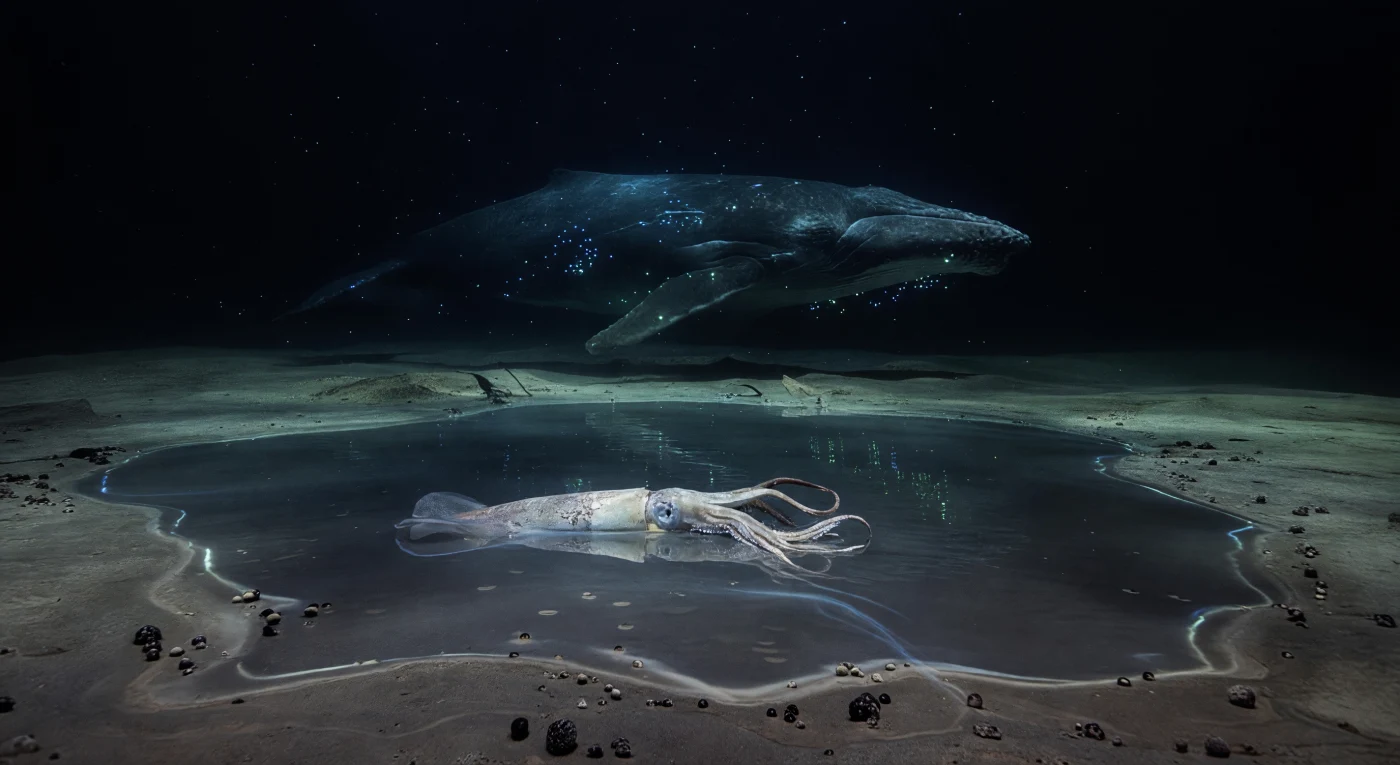
At roughly four to six thousand metres below the surface, where pressure crushes at four hundred atmospheres or more and the water temperature hovers near two degrees Celsius, a brine pool sits inset into the grey-brown abyssal sediment like a still, metallic mirror — its hypersaline water so dense that it forms a stable liquid-within-liquid interface, traced at its margins by pale bacterial films and scattered manganese nodules accreted over millennia. Just centimetres above this shimmering halocline, a wounded colossal squid (*Mesonychoteuthis hamiltoni*) drifts in suspension, its scarred mantle pallid against the black water column, long tentacles loosened and curling to expose rows of hooked suckers — the biological record of an encounter written in flesh. Ribbons of cyan and green bioluminescence cling to the disturbed density boundary, produced by the chemosynthetic microbial communities thriving along the basin rim and by the squid's own disrupted tissues, their cold light the only illumination across an otherwise lightless plain. Beyond the brine shore, a sperm whale (*Physeter macrocephalus*) turns in silent profile through the water column, its wrinkled flank marked with fresh circular sucker scars, its massive echolocating head having already swept these depths with focused acoustic pulses in pursuit of prey that retreats toward the abyss. Marine snow drifts freely in all directions through water that has not seen sunlight since it sank centuries ago, and the sediment edge beyond dissolves into absolute darkness — a world of immense pressure, biological light, and predatory silence that requires no witness to persist.
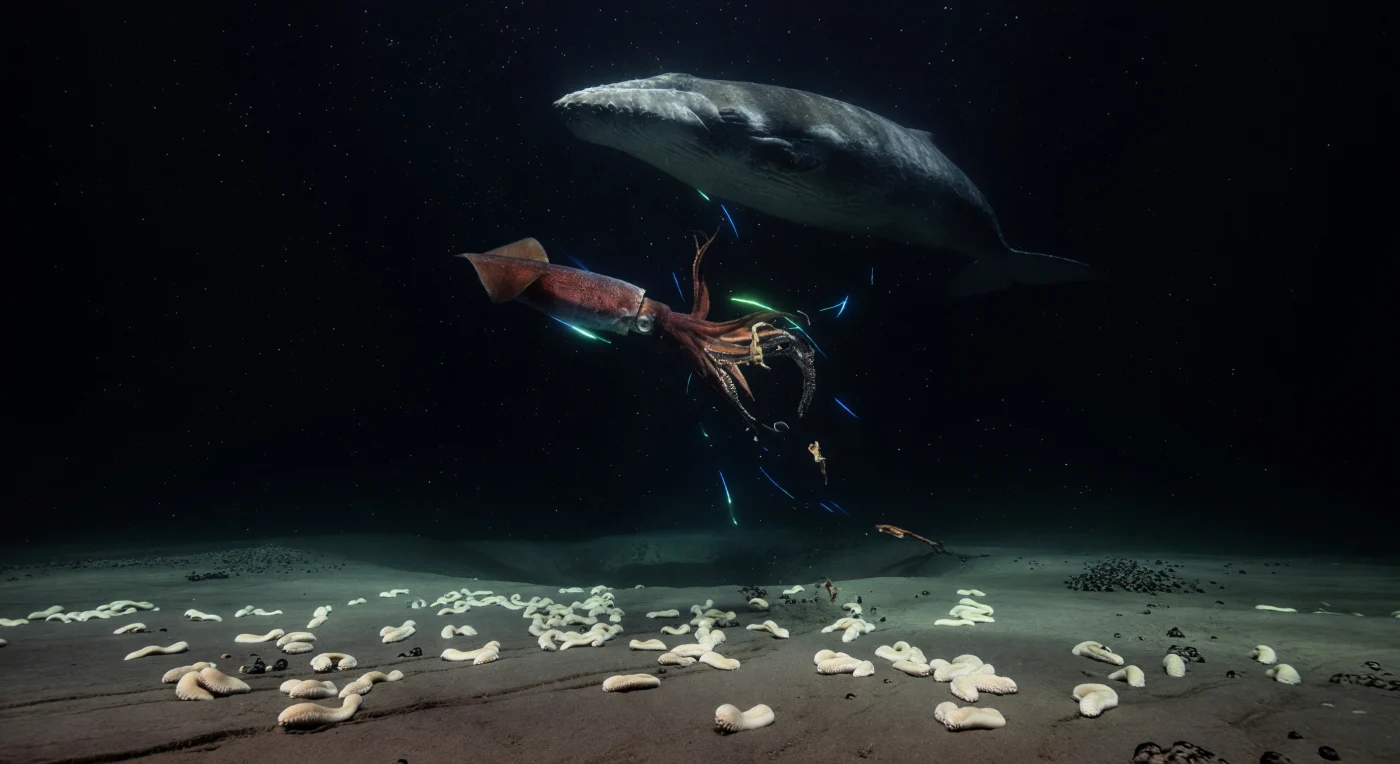
At crushing pressures where four hundred or more atmospheres compress the cold water column to near-solid stillness, the abyssal plain stretches in every direction as a vast, nearly level expanse of grey-brown sediment dimpled with the tracks of slow-moving fauna and studded with black manganese nodules that have been accumulating for millions of years. Across this quiet terrain, pale holothurians — sea cucumbers built for oligotrophic patience — graze the microbial films and settling organic matter that drifts down from the sunlit world far above, their bodies translucent and unhurried in water barely above freezing, the community so sparse and the plain so enormous that each individual seems to exist in its own private silence. High above this benthic congregation, invisible in the absolute blackness of the water column, something violent is happening: a sperm whale — *Physeter macrocephalus*, the deepest-diving of all large toothed whales, capable of suspending breath and metabolism for over an hour — has seized a giant squid (*Architeuthis dux*) and is driving it laterally through the dark, the struggle announced not by any light from without but by the bioluminescent chemistry of disturbed dinoflagellates and agitated tissue, smearing cyan arcs across the black water as the squid's hooked suckers rake the whale's scarred rostrum and arms splay wide under tearing tension. Fragments of tissue and organic debris spiral slowly downward from the clash, beginning the long fall toward the holothurian garden below, destined to become part of the marine snow that sustains this entire hidden ecosystem — a closed loop of predation, death, and recycling that has operated without witness across geological time.
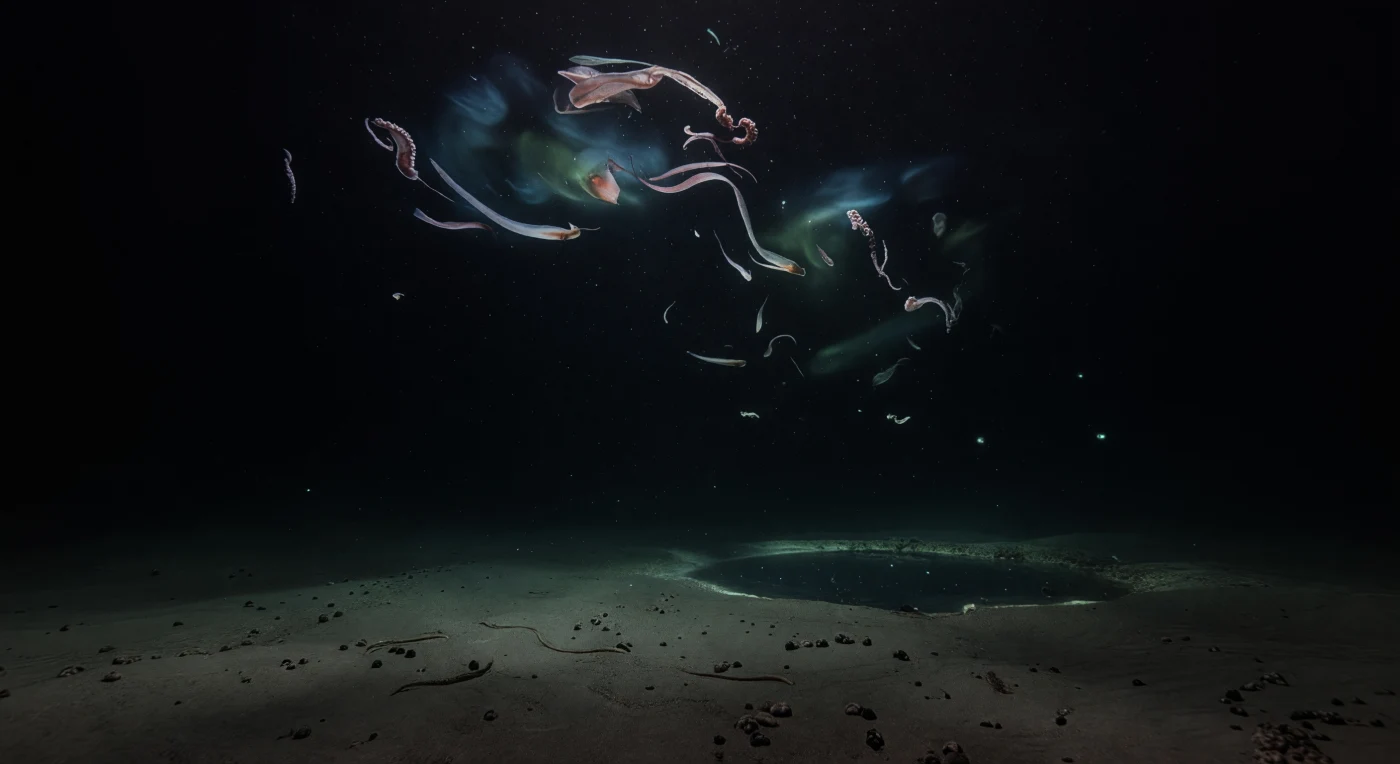
Where two titans met in the absolute dark, the water still carries the memory of violence — a slowly dissolving swirl of cyan and green bioluminescence marks the turbulent wake of their passage, its faint chemical light already dimming as torn ribbons of pale squid mantle and translucent reddish membrane spiral downward through water pressing at nearly four hundred atmospheres, cold to a near-freezing stillness that preserves each fragment with terrible clarity. Sucker-ring debris, some still bearing the hooked rims of *Architeuthis* ventouses, drifts alongside the perpetual fine marine snow, that ceaseless fall of organic particles that is the abyssal column's only weather, each piece descending through blackness interrupted only by the sparse cold pulses of bioluminescent organisms scattered at the margins of the disturbance. Far below, the abyssal plain receives all of this without ceremony: grey-brown diatomaceous sediment stretching into formless distance, scattered manganese nodules accreted over millions of years at geological patience, a few holothurians — sea cucumbers processing that same sediment grain by grain — moving on trails only they will ever follow, while a brine pool nearby lies still as a buried mirror, its hypersaline boundary refracting the faintest ambient bioluminescent traces into a subtle shimmer. This is the ocean's interior life, complete and indifferent — the predator and prey already vanished upward or downward into the dark, the plain absorbing what remains, the pressure holding everything in its enormous, silent custody.
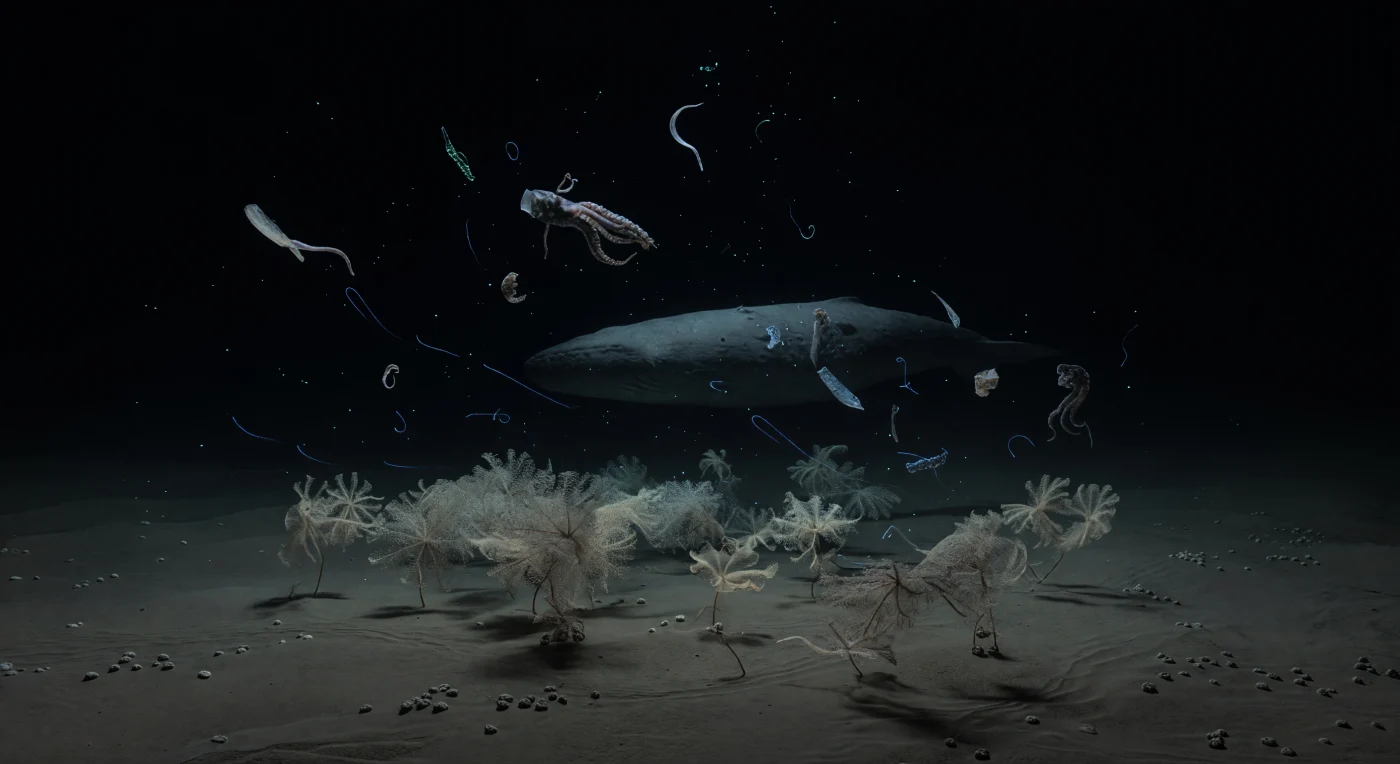
Across an abyssal plain lying under roughly four hundred to six hundred atmospheres of cold, still water, a sperm whale moves as a massive shadowed form just above a sediment field colonized by xenophyophores — single-celled giants, each an enormous protist lattice of branching agglutinated tubes rising from the mud like frost tracery on dark glass, filtering particles from water that has not seen sunlight in centuries. At this depth the only illumination is biological: cold cyan and blue-green pinpricks ignite and fade where disturbed plankton respond to the pressure waves of the whale's passage, and descending fragments of giant squid — torn mantle ribbons, a severed arm still bearing hooked suckers, translucent tissue curling slowly under gravity — trail faint bioluminescent smears as they sink through the nepheloid haze above the bottom, momentarily mapping the turbulence of a hunt concluded somewhere far above. The whale's pale skin carries the permanent record of that hunting life in deep circular suction scars, each mark left by an Architeuthis arm during some earlier struggle in waters that were already completely dark, and its slow drift across the xenophyophore field displaces bottom water in gentle billows that cause the fragile protist structures to tremble without breaking, their gossamer forms persisting as they have for years of patient accumulation on sediment that receives perhaps one milligram of organic carbon per square centimeter per year. Here, where water temperature holds near two degrees Celsius and the pressure compresses every cubic centimeter of the surrounding sea, life proceeds without reference to any surface world — the whale breathing its last stored oxygen before a rise it has already calculated, the squid remains continuing their weeks-long descent toward the benthos, and the xenophyophores simply enduring, drawing their living matter from the dark, cold, almost empty water that is the permanent condition of the deep ocean plain.
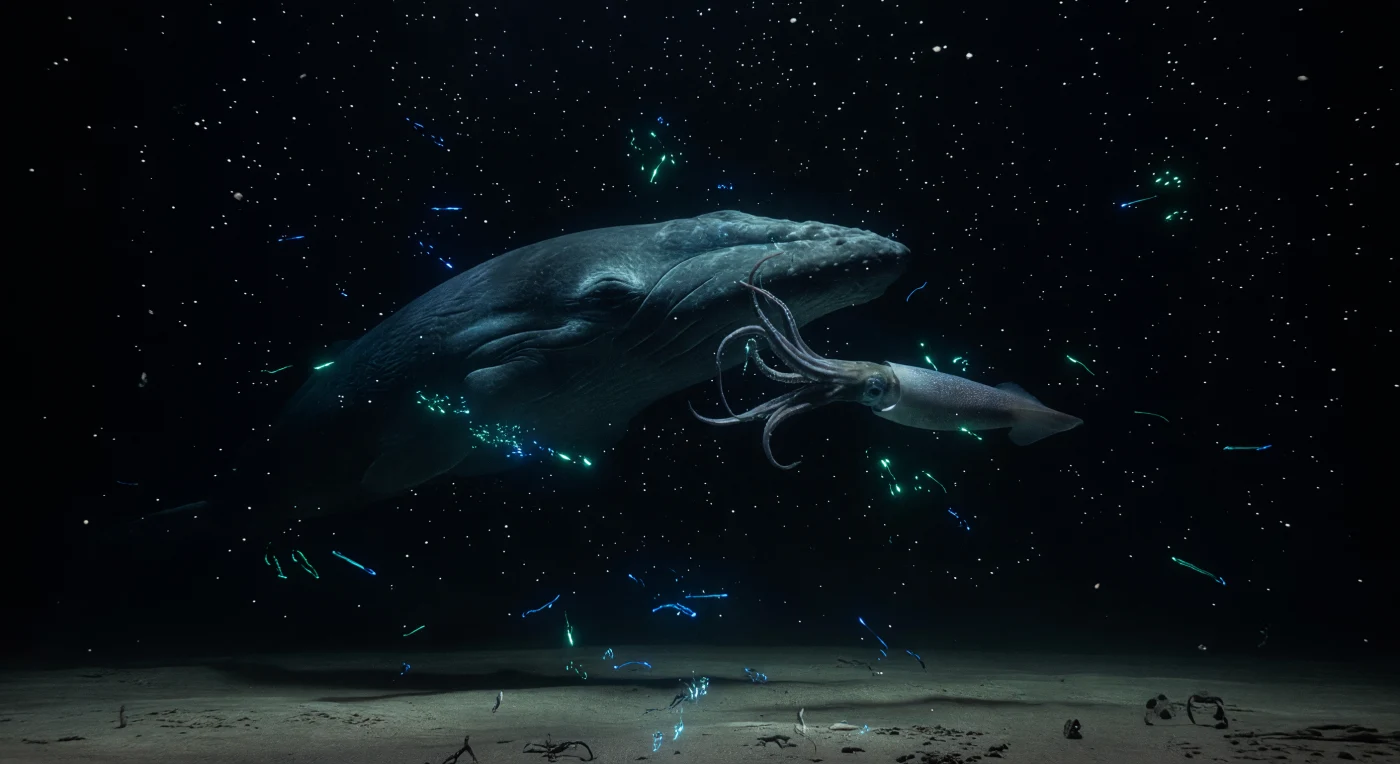
In the lightless water column suspended thousands of meters above the abyssal sediment, one of the ocean's most ancient predatory exchanges unfolds in absolute cold and crushing pressure. *Physeter macrocephalus*, the largest toothed predator on Earth, descends into the abyssopelagic realm on a single breath held for over an hour, guided by the most powerful biological sonar known — a click train capable of resolving soft-bodied prey in featureless black water — while *Architeuthis dux*, the giant squid, attempts escape by jetting backward through water dense with slowly settling marine snow, each particle a fragment of biological material drifting down from the sunlit world far above. The violence of their acceleration mechanically disturbs the surrounding planktonic organisms and displaces bioluminescent dinoflagellates and small gelatinous forms, releasing brief cascades of blue-green light that trace the geometry of pursuit like luminous wreckage — the squid's trailing arms briefly outlined in cold fire, the whale's scarred rostrum and wrinkled skin emerging from darkness in the same fleeting glow before the water reseals into blackness. At these depths, hydrostatic pressure exceeds 400 atmospheres, temperatures hover near 2 °C, and the biochemistry of both animals is built for exactly this extreme: sperm whale blood carries extraordinary oxygen reserves, while the squid's ammonium-rich tissues provide near-neutral buoyancy in water that has not seen sunlight in centuries. Far below, the abyssal plain extends as a vast flat expanse of foraminiferal ooze scattered with manganese nodules — a seafloor that records nothing of the struggle above, only the eventual slow arrival of organic particles from a world it will never witness directly.
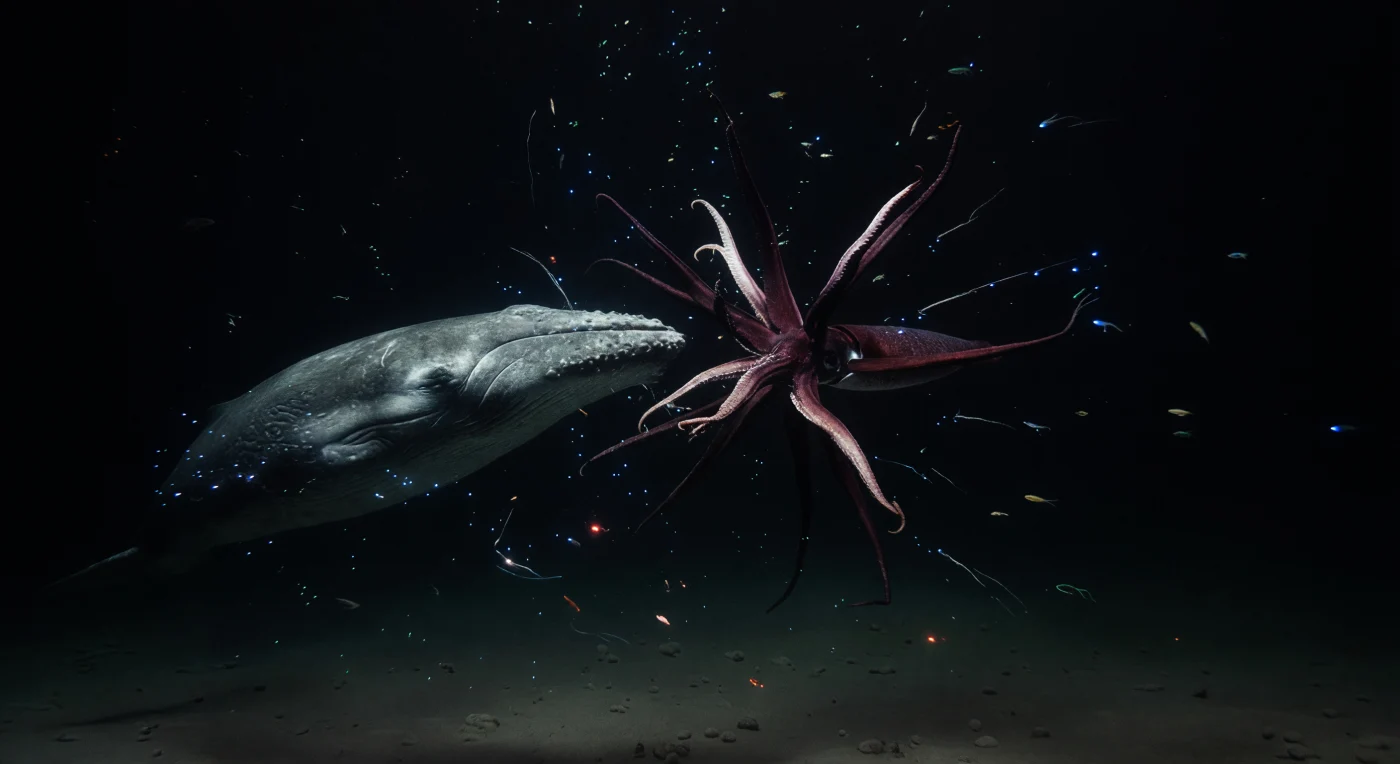
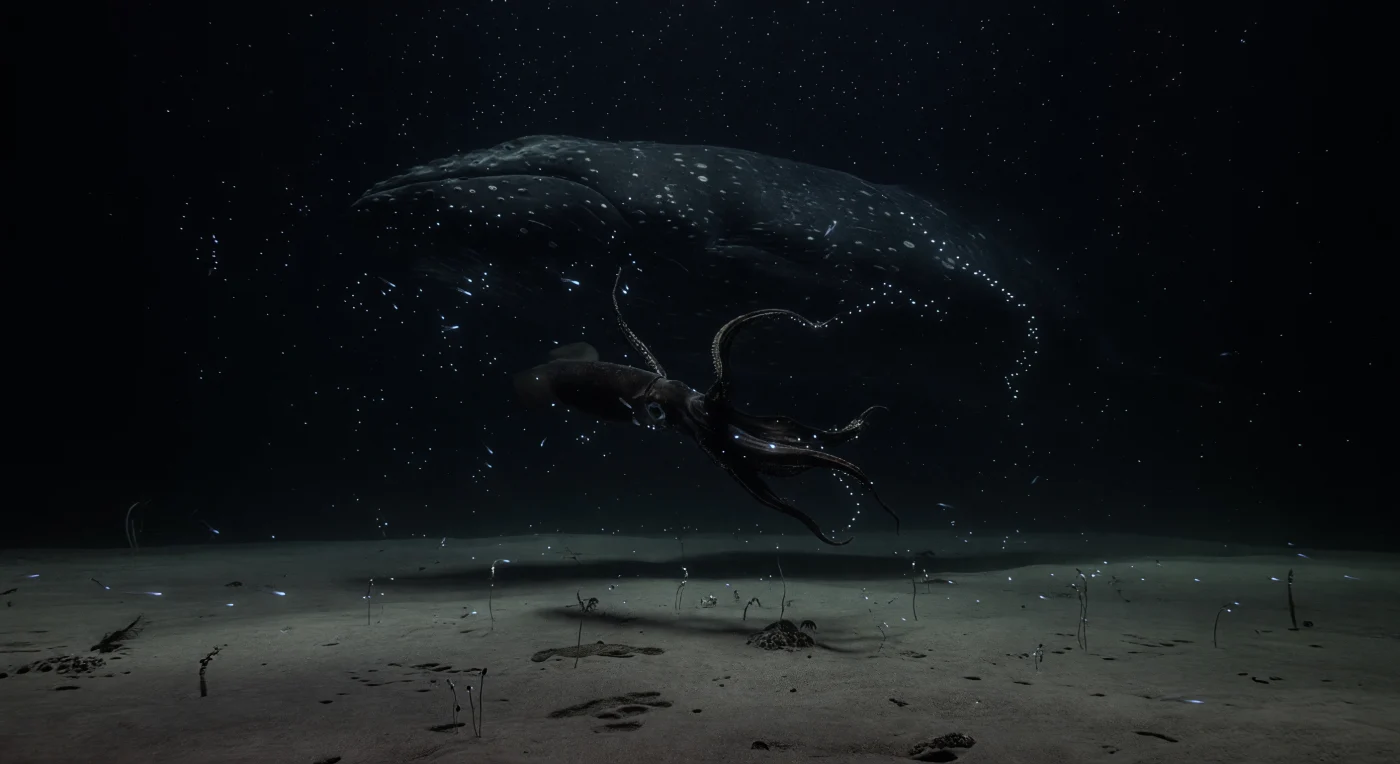
In the sunless water column hanging kilometers above a barely-perceptible abyssal plain, two of the ocean's most formidable animals meet in total darkness, their encounter illuminated only by the fragmented bioluminescent panic of disturbed deep-sea shrimps whose blue-cyan alarm flashes strobe across swiveling hooks and scarred cetacean skin. *Mesonychoteuthis hamiltoni*, the colossal squid, is the largest invertebrate on Earth by mass, its muscular mantle capable of rapid chromatophore expansion into wine-dark defensive displays, its feeding clubs armed with rotating toothed hooks that leave the distinctive circular scars etched across the slate-grey flanks of *Physeter macrocephalus* — scars that researchers study at the surface as the only lasting testimony of battles never directly witnessed. At these abyssopelagic depths, pressure exceeds 400 atmospheres and water temperatures hover near 1–2 °C, conditions that demand extraordinary physiological adaptation: the sperm whale descends on a single breath, its flexible ribcage yielding to compression, its myoglobin-rich tissues sustaining a dive that may last over an hour, while the squid navigates the same crushing cold through pressure-tolerant coelomic fluid and neutrally buoyant ammonium-rich tissues. Marine snow drifts through the scene without reference to any surface world, a continuous slow fall of organic particles that traces the invisible architecture of the water column, and the faint haze of manganese-nodule-scattered seafloor far below exists as a geological patience measured in millions of years — indifferent to the explosive, hook-lined negotiation unfolding in the black water above it.
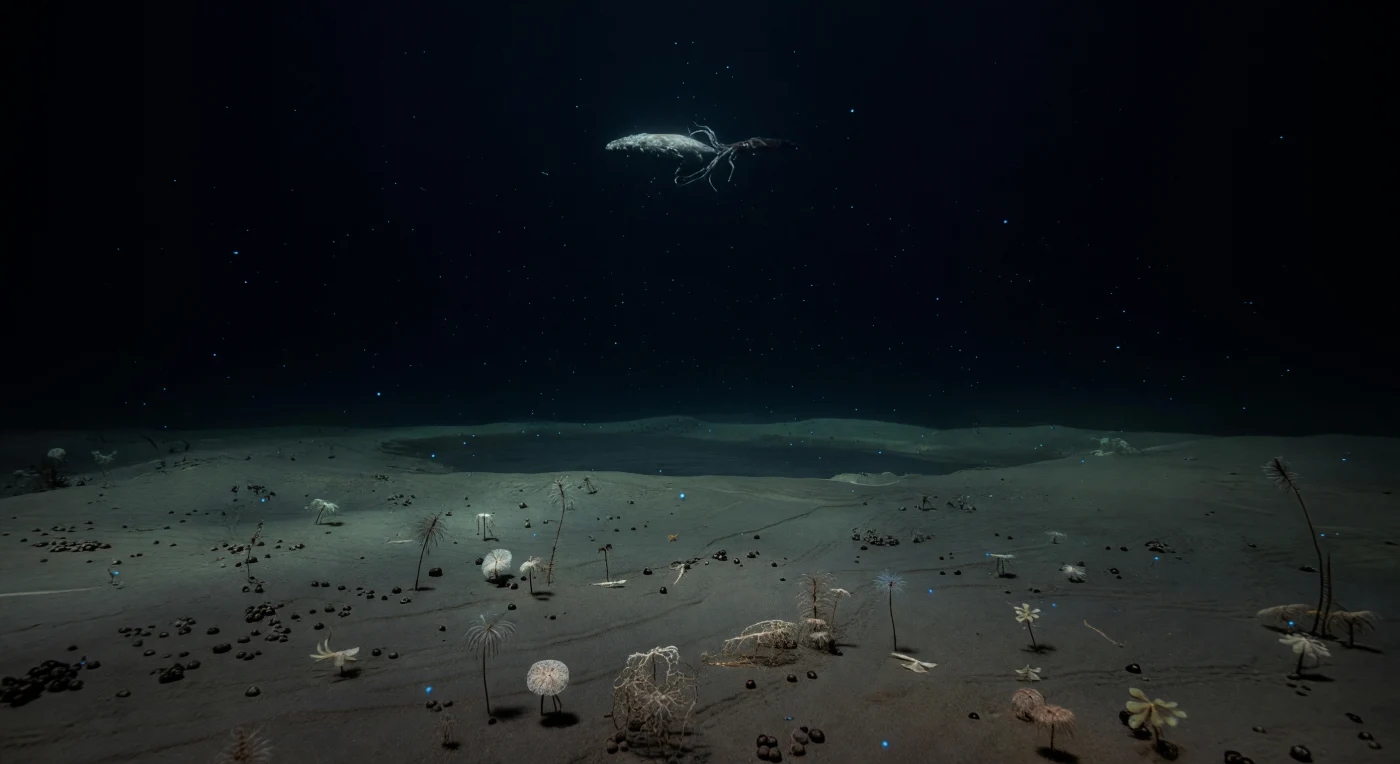
Far above the abyssal plain, at a depth where pressure crushes the equivalent of hundreds of atmospheres and water temperatures hover near 2 °C, a sperm whale and a giant squid turn together in slow, violent revolution — the whale's scarred pale head and wrinkled flanks faintly traced by cold bioluminescent smears stirred from stressed plankton and the squid's own stress photophores, hook-lined suckers catching the living glow for fractions of a second before darkness swallows them again. Between that distant struggle and the seafloor below, the water column stretches as an immense silent corridor, threaded with drifting marine snow — particulate organic matter sinking from the sunlit world far above — and sparse cyan-blue bioluminescent beads, each a living organism signaling into the void with no witness but the darkness itself. Below, the abyssal plain resolves into cold grey-brown sediment, softly undulating and fading at its margins into total obscurity, studded with black-brown manganese nodules accreted over millions of years at rates measured in millimeters per million years, while delicate sea pens anchor their colonial bodies into the fine mud and xenophyophores — among the largest single-celled organisms on Earth — rest as pale organic lacework across the substrate, filtering the slow organic rain descending from above. At the plain's edge, the barely perceptible sheen and refractive waviness of a brine pool margin marks a hypersaline lens of water too dense to mix freely with the surrounding column, a chemical anomaly older than any human observation. This entire world — predator and prey, sediment and nodule, colonial animal and giant protist — exists in perpetual cold darkness, sustained by the slow fall of matter from a sunlit surface it will never reach.