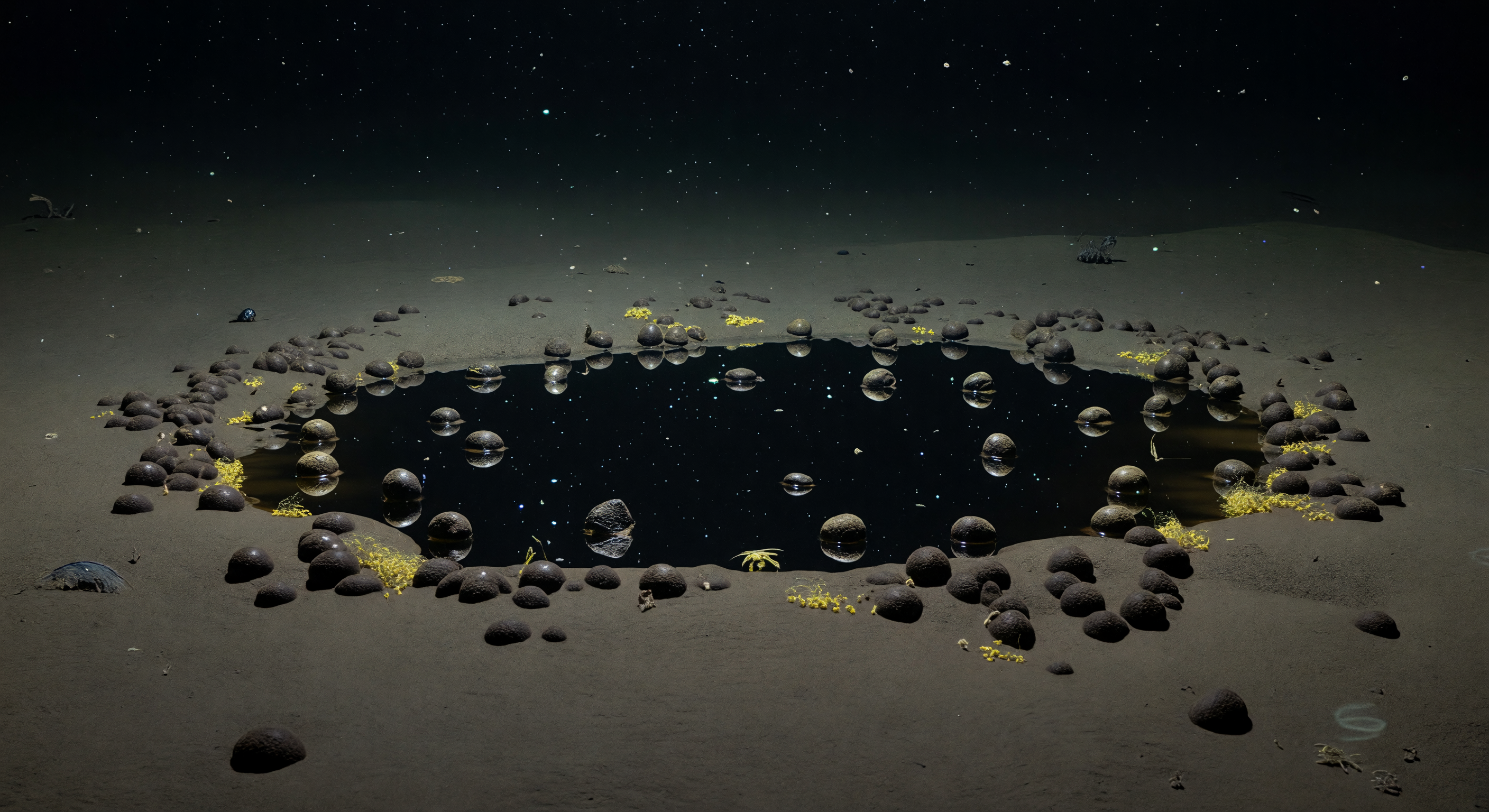
At roughly 4,500 to 5,500 metres beneath the surface, where pressure exceeds 400 atmospheres and temperatures hover near 2 °C, the abyssal plain stretches in near-total darkness as a featureless expanse of taupe-grey sediment — except where a shallow depression cradles a body of hypersaline brine so dense it refuses to mix with the overlying water, resting instead like a submarine lake with a razor-sharp, mirror-like interface that reflects the scattered manganese nodules at its margin as perfect, faintly stretched inversions. These nodules — polymetallic concretions of manganese, iron, nickel, and cobalt — have grown grain by grain over millions of years, accreting around microscopic nuclei at rates measured in millimetres per million years, each one half-swallowed by the soft ooze that accumulates from the perpetual slow rain of marine snow drifting down from the sunlit world far above. At the brine's edge, where lethal hypersalinity gives way to ambient seawater, chemosynthetic bacterial mats glow in faint sulphurous yellow and sparse symbiont-bearing mussels anchor themselves at the only chemically viable margin, deriving energy not from sunlight but from the methane and hydrogen sulphide seeping upward through ancient evaporite strata below. Tiny blue-green bioluminescent pulses wink among the falling particles — fleeting signals from drifting zooplankton and small benthic organisms — and their cold light trembles in miniature across the glossy brine surface, the only illumination in a world that has never known the sun, immense and pressurized and profoundly silent, existing entirely on its own terms.
Abyssal brine pools