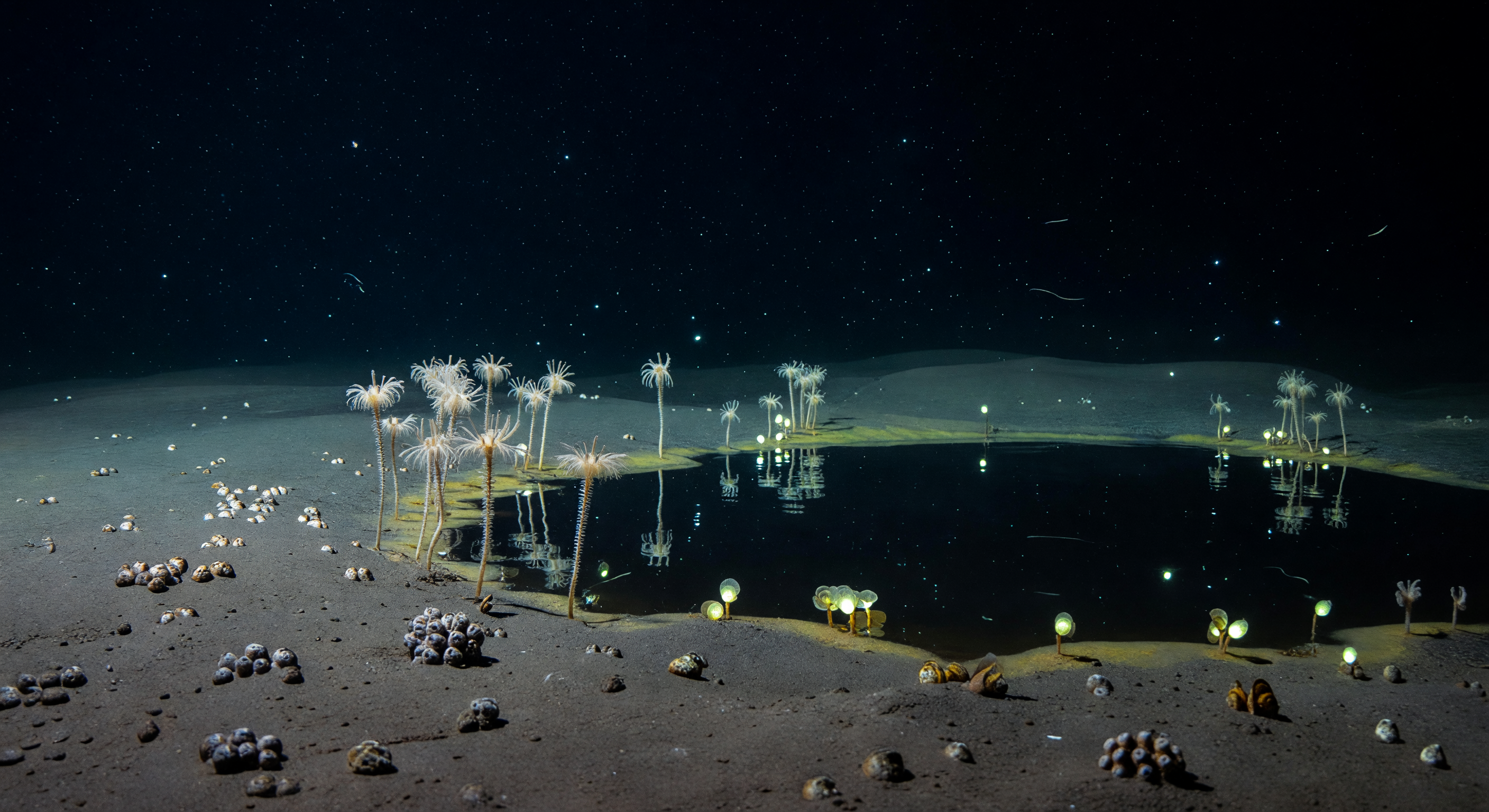
At depths where pressure crushes the water column into 400 to 600 atmospheres of cold silence, a flat sediment plain of grey-brown ooze stretches outward, peppered with half-buried manganese nodules that have been accumulating for millions of years at rates of mere millimetres per millennium. From this seafloor mud, stalked crinoids — ancient suspension feeders whose lineage predates the dinosaurs — raise pale ivory crowns into a current so faint it barely registers, each feathery arm filtering the slow rain of marine snow that descends ceaselessly from the sunlit world kilometres above. At the plain's edge lies the brine pool: a body of hypersaline water so dense, two to eight times the salinity of surrounding seawater, that it settles into depressions and holds its form like a submarine lake, its surface a black mirror with a sharply defined halocline interface that distorts and swallows the reflected geometries of the crinoids standing at its shore. Yellow bacterial mats fringe this lethal boundary, sustained by chemosynthetic metabolism rather than sunlight, while clusters of symbiont-bearing mussels colonise the transitional zone where oxygenated bottom water meets the anoxic, organism-killing brine below. Sparse blue-green bioluminescent sparks drift through the surrounding water column — organisms communicating, hunting, or simply existing in a world of perpetual darkness where all light is biological and all life has negotiated, in its own way, the terms of existence at the edge of an inland sea that the ocean quietly keeps to itself.
Other languages
- Français: Crinoïdes au-delà de la Saumure
- Español: Crinoides Más Allá de la Salmuera
- Português: Crinoides Além da Salmoura
- Deutsch: Seelilien jenseits der Sole
- العربية: قنافذ البحر وراء الملوحة
- हिन्दी: नमक से परे क्रिनॉइड
- 日本語: 塩水の彼方の海百合
- 한국어: 염수 너머의 바다나리
- Italiano: Crinoidi Oltre la Salamoia
- Nederlands: Crinoïden Voorbij het Zout