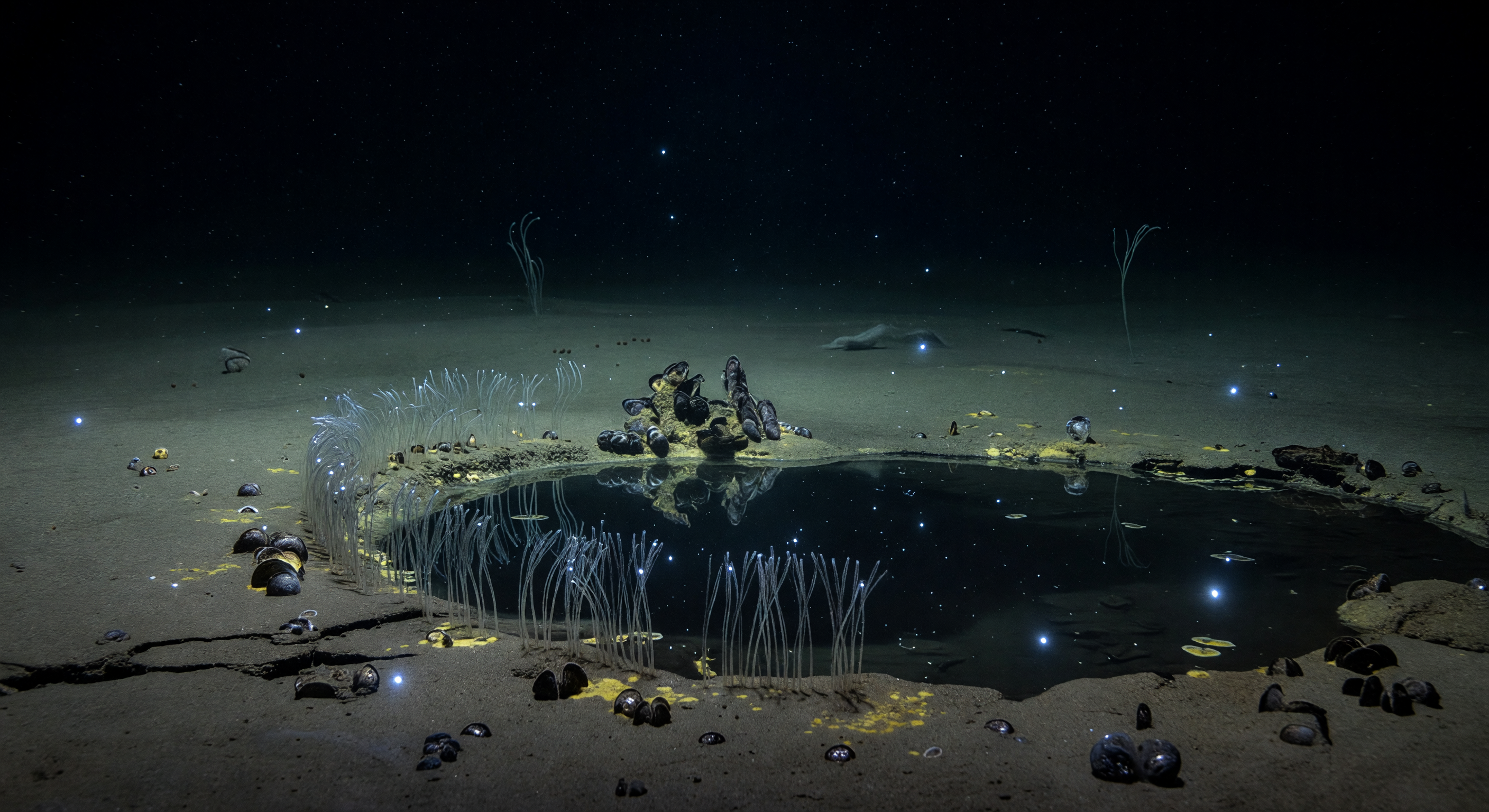
At depths where pressure crushes the water column to roughly 400–600 atmospheres and ambient temperatures hover just above freezing, a crescent of translucent sea pens (*Pennatulacea*) rises from grey-brown abyssal sediment along the lip of a brine moat — a submarine lake of hypersaline water so dense it refuses to mix with the ocean above it, its surface resolving into an eerily sharp mirror that returns perfect inverted images of each feathered axial plume. This brine, likely sourced from the dissolution of ancient evaporite deposits or fault-guided seepage, may carry two to eight times the salinity of normal deep seawater, rendering it anoxic and largely lethal to metazoans yet sustaining sulfur-oxidizing bacterial mats whose faint yellowish films spread across seep-rich cracks nearby, while chemosynthetic mussels cluster at the chemocline margin where toxic and oxygenated waters briefly negotiate. Scattered manganese nodules lie half-embedded in the sediment — products of millions of years of slow accretion from dissolved metals settling through the water column — and a soft-bodied holothurian moves almost imperceptibly across the plain beyond, its presence a reminder that, at these depths, life has reorganized itself entirely around pressure, cold, and chemical energy rather than sunlight. The only illumination here is intrinsic to life itself: cold-blue pulses from bioluminescent plankton drifting in slow suspension, a ghostly microbial glow barely tracing the glassy brine interface, and the constant quiet fall of marine snow — particulate organic matter descending from the sunlit world thousands of meters above — dusting every surface with the faint, continuous record of a biosphere that this place will never directly see.
Abyssal brine pools