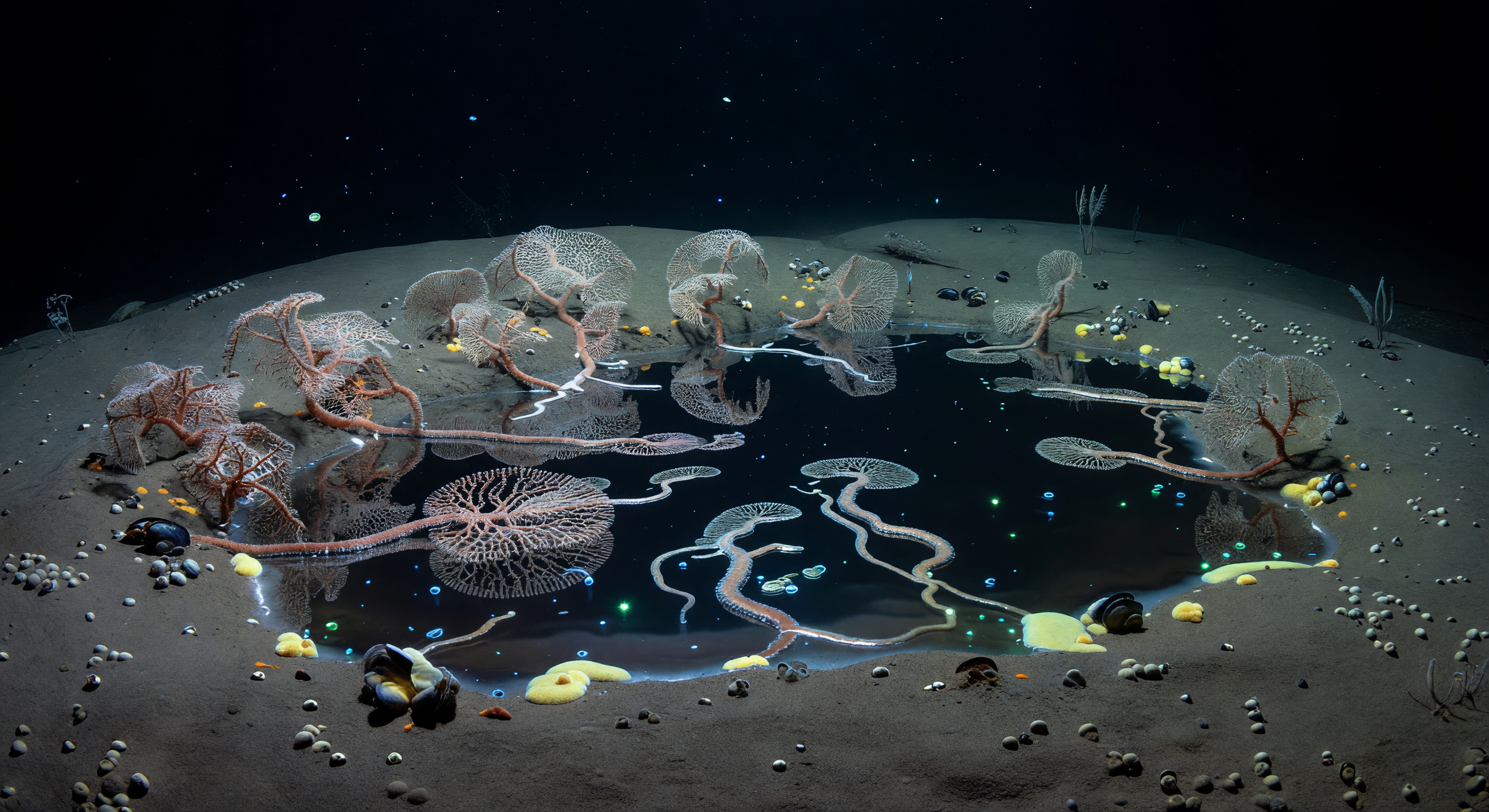
At 4,800 metres beneath the surface, where pressure exceeds 480 atmospheres and ambient water hovers near 2 °C, a shallow depression in the abyssal plain holds one of the ocean's most extraordinary phenomena: a submarine lake of hypersaline brine, its upper boundary a perfectly defined mirror of dark polished stillness, refracting the surrounding water with the uncanny shimmer of a submerged mirage. The brine itself — two to five times the salinity of the overlying seawater — is too dense to mix, pooling in geological silence as tongues of it seep between the sprawling forms of giant xenophyophores, the largest known single-celled organisms on Earth, whose agglutinated, lacework ridges of sediment and organic matter pattern the basin flank in fragile pale labyrinths. Along the brine margin, sulphur-oxidising bacterial mats spread in velvety yellow films, sustained entirely by chemosynthesis, and clusters of deep-sea mussels harbouring symbiotic bacteria occupy the chemically enriched edge where lethal brine and cold seawater meet in an invisible gradient of dissolved methane and hydrogen sulphide. Rare cyan and green bioluminescent pinpricks drift through the absolute darkness — microscopic organisms advertising their presence in a world where light has not reached since the Hadean — while marine snow descends with imperceptible slowness through water so still and cold that a holothurian grazing the silted plain and distant sea pens barely disturb the primordial quiet of a landscape that has existed, unseen, on its own terms for millions of years.
Other languages
- Français: Plaines de Saumure Abyssales
- Español: Llanuras de Salmuera Abisal
- Português: Planícies de Salmoura Abissal
- Deutsch: Abyssale Salzlaken-Ebenen
- العربية: سهول المحلول الملحي العميق
- हिन्दी: अगाध नमकीन मैदान
- 日本語: 深海塩水平原
- 한국어: 심해 염수 평원
- Italiano: Pianure di Salamoia Abissale
- Nederlands: Abyssale Pekelplakken